
The COVID-19 pandemic since early 2020 has changed many things, including societal habits. One of these changes is that the pandemic has forced some jobs to be done from home, or what is more commonly referred to as Work From Home (WFH). However, behind the myriad of negative impacts that have emerged, there is some good news hidden within the WFH policy: pollution has decreased. According to a report from the Indonesian Meteorological, Climatological, and Geophysical Agency (BMKG), the average concentration of PM2.5 (one of the most dangerous air pollutants) in March 2019 decreased by over 50% in March 2020, at the onset of the pandemic.
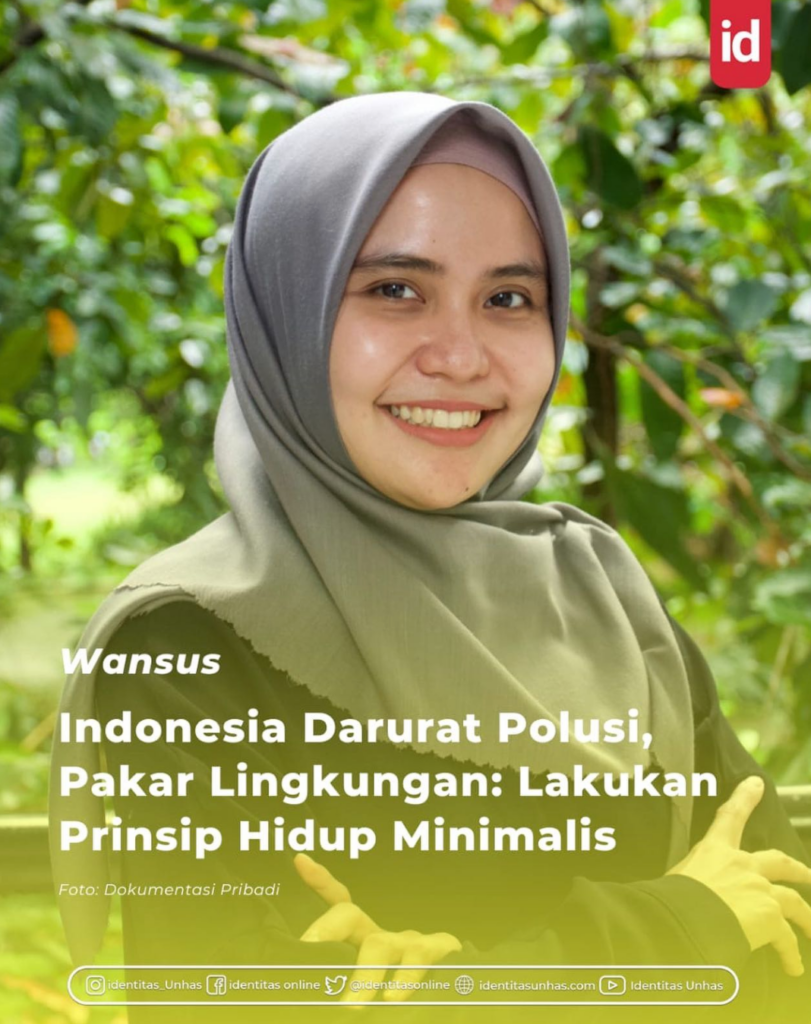
How do you respond to the data stating that Indonesia is in a pollution emergency?
In response to this, there must be collaboration with all parties, including the government, industry, media, communities, and others, to reduce air pollution in Indonesia. In Bandung itself, communities have great power in protecting the environment because they collaborate with each other to maintain it. Then the media plays a role in educating the public. The public, which naturally has varying levels of understanding, can learn about environmental issues.
What are the effects of poor air quality?
As we know, air pollution, such as gases and other particles, will have a significant impact on human health. Air pollution can make us easily dizzy. Additionally, air pollution also affects human sanity. Therefore, people who inhale too much of it have a higher chance of developing autism. So, air pollution also has a significant impact on human mental health.
Another impact we can see is from communities living near industrial areas. They are prone to skin problems. Additionally, air pollution in industrial areas also affects pregnant women giving birth. The child was born in a state of poor physical and mental health.
According to a report from IQAir, the average PM2.5 in Makassar reached 13.5 micrograms per cubic meter. Is that a threat to those of us living in Makassar?
With PM2.5 levels reaching 13.5 micrograms/m3, this poses a threat to us and also to the industrial sector. The threat is in obtaining funds from investors for his company. It turns out that investors also consider the level of pollution a company generates during production. If a company contributes significantly to environmental pollution, investors are also reluctant to invest in that company. This can lead to negative public perception of the investor for investing in an environmentally unfriendly company.
What efforts can be made in the future to address air pollution?
For ourselves, the efforts we can make are to change our habits. We can apply the principle of minimalist living because it is also considered to have an impact on the environment.
Unconsciously, habits have a negative impact on the environment. Our habit of having a lot of clothes is also something that is not minimalist and has a negative impact on the environment. This is because various sources say that making just one shirt requires enough air to sustain two people. Additionally, the use of motor vehicles must also be minimized because motor vehicles are one of the largest contributors to environmental pollution. Then minimize the use of electronic devices because electricity is generated from environmentally unfriendly materials like coal combustion.
So, the minimalist principle of life being referred to is not only in the ownership of goods, but also in our habits. Therefore, a minimalist lifestyle is needed. Besides helping to keep our minds well-organized, it can also help reduce pollution for the environment.
What is the government’s role in addressing Indonesia’s air pollution problem?
Although regulated in Government Regulation (PP) Number 22 of 2021 concerning the Implementation of Environmental Protection and Management, the main problem is the very limited state budget for the environment. This then makes it difficult for the government to allocate funds for environmental interests. Yet, there are many things that need to be improved, such as the waste problem, emissions, Green Open Spaces (GOS), etc. So, the most concrete step taken is actually increasing the state budget for environmental interests in Indonesia.
Another major issue is the lack of leaders who truly understand the environment. One of the things needed to address air pollution in Indonesia is education for the public. If the leaders who come into power don’t truly understand the environment, then educating the public will also be difficult. Therefore, leaders who truly understand the environment are needed.
What are your expectations for the future regarding this air pollution?
Regarding air pollution, it is hoped that in the future, all parties in Indonesia, including the government, the industrial sector, scientists, students, housewives, and others, can play their respective roles in the environment. Then, collaborating on these roles is certainly necessary to achieve environmental health. Then, the public is also expected to minimize habits that have a negative impact on the environment.