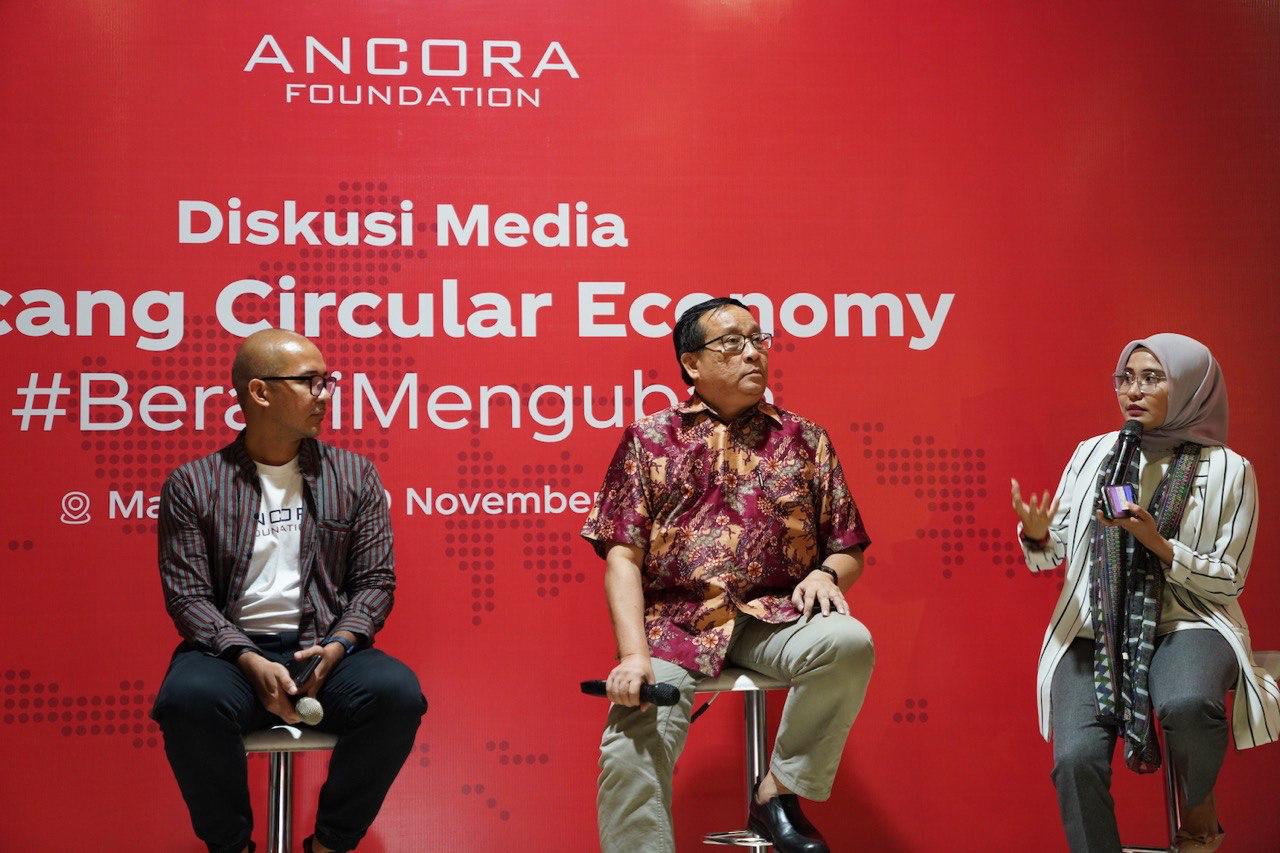

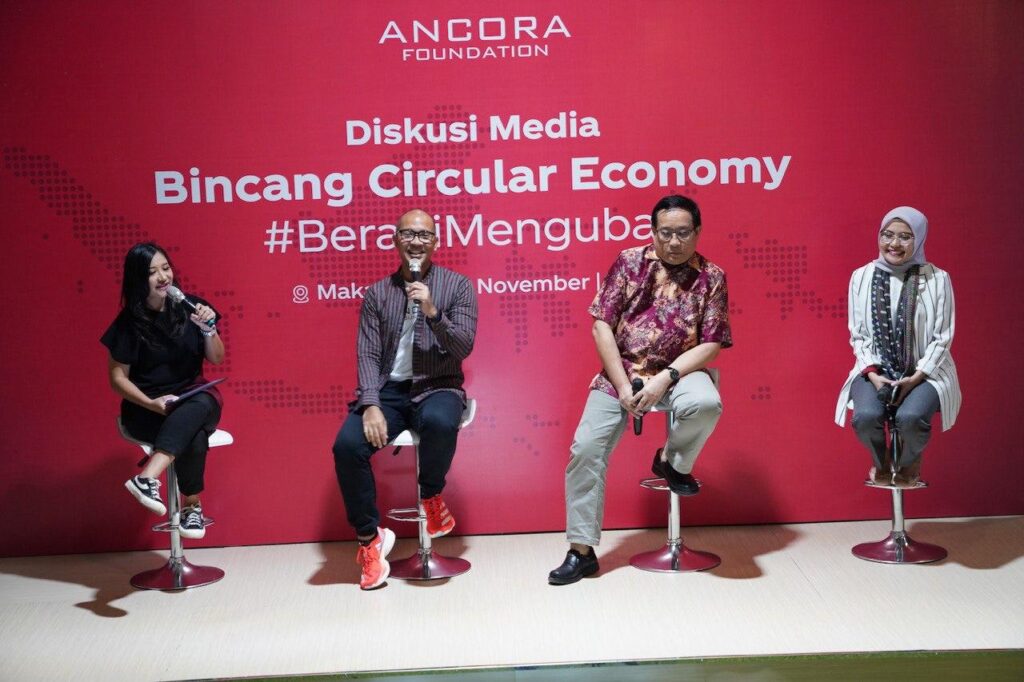
Discussion In order to raise public awareness and understanding of the economic potential of waste management, the Ancora Foundation organized a public discussion titled “Circular Economy Talk: Dare to Change,” which took place at Bikin-Bikin Creative Hub, Nipah Park, Makassar, on Thursday, November 9, 2023.
This event features three main speakers who are competent in their fields: Ahmad Zakky Habibie, Executive Director of the Ancora Foundation; Ir. Rijal M. Idrus from the Climate Change Study Center at LPPM Hasanuddin University; and Nurul Masyiah Rani Harusi, a lecturer in Environmental Engineering at Hasanuddin University. This discussion raises important issues related to waste management in Makassar City and the potential for implementing a circular economy as a sustainable solution.
In his presentation, Ahmad Zakky Habibie emphasized that the issue of waste has now become a major challenge for Indonesia. According to data from the Ministry of Environment and Forestry (KLHK) in 2022, 37 percent of the total national waste, or approximately 13.45 million tons, is not managed properly. Zakky explained that if the waste is managed with a circular economy approach that emphasizes reuse and processing waste into new value, Indonesia has the potential to increase its Gross Domestic Product (GDP) by Rp593 trillion to Rp638 trillion in 2023. The circular economy is viewed not only as a system but also as a behavioral change with a significant economic impact. However, to achieve this, massive and continuous public education is needed.
Meanwhile, Nurul Masyiah Rani stated that Makassar City generates approximately 1,023.71 tons of waste daily, with plastic waste accounting for 21.51 percent or about 220 tons per day, and used plastic bottle packaging reaching 15 tons per day. If this type of waste is managed effectively, the economic potential that could be generated reaches Rp22.5 million per day, which is currently wasted at the Final Disposal Site (TPA). He emphasized the importance of changing the public’s thinking paradigm towards waste, from initially considering it as waste to recognizing it as a potential resource with economic value.
In the view of Ir. Rijal M. Idrus, the waste problem in South Sulawesi Province is generally still quite complex. The study results show that the majority of rural residents have not yet disposed of their waste in the proper place. Relatively better waste management is only found in urban areas. The lack of waste management facilities and infrastructure, along with community habits, are the main reasons for the low quality of the waste management system in the area.
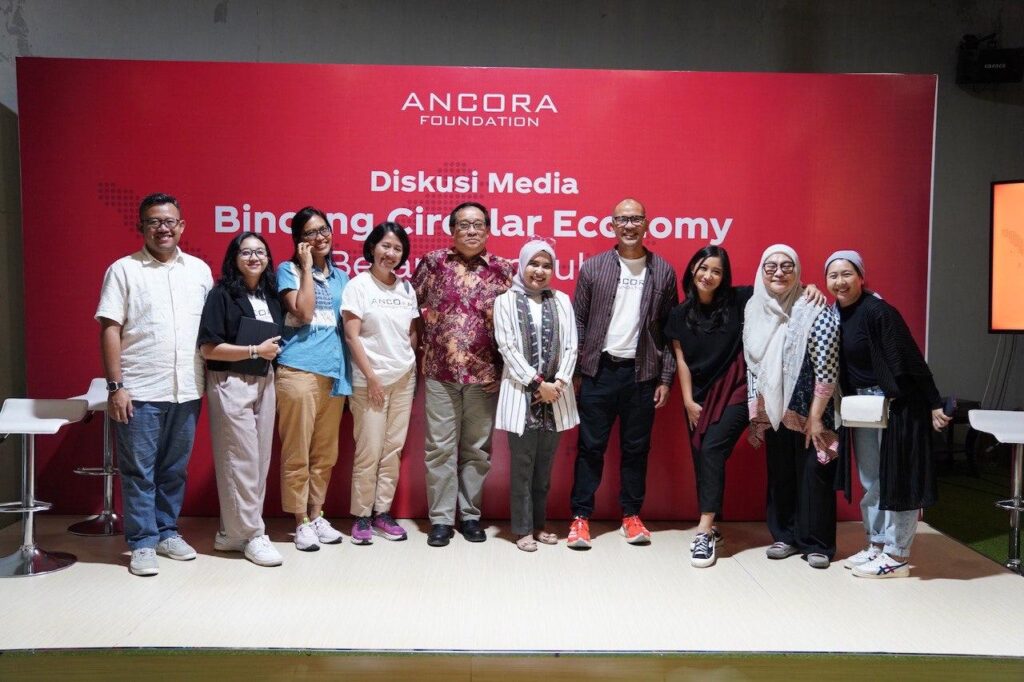
This discussion serves as an important reflection on the need for collaboration between communities, academics, governments, and the private sector in strengthening a circular economy-based waste management system. Public education, behavioral change, and the provision of appropriate waste processing infrastructure and technology are concrete steps to address environmental challenges while also creating new sustainable economic opportunities.