

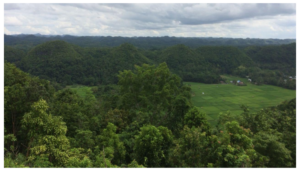
Makassar, Indonesia/May 21, 2026/PRG/Have you ever wondered how scientists can reconstruct ancient oceans from rocks that formed millions of years ago? In South Sulawesi, Indonesia, a limestone formation known as the Taccipi Limestone preserves an extraordinary geological record of environmental change. Through detailed microscopic analysis, researchers discovered that these rocks are more than just hardened sediments — they are natural archives containing clues about Earth’s ancient marine systems.
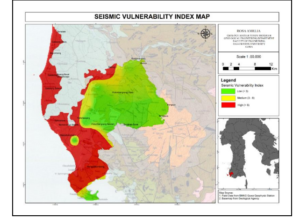
Makassar, Indonesia/May 21, 2026/PRG/Earthquakes cannot be predicted with precision, nor can they be prevented. Yet the destruction they leave behind is never purely a product of geological forces alone — it is equally a consequence of what we choose to build, where we choose to settle, and how well we prepare. In Takalar Regency, a fast-growing coastal district in South Sulawesi, a 2025 research study is offering a scientifically grounded foundation for making those choices more wisely.
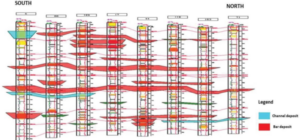
Makassar, Indonesia/May 21 2026/PRG/This research directly supports Sustainable Development Goal 7 (Affordable and Clean Energy) by developing a smarter, lower-cost method for detecting oil and gas reserves. More efficient energy exploration means fewer wasted resources, lower production costs, and a faster transition toward reliable, affordable energy supplies — especially critical for developing nations like Indonesia that still depend on hydrocarbon energy during the global energy transition.
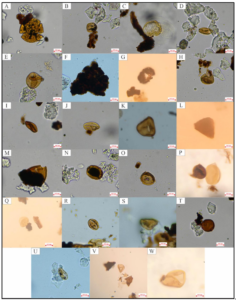
Makassar, Indonesia/May 21, 2026/PRG/This research directly supports Sustainable Development Goal 15 (Life on Land) by reconstructing past terrestrial ecosystems — including ancient forests, mangroves, and swamplands. Understanding how these ecosystems evolved over millions of years helps scientists and policymakers better protect today's forests, peatlands, and biodiversity hotspots in the Indo-Pacific region.
Makassar, Indonesia/May 21, 2026/PRG/Deep beneath the dense forests of East Kalimantan, a sophisticated yet elegantly simple technique is quietly transforming the way petroleum engineers locate and evaluate underground hydrocarbon reservoirs. Rather than relying solely on expensive conventional tools, geoscientists are now turning to something far more immediate — the gases liberated the moment a drill bit fractures subsurface rock.
Makassar, Indonesia/May 21, 2026/PRG/Hidden inside ancient sandstones in South Sulawesi, scientists have found clues to a 50-million-year-old puzzle — and the answers could shape how we use the Earth's resources more wisely. Based on peer-reviewed research published in IOP Conference Series: Earth and Environmental Science (2025) | Science Communication Feature.
Makassar, Indonesia/May 21, 2026/PRG/Millions of years before humans ever set foot on Sulawesi, the southern arm of this Indonesian island was a vast, lush delta — a dynamic meeting point between ancient rivers and the sea. Today, researchers from Hasanuddin University have found a remarkable way to reconstruct that forgotten world: by reading the language of ancient pollen.
Makassar, Indonesia/May 21 2026/PRG/What if ordinary sandstones could tell extraordinary stories about Earth’s past—and even guide our future? A recent scientific study from South Sulawesi, Indonesia, shows that rocks are not just silent witnesses. They are storytellers, revealing how landscapes, climates, and tectonic forces have shaped our planet over millions of years.
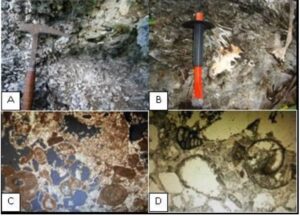
Pleistocene coral reefs in eastern Indonesia commonly form narrow terraces, such as those found in the Bulukumba region. These reefs indicate highly tectonized or uplifted areas. This study focuses on the Bira District of Bulukumba Regency, located at the southern tip of the South Sulawesi Peninsula.
The primary objective of this research is to characterize the depositional environment based on coral reef development and to interpret the paleoenvironment during reef formation. Several methods were employed, including the use of intersecting lines perpendicular to the cliff for structural analysis, petrographic examinations, and paleoenvironmental interpretations.These reefs serve as valuable archives of past climate conditions, as their development is directly influenced by environmental factors.
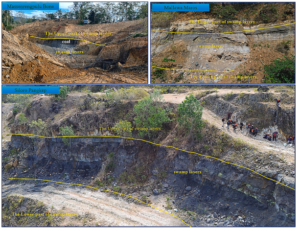
This study focuses on a research area located in the southern part of Bulukumba Regency, South Sulawesi, with the primary objective of analyzing reef development. The research methods include field surveys conducted along four transects across the reef cliffs. Laboratory analyses primarily involve petrographic and biofacies examinations to reconstruct the reef\'s evolutionary history.
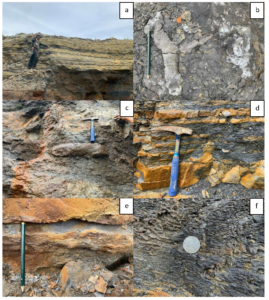
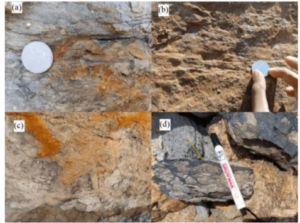
Four distinct reef biofacies have been identified in this study which are Coralgal Framestone–Wackestone, Massive Coral Framestone Facies, Plate-like Coral Bindstone Facies, Branching Coral Bafflestone Facies
Based on facies associations and the accumulation of reef organisms, the studied reefs are interpreted to have developed within a reef complex in a shallow marine environment.
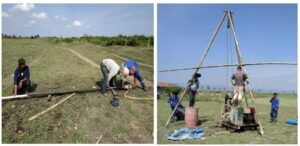
Studying the climate change timeline is important for predicting future environmental changes in Tempe Lake. The characteristics of lake and marine sediments are key proxies for understanding environmental and physiographic transformations.
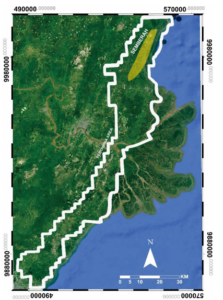
This research aims to characterize sediment deposits at the Tempe Lake outlet to understand the depositional physiographic conditions based on mineral composition, sulfate content, salinity levels, and marine influences at the lake outlet. We would also assess the impact of Bone Gulf on the environmental conditions of the Tempe Lake outlet. The research methodology involved field surveys, with sediment samples collected from the upstream to the estuary of the Cenrana River. These samples were analyzed using sedimentological, petrographic, and geochemical (XRD) techniques. Our study results indicate that the sediment materials at the Tempe Lake outlet are predominantly composed of coarse to medium sand.