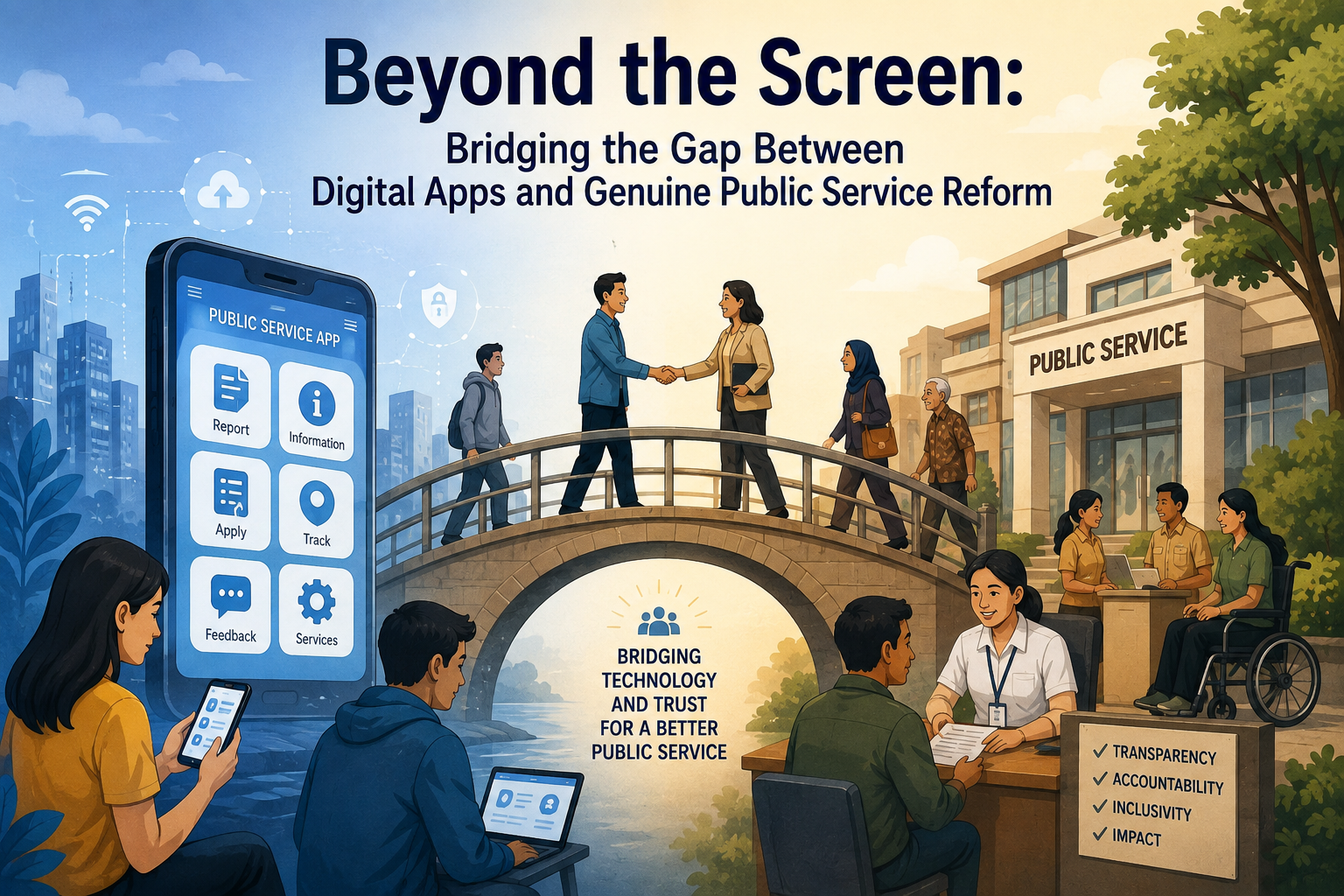

Makassar/Indonesia/30-06-2026/PCD-RG —– In our fast-paced modern world, cities worldwide are rushing to embrace digital transformation, launching mobile applications and online portals to modernize local bureaucracy. Yet, does swapping paper forms for smartphone screens automatically create a government that truly serves its citizens? This critical question lies at the very heart of an insightful scholarly study published on June 30, 2026, in the Journal of Public Administration Research by Karya Grafindo Prima Perkasa. Titled “Digital Governance and Citizen-Centric Public Services: Evaluating Administrative Reform in Local Government,” this research dives deep into how digitalization impacts public service delivery on the ground.
Focusing on the Local Government of Bandung City, West Java, Indonesia—a major urban municipality widely recognized for its smart city initiatives—the study evaluates administrative reforms through a qualitative evaluative case study design. The research gathered rich, in-depth insights from twelve purposively selected informants, including senior planning officials, informatics managers, frontline licensing officers, public complaint coordinators, IT technical staff, and local residents. Their empirical findings reveal a compelling double-edged reality. On one hand, online platforms for civil registration, business licensing, and complaint handling have simplified basic procedures, enhanced internal monitoring, boosted administrative transparency, and saved community members valuable time and travel expenses.
On the other hand, the study uncovers a persistent structural gap between technological adoption and actual bureaucratic transformation. In many instances, digital tools are merely added onto traditional routines without simplifying underlying administrative processes. Residents still encounter fragmented agency applications requiring multiple logins, limited data sharing between municipal departments, uneven digital literacy, and persistent requirements for manual document verification. Furthermore, citizen participation remains largely reactive—restricted mainly to submitting complaints after issues occur rather than contributing strategically to public service design. Consequently, without process redesign, digital governance risks becoming symbolic modernization rather than complete institutional reform.
Crucially, the study demonstrates that effective administrative modernization connects directly with SDG 17: Partnerships for the Goals, which highlights the critical necessity of multi-stakeholder collaboration, institutional coherence, and cross-sector partnerships. Achieving genuine citizen-centric governance demands that local government departments dismantle internal operational silos, harmonize electronic databases, and build active feedback loops with local communities. When public administration institutions treat citizens as active co-producers of public value rather than passive service consumers, municipal governance becomes far more inclusive, accountable, transparent, and democratically responsive.
Ultimately, digital platforms are valuable tools, but their true success depends on institutional commitment and human-centered reform. Local governments must shift focus from simply releasing new software applications to simplifying administrative procedures, expanding digital accessibility for vulnerable populations, and empowering civil servants. By aligning technological innovation with institutional integration and continuous citizen participation, municipal leaders can fulfill the true promise of digital governance, creating public services that authentically serve everyone.
Reference:
DOI: https://doi.org/10.67171/pn401p03
Contact:
Prof. Dwia Aries Tina Pulubuhu
+62 87856272912 (PCD-RG)
dwiatn@unhas.ac.id