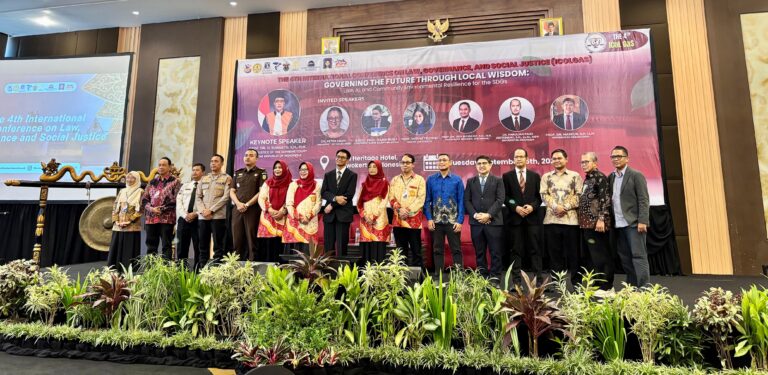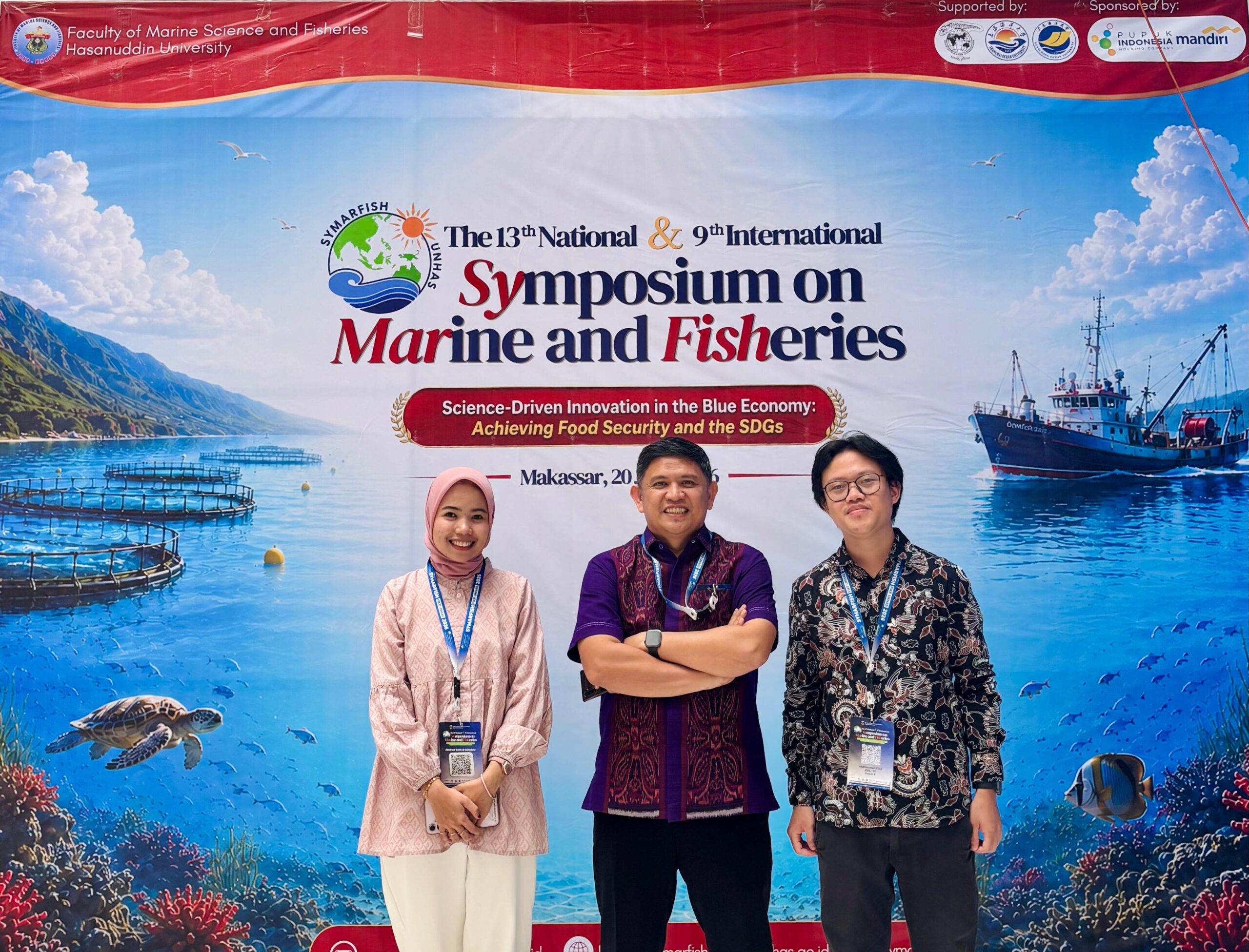

The TRG Waste Management Law Team participated in the 13th National and 9th International SYMARFISH Symposium on Marine and Fisheries, held on 20 June 2026 at the Faculty of Marine Science and Fisheries, Hasanuddin University (FIKP UNHAS). The symposium brought together approximately 120 participants, including academics, researchers, legal scholars, policymakers, students, and practitioners from various institutions. As an interdisciplinary scientific forum, the symposium provided a valuable platform for exchanging research findings, fostering academic dialogue, and strengthening collaboration to address contemporary challenges in marine and fisheries governance, environmental sustainability, and natural resource management.
The primary objective of the symposium was to strengthen interdisciplinary scientific collaboration and promote evidence-based policy development in marine and fisheries governance by integrating legal, environmental, social, and economic perspectives to support sustainable development. Through keynote lectures, scientific presentations, and panel discussions, participants explored innovative approaches to improving governance, encouraging sustainable resource management, and enhancing collaboration among universities, research institutions, government agencies, and other stakeholders.
Representing the TRG Waste Management Law Team, a research paper entitled “Energy Transition or Ecological Burden Shifting? Ecological Traceability and Accountability in the Nickel Trade in Halmahera” was presented during the scientific sessions. The paper examined the legal paradox underlying Indonesia’s nickel trade governance, where nickel has been positioned as a strategic mineral supporting the global energy transition while its extraction and processing continue to pose significant ecological risks to local communities in producing regions, particularly Halmahera. Rather than viewing the nickel trade solely through the lenses of downstream industrialization, investment, or export growth, the study approached it as a matter of environmental justice involving the distribution of environmental risks, transparency of environmental data, ecological traceability, and accountability across global supply chains.
Using normative legal research enriched by a socio-legal approach, the study analyzed legislation, legal doctrines, academic literature, policy reports, and factual data relating to the nickel industry in Halmahera. The findings suggested that the legality of mining permits, environmental impact assessments, and downstream industrialization policies alone is insufficient when environmental information remains inaccessible, the ecological footprint of nickel commodities cannot be effectively traced, and legal responsibility is confined primarily to local actors. In response to these challenges, the study proposed an Environmental Data Justice–Ecological Traceability Trade-Based Accountability framework that reorients nickel governance from administrative compliance toward ecological accountability. This framework emphasizes that a just nickel trade should ensure that Halmahera does not become an ecological sacrifice zone in supporting the future of the global clean energy transition.
The participation of the TRG Waste Management Law Team reflected its commitment to advancing legal scholarship on environmental governance, environmental justice, and sustainable natural resource management through international academic engagement. The symposium also provided opportunities to exchange ideas with experts from diverse disciplines, receive valuable scholarly feedback, and establish future collaborations addressing increasingly complex environmental and governance challenges.
This academic activity also contributed to the achievement of several Sustainable Development Goals (SDGs). The dissemination of research findings and scientific discussion supported SDG 4 (Quality Education) by strengthening research capacity and academic knowledge exchange. The study also aligned with SDG 14 (Life Below Water) by encouraging more responsible governance of activities that directly or indirectly affect coastal and marine ecosystems. Furthermore, the emphasis on collaboration among researchers, universities, and policymakers reflected the spirit of SDG 17 (Partnerships for the Goals) in promoting collective action for sustainable development. In accordance with the broader objective of ensuring that natural resource governance generates long-term social benefits, the research also supports SDG 1 (No Poverty) by advocating equitable and accountable management of strategic natural resources that can contribute to sustainable livelihoods and community welfare.
Overall, the participation and research presentation by the TRG Waste Management LawTeam demonstrated the important contribution of legal scholarship in addressing the governance challenges arising from the global energy transition. By introducing the concepts of environmental data justice, ecological traceability, and trade-based accountability, the study encourages a more transparent, equitable, and accountable framework for Indonesia’s nickel trade while reinforcing the role of law in achieving sustainable development and environmental justice.