

MAKASSAR, Indonesia 10 September 2026/SRI-RG/- Indonesia poured IDR 423.4 trillion into infrastructure development in 2024 alone, funding major projects such as the Trans-Sumatra toll road and the new National Capital City. Yet even as cranes rise across cities like Makassar, project managers admit they spend nearly 90% of their working hours simply trying to communicate with everyone involved in a project, and more than 40% of field workers say miscommunication is what derails a project the most.
But what if the biggest threat to a construction project isn’t concrete, steel, or budget, but a conversation that never quite gets through?
A newly published study zeroes in on exactly this problem in Makassar City. The research, titled “An Analysis of Miscommunication Factors Affecting Time Delays and Quality Degradation in Construction Projects in Makassar City,”was published in Engineering, Technology & Applied Science Research (ETASR) on 8 December 2025. The study surveyed 30 experienced professionals, including project owners, managers, contractors, supervising consultants, and material suppliers, all with at least two years of experience, then used a statistical method called the Relative Importance Index (RII) to rank exactly which communication failures hurt projects the most.
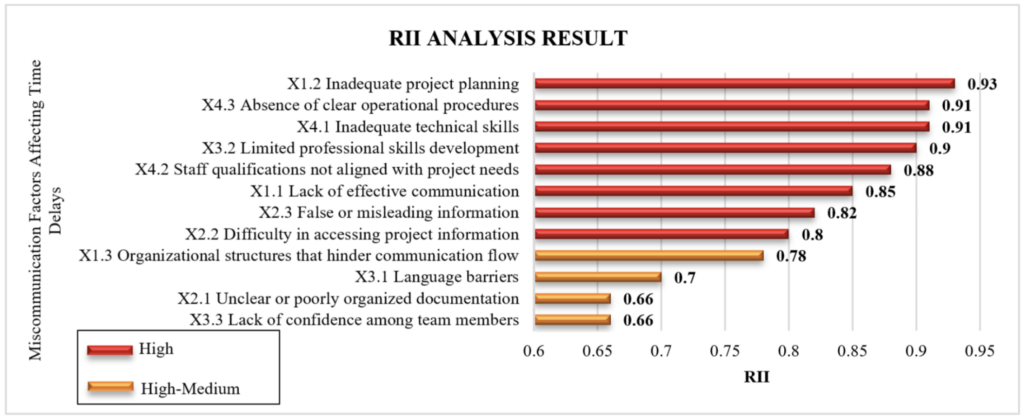
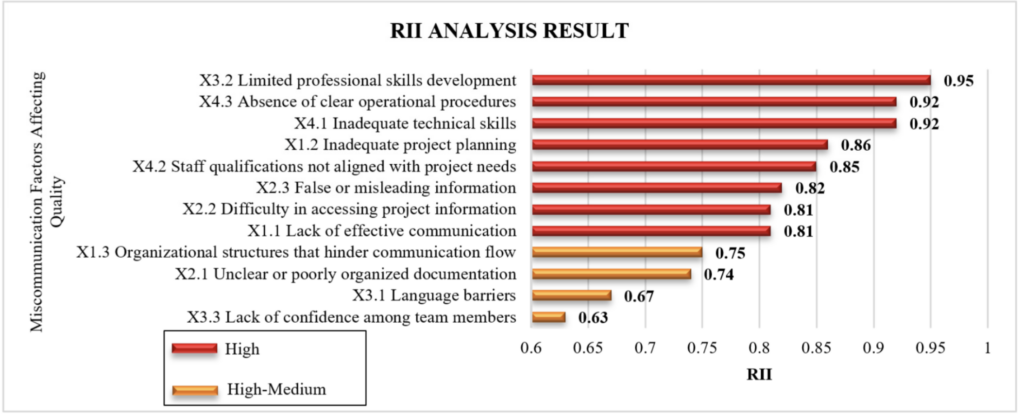
The findings sorted the culprits into four groups: organizational and managerial issues, project-related information, professional behavior and culture, and technology and methods. Among twelve specific factors tested, inadequate project planning scored the highest RII for causing delays, at 0.93. For quality, limited professional skills development topped the list, at 0.95. Close behind were unclear operational procedures and weak technical skills, both scoring above 0.90 for their impact on both time and quality. Local context matters too: earlier research on Makassar apartment projects found that nearly 67% of construction delays traced back to communication failures alone.
At the same time, this research speaks directly to SDG 17: Partnerships for the Goals. Construction projects only succeed when architects, engineers, contractors, consultants, and clients coordinate as genuine partners rather than isolated parts of a supply chain. The study shows that when this web of collaboration weakens through unclear planning, poor documentation, or gaps in skill, the whole partnership structure suffers, and so do the buildings, budgets, and communities depending on them.
Importantly, the researchers found the fixes do not require expensive new technology. Strengthening upfront planning, writing clearer standard operating procedures, and investing in ongoing professional training for construction teams could meaningfully cut delays and lift build quality. These are organizational choices, not costly infrastructure upgrades, making them achievable even for mid-sized contractors and local development authorities.
In a rapidly urbanizing city like Makassar, where infrastructure demand keeps climbing alongside population growth, this research offers something valuable: proof that the biggest risks to a construction project are often invisible, buried in how people talk, plan, and share information with one another. Fixing that conversation, the study suggests, may be one of the most cost-effective ways to build faster, safer, and better.
Reference: DOI: https://doi.org/10.48084/etasr.12987
Contact:
Rosmariani Arifuddin
Department of Civil Engineering, Hasanuddin University
Email: rosmarianiarifuddin@unhas.ac.id