

Why Children Become Obese: It’s Not Just About Junk Food
MAKASSAR, Indonesia Apr 3 2026/OCNRG/ – When people talk about childhood obesity, the explanation often sounds simple: children eat too much junk food and do not exercise enough. But the reality is more complicated than that.
Children’s health is shaped by a combination of everyday habits—what they eat, how active they are, and how they spend their time. When several unhealthy habits occur together, their effects can reinforce one another, increasing the risk of obesity.
This idea was explored in a scientific study titled “Improved Understanding of Interactions between Risk Factors for Child Obesity May Lead to Better Designed Prevention Policies and Programs in Indonesia,” published in the journal Nutrients in January 2020.
Rather than focusing on a single behavior, the researchers examined how diet, junk food consumption, and sedentary lifestyles interact in shaping obesity risk among children. The study involved 488 schoolchildren aged 7–12 years in Yogyakarta, including 244 children who were obese and 244 children with normal weight. Researchers collected information about their daily food intake, physical activity, and family background to better understand patterns associated with obesity.
What we found reflects a pattern increasingly seen in many countries undergoing rapid lifestyle changes.
Children who were obese tended to eat fewer fruits and vegetables, consume more junk food, and spend longer hours in sedentary activities, such as watching television, playing games, or sitting for extended periods.
But the most important discovery was how these behaviors interact.
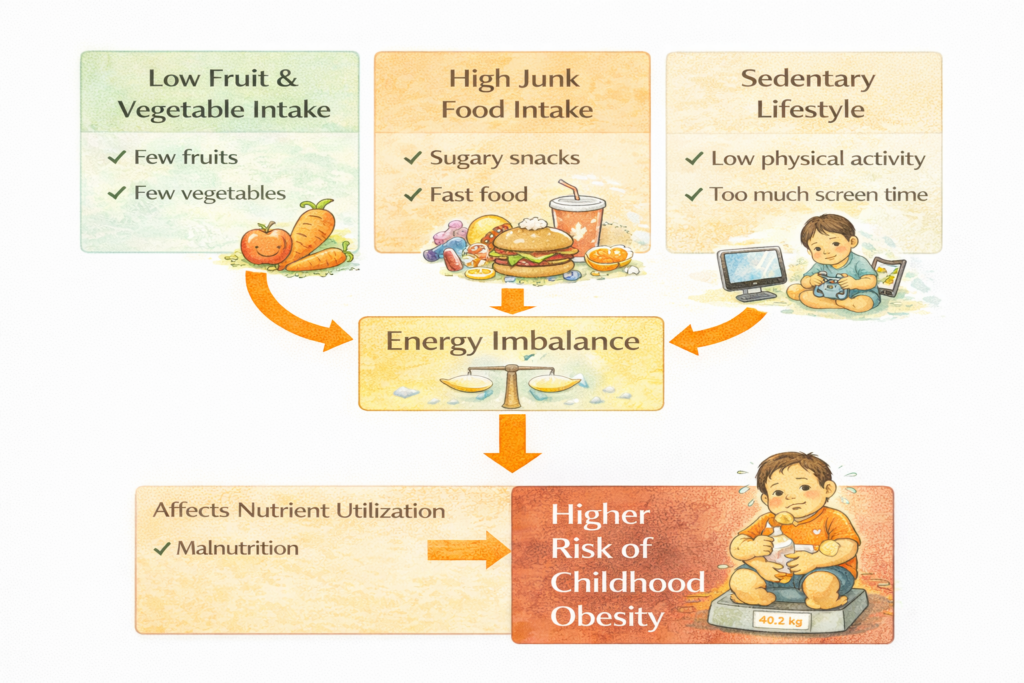
For example, children who consumed fruits and vegetables at least three times per day were about 54% less likely to be obese than those who rarely ate them. Meanwhile, children who spent less than five hours per day in sedentary activities were about 82% less likely to be obese compared with those who were mostly inactive.
However, the real impact appeared when these behaviors were combined.
Children who both ate more fruits and vegetables and were less sedentary had the lowest risk of obesity. On the other hand, children who rarely ate fruits and vegetables and spent long hours sitting were much more likely to be obese.
This finding highlights an important lesson that childhood obesity is rarely caused by a single habit. Instead, it is often the result of multiple lifestyle factors working together. A child who eats poorly but remains physically active may face a lower risk than a child who both consumes unhealthy foods and spends most of the day sitting.
Indonesia, like many other countries, is currently experiencing what researchers call a “nutrition transition.” Traditional diets rich in vegetables and home-cooked foods are increasingly replaced by energy-dense snacks, sugary drinks, and fast foods. At the same time, children are spending more time indoors and in front of screens.
These shifts create an environment where unhealthy choices become easier—and healthier habits become harder to maintain.
For this reason, the study suggests that preventing childhood obesity requires integrated strategies. Improving children’s diets alone may not be enough if sedentary lifestyles continue to increase. Similarly, encouraging physical activity may have limited impact if children are surrounded by unhealthy food options.
Instead, effective solutions may need to address both nutrition and lifestyle simultaneously—for example by improving school food environments, encouraging active play, and educating families about healthy eating habits.
Ultimately, tackling childhood obesity may not be about fixing a single behavior—but about reshaping the everyday environments where children grow, eat, and play.
Reference:
DOI: https://doi.org/10.3390/nu12010175
Contact:
Andi Imam Arundhana Thahir
+62 852-7009-4092
andi.imam@unhas.ac.id