

Why Stunting Prevention Must Start Before Birth: Lessons from Sulawesi
MAKASSAR, Indonesia Apr 1 2026/OCNRG/ – Around the world, millions of children face a silent threat to their growth and future, stunting. Stunting occurs when a child’s height is too short for their age due to long-term undernutrition. But the problem is deeper than height alone—it can affect brain development, school performance, and productivity later in life. In fact, global estimates suggest that more than 149 million children under five years old are stunted, making it one of the most pressing global health challenges.
This issue is closely connected with Sustainable Development Goal (SDG) 3: Good Health and Well-being, which aims to ensure healthy lives and promote well-being for all at all ages. Preventing stunting is essential not only for children’s health but also for the long-term development of societies.
A recent scientific study offers important insights into this challenge. The article “Exploring Factors Associated with Stunting in 6-Month-Old Children: A Population-Based Cohort Study in Sulawesi, Indonesia,” published in the journal Nutrients by MDPI on 1 August 2023, investigated why some infants already show signs of stunting in their first months of life.
The study followed 152 mother–infant pairs in Banggai, Central Sulawesi, from late pregnancy until the babies reached six months of age. Researchers examined factors such as maternal nutrition, birth outcomes, and infant feeding practices to understand what contributes to early growth problems.
One of the most striking findings is that stunting often begins before a child is even born. Infants who were small for their gestational age (SGA)—meaning they were smaller than expected at birth—were far more likely to become stunted during their first six months of life.
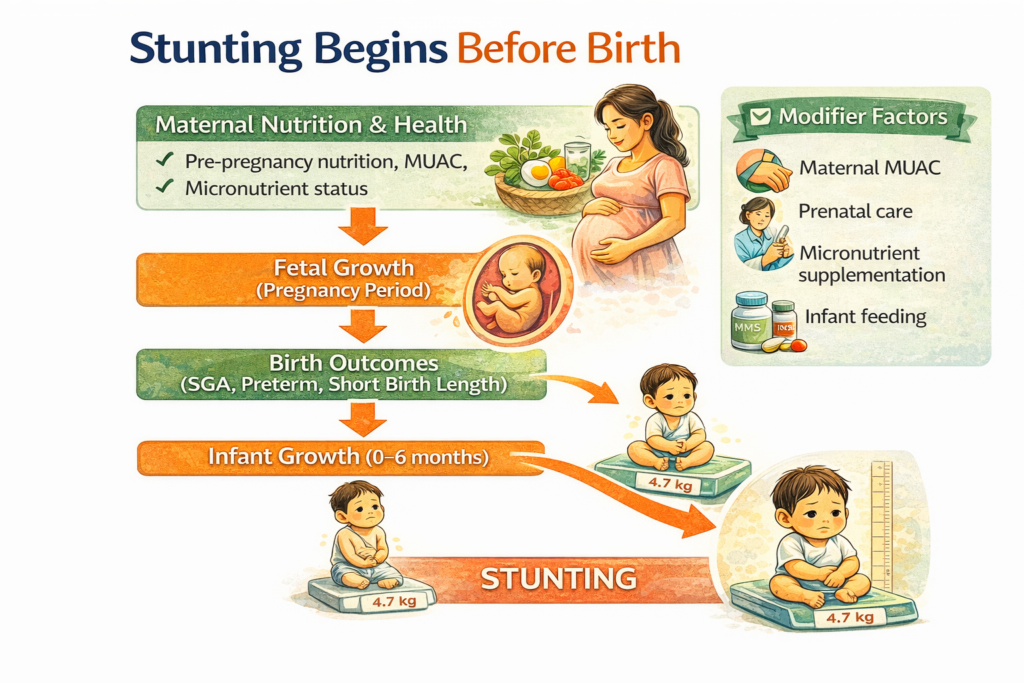
Other risk factors also emerged. Babies born prematurely or with shorter birth length were more likely to experience stunting. Maternal nutritional status during pregnancy, measured through indicators such as mid-upper arm circumference, also played a role. In other words, the health of the mother strongly influences the growth of the child.
These findings highlight a crucial message: waiting until a child is a toddler may already be too late to prevent stunting. Many underlying causes occur during pregnancy or even before conception. That is why early intervention—especially improving maternal nutrition—is essential.
The research also explored the potential role of multiple micronutrient supplements (MMS) for pregnant women. While the differences were not statistically significant, babies whose mother’s received supplements before pregnancy showed a trend toward better growth compared with those whose mothers started supplementation only during pregnancy.
This suggests that improving women’s nutrition before pregnancy begins may help break the cycle of poor growth.
The implications are clear. Efforts to reduce stunting should not focus only on feeding children after birth. They must include maternal nutrition, prenatal care, and early-life monitoring. Programs targeting the first 1,000 days of life—from conception to a child’s second birthday—are especially critical.
By investing in maternal health, nutrition education, and early childhood care, countries can move closer to achieving significant reduction of malnutrition and stunting. Preventing stunting is not only about helping children grow taller but it is about giving them a stronger start in life, improving education outcomes, and building healthier generations for the future.
Reference:
DOI: https://doi.org/10.3390/nu15153420
Contact:
Andi Imam Arundhana Thahir
+62 852-7009-4092
andi.imam@unhas.ac.id