

Why do some children experience both stunting and obesity at the same time? This question lies at the core of a growing global health concern and is a key focus of research conducted by the Obesity and Child Nutrition Research Group. Increasingly observed in low- and middle-income settings, the coexistence of these two conditions challenges conventional understanding of malnutrition and calls for more integrated approaches.
This research is formally titled “Interactions of Sociodemographic Factors, Nutrition, and Gut Microbiota in Uncovering the Mechanisms of Stunting–Obesity Coexistence among School-Aged Children in South Sulawesi.” It is designed as a multi-year study (2025–2026), reflecting a sustained effort to capture dynamic and longitudinal aspects of child growth, behavior, and biological processes.
Traditionally, stunting has been viewed as a marker of chronic undernutrition, while obesity is associated with excess energy intake. However, these conditions are no longer mutually exclusive. In many contexts, they occur within the same child, household, and community, reflecting what is widely recognized as the double burden of malnutrition. This phenomenon highlights complex interactions between biological, behavioral, and environmental determinants that shape children’s growth and metabolic outcomes.
The study was conducted among 161 children and 117 parents across six schools in three areas—Makassar, Takalar, and Maros, providing a diverse representation of dietary patterns, living environments, and socio-cultural contexts in South Sulawesi. By combining field-based assessments with advanced microbiome analysis, the research adopts a comprehensive and integrative approach to understanding child nutrition.
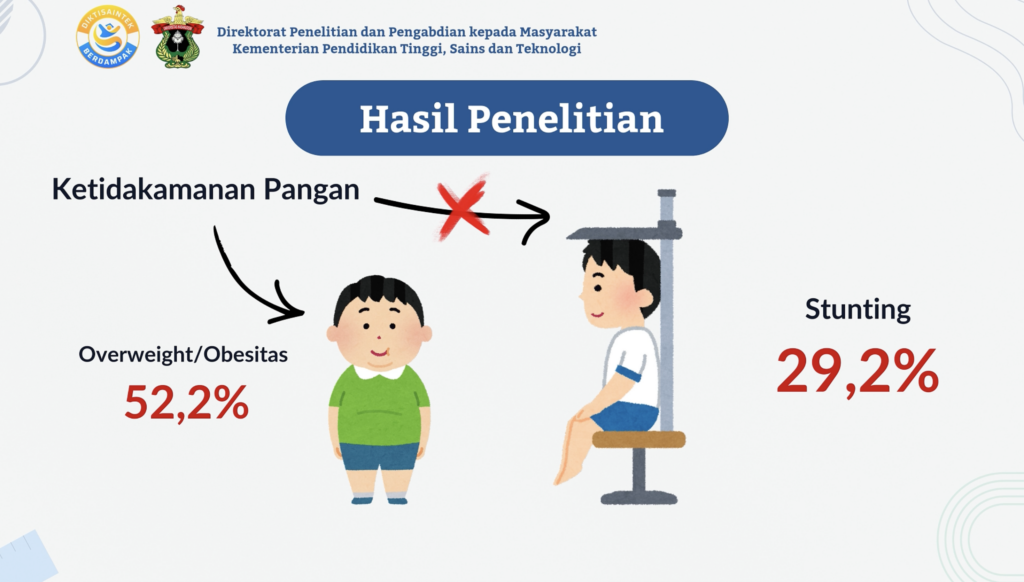
A central component of the study is the exploration of the gut microbiome, an often overlooked but increasingly important factor in child health. The gut microbiota plays a critical role in nutrient metabolism, immune regulation, and energy balance. By examining how children’s dietary intake, family and school environments, and broader food systems interact with gut microbiome dynamics over time, this research seeks to uncover how early-life and ongoing exposures influence growth trajectories and metabolic risk.
Importantly, the study integrates multiple layers of data, including behavioral patterns, environmental exposures, and biological markers, to better capture the complexity of child nutrition. This approach allows for a more nuanced understanding of how risk factors cluster and interact, rather than acting independently. Such insights are essential for explaining why some children may simultaneously experience impaired linear growth and excess weight gain.
Beyond generating scientific evidence, this research aims to inform more precise and context-specific intervention strategies. Addressing the double burden of malnutrition requires moving beyond fragmented approaches that treat undernutrition and obesity separately. Instead, integrated strategies are needed—ones that consider the interplay between diet, environment, and biology, including the role of the gut microbiome.
This work contributes directly to several Sustainable Development Goals (SDGs). By addressing malnutrition in all its forms, it supports SDG 2 (Zero Hunger) and SDG 3 (Good Health and Well-being). Furthermore, the study reflects SDG 17 (Partnerships for the Goals) through collaborative research efforts aimed at generating actionable and locally relevant evidence.
Ultimately, this research seeks to advance a more holistic understanding of child health. By bridging biological mechanisms with real-world contexts, it contributes to the development of more effective, sustainable, and integrated strategies to prevent both stunting and obesity—together, not in isolation.