
Intermittent fasting has become a popular health trend. The idea sounds simple: eat during certain periods and spend other periods without food. But beyond weight control, could fasting actually influence how the body ages?
A new study offers an intriguing clue—not from humans, but from fruit flies.
Researchers investigated how intermittent fasting (IF) affected survival and the activity of genes involved in metabolism, antioxidant defense, and autophagy in Drosophila melanogaster. Fruit flies are widely used in biological research because many important genes and cellular pathways are shared with humans. In fact, approximately 75% of human disease-associated genes have counterparts in Drosophila.
The researchers used male fruit flies and divided them into three groups. One group had food available all the time. The other two groups experienced fasting for either 4 or 8 hours, three times a week. After fasting, the flies returned to normal feeding.
The results were surprising.
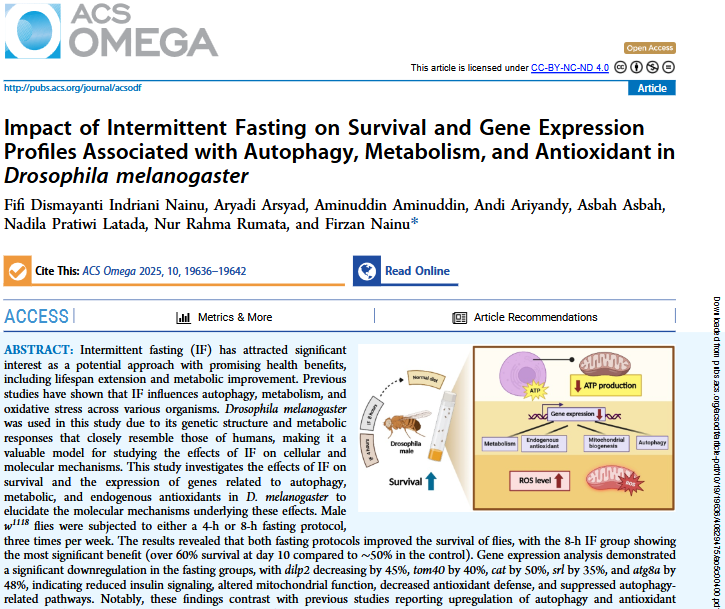
Both fasting schedules improved survival compared with the continuously fed control group. By day 10, about 60% of flies in both fasting groups were still alive, compared with around 50% of the control flies. The 8-hour fasting group showed the strongest overall survival benefit.
But the molecular story was more complicated.
Fasting reduced the activity of several genes. The dilp2 gene, associated with insulin signaling, decreased by about 45%, while tom40, involved in mitochondrial function, decreased by about 40%. Genes related to antioxidant defense and cellular maintenance were also reduced: cat fell by 50%, srl by 35%, and atg8a by about 48–55%.
Even more unexpected was the finding that reactive oxygen species (ROS)—molecules associated with oxidative stress—increased in both fasting groups. The 8-hour group showed the highest ROS levels.
So, is fasting good or bad?
The answer may be: it depends.
The study suggests that fasting can trigger complex adaptations. Some changes may help cells adjust to limited nutrients and improve survival, while excessive or prolonged stress could potentially overwhelm antioxidant defenses. The researchers therefore caution that the biological effects of fasting are not simply “more fasting equals more health.”
This research supports SDG 3: Good Health and Well-Being by improving our understanding of how dietary patterns may influence cellular health and longevity. However, these findings come from fruit flies, not humans. They should not be used as proof that a particular fasting schedule will extend human lifespan.
The bigger lesson is that nutrition can influence biology far beyond hunger and fullness. What happens when we stop eating may activate a complex network of metabolic and cellular responses—and scientists are still discovering how those responses work.
Article Metadata
Article title: Impact of Intermittent Fasting on Survival and Gene Expression Profiles Associated with Autophagy, Metabolism, and Antioxidant in Drosophila melanogaster
Journal: ACS Omega 2025;10(19):19636–19642
Publisher: American Chemical Society
Publication date: 12 May 2025
DOI: https://doi.org/10.1021/acsomega.5c00400
Authors: Fifi Dismayanti Indriani Nainu; Aryadi Arsyad; Aminuddin Aminuddin; Andi Ariyandy; Asbah Asbah; Nadila Pratiwi Latada; Nur Rahma Rumata; Firzan Nainu
Aryadi Asryad
Email: aryadi.arsyad@med.unhas.ac.id