
A wound may look like a simple problem: clean it, cover it, and wait for the skin to heal. But when a wound becomes infected, healing can become much more complicated. Bacteria can keep the body’s natural repair process from working properly, causing wounds to remain open for much longer and increasing the risk of serious complications.
This challenge has encouraged researchers to look beyond conventional treatments. One promising idea comes from Laportea decumana, a plant traditionally associated with biological activities such as antioxidant, anti-inflammatory, antibacterial, and pain-relieving effects. Researchers from Hasanuddin University and collaborating institutions recently explored whether its extract could make a modern wound dressing more effective.
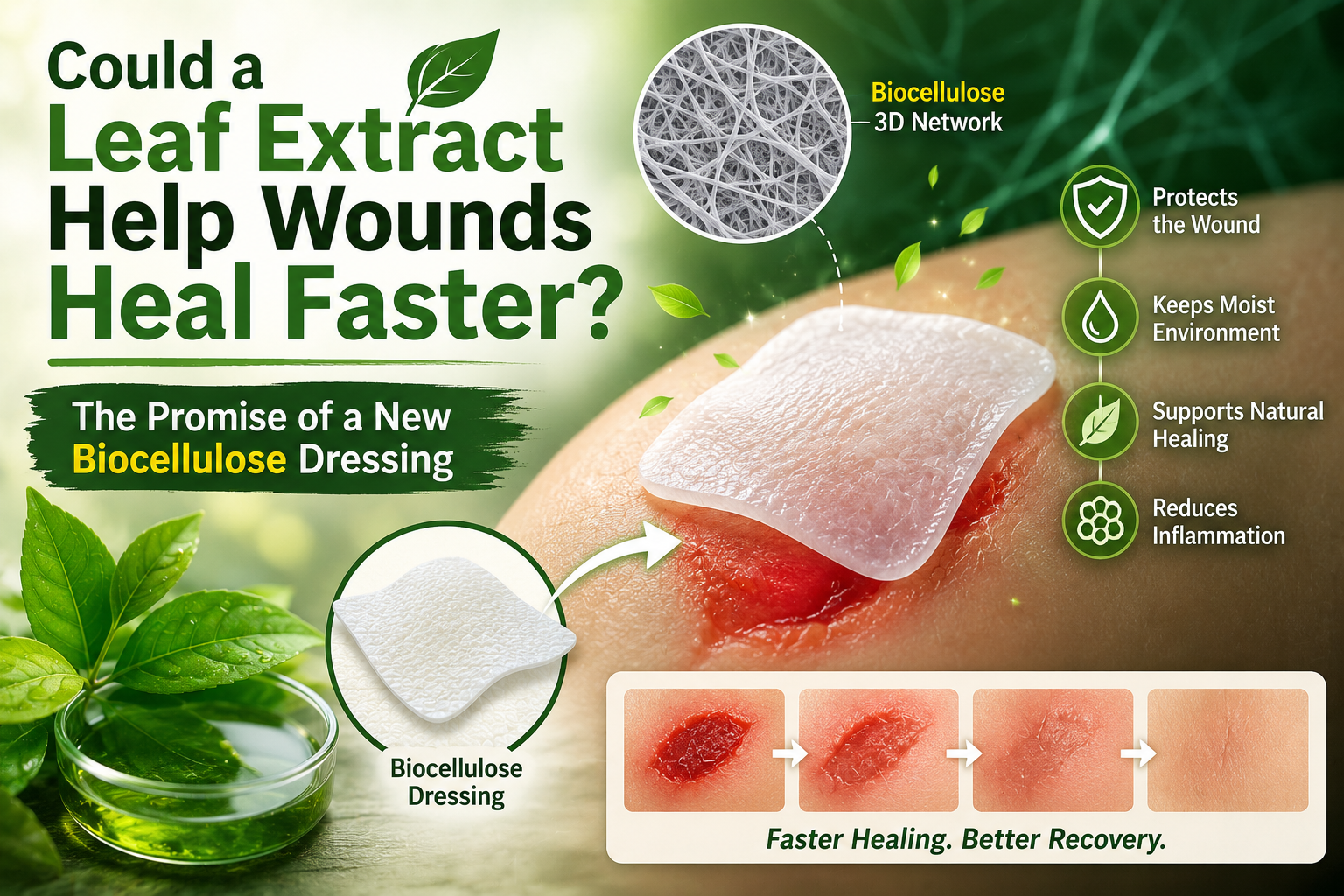
Their approach combines the plant extract with biocellulose, a material already attracting attention in wound care. Biocellulose can act as a protective layer over damaged skin while providing a suitable environment for tissue repair. In this study, researchers developed a dressing containing 4% Laportea decumana extract (LDE) and compared it with ordinary biocellulose and untreated wounds.
The experiment involved 15 male rats, each receiving three wounds that were deliberately infected with a mixture of three bacteria: Staphylococcus aureus, Staphylococcus epidermidis, and Pseudomonas aeruginosa. The wounds were then observed for 14 days, allowing researchers to follow different stages of healing.
At first, there was little difference between the treatment groups. But as healing progressed, the picture became more interesting. From Day 11 onward, wounds treated with the 4% LDE-enriched biocellulose dressing were significantly smaller than untreated wounds and those receiving biocellulose alone.
The researchers also observed improvements beneath the surface. The LDE-enriched dressing appeared to promote granulation tissue formation, fibroblast activity, and collagen deposition—important processes in rebuilding damaged tissue. During the later stage of healing, the treatment also accelerated re-epithelialization, the process through which new skin grows over the wound.
Why might this plant-based dressing work? The researchers suggest that compounds in Laportea decumana may contribute antioxidant, anti-inflammatory, and antibacterial effects. Chemical analysis of the extract identified a variety of compounds, suggesting that its biological activity may result from the combined effects of multiple substances rather than a single ingredient.
These findings support SDG 3: Good Health and Well-Being, which promotes better health and access to effective healthcare. Developing affordable and innovative wound-care technologies could be especially valuable in managing infected wounds and reducing complications.
Still, there is an important reason to remain cautious. This was an animal study, not a human clinical trial. The researchers also noted that further research is needed to understand the exact antimicrobial and anti-inflammatory mechanisms of the treatment.
For now, the study offers an exciting glimpse into how traditional plant resources and modern biomaterials could work together. A simple leaf extract combined with an advanced dressing may one day contribute to faster wound recovery—but more evidence is needed before this promising laboratory finding can become a treatment for patients.
Article Metadata
Article title: Accelerated Wound Healing Using Biocellulose Dressings Enriched With Laportea decumana Extract in Polymicrobial Infection Wound Models
Journal: Advances in Pharmacological and Pharmaceutical Sciences 2026;2026:4224962
Publisher: John Wiley & Sons Ltd
Publication date: 2026
DOI: https://doi.org/10.1155/adpp/4224962
Authors: Yulia Yusrini Djabir; Dwi Novrianty Busaeri; Muhammad Haryandi; Nurhasni Hasan; Habibie Habibie; Djulfkri Mewar; Hien Minh Nguyen; Aryadi Arsyad
Aryadi Asryad
Email: aryadi.arsyad@med.unhas.ac.id