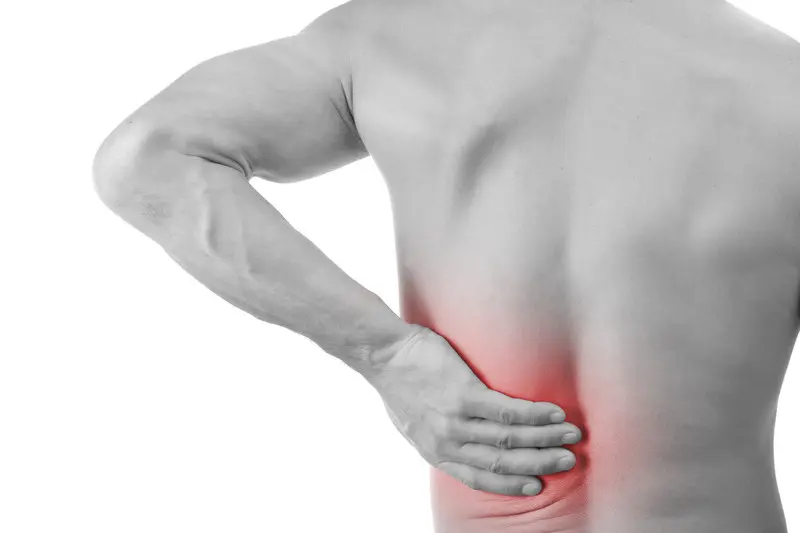

Low back pain is more than an occasional ache after a long day. It can make sitting, working, walking, or simple movements uncomfortable. According to Yuharti and colleagues, low back pain affects a large population and is a major cause of disability. In Indonesia, the article reports a prevalence of about 18%.
One common contributor is a myofascial trigger point—a sensitive, tight area in a muscle that can cause pain when pressed or activated. Two treatments used to manage these painful areas are dry needling (DN) and deep friction massage (DFM).
So, which one works better?
The researchers studied 32 people with low back pain, randomly divided into two groups of 16. One group received dry needling, in which thin needles are inserted into targeted muscle tissue without injecting medication. The other received deep friction massage, a hands-on technique using repeated pressure on muscle tissue. Each participant received one treatment session lasting about 20–30 minutes.
The researchers measured three things: pain using a Visual Analog Scale, lower-back movement using a goniometer, and trigger point size using muscle ultrasonography. This provided patient-reported and physical measurements.
The clearest result was pain relief. Both treatments significantly reduced pain after the session. However, dry needling produced the stronger reduction. The researchers suggest that needling may trigger a local muscle response, promote relaxation, improve circulation, and influence the nervous system’s processing of pain.
But there is an important caution: neither treatment produced a statistically significant difference in trigger point size between the groups. Although changes were observed, the researchers could not conclude that either method reliably reduced trigger point size. Similarly, lower-back movement showed numerical improvement, but the difference between treatments was not statistically significant.
This matters because a treatment can reduce pain without immediately changing every measurable feature of the affected muscle. Pain relief and improved movement do not always happen at the same pace.
The study offers a practical message: dry needling may be a promising option when rapid pain relief is the main goal, while deep friction massage remains a useful non-invasive alternative. The choice should consider the patient’s condition, preferences, and professional assessment.
This research is closely connected to SDG 3: Good Health and Well-Being. By exploring approaches to managing a common source of pain and disability, research like this can support better health and functional well-being.
The authors emphasize that the study tested only one treatment session. More research involving multiple sessions and longer follow-up is needed before firm conclusions about long-term effects can be made.
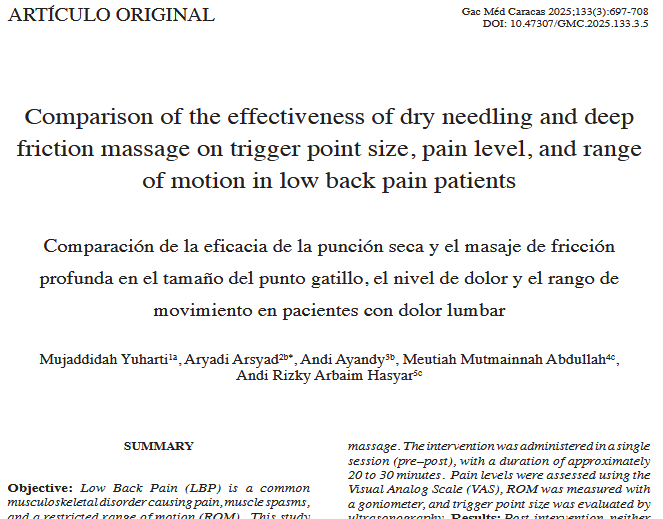
Article Metadata
Article title: Comparison of the effectiveness of dry needling and deep friction massage on trigger point size, pain level, and range of motion in low back pain patients
Journal: Gac Méd Caracas 2025;133(3):697–708
Publisher: Caracas: Academia Nacional de Medicina
Publication date: 14 September 2025
DOI: 10.47307/GMC.2025.133.3.5
Authors: Mujaddidah Yuharti, Aryadi Arsyad, Andi Ayandy, Meutiah Mutmainnah Abdullah, and Andi Rizky Arbaim Hasyar
Aryadi Arsyad
Email: aryadi.arsyad@med.unhas.ac.id