
Feeling irritable, tired, emotional, or experiencing abdominal and muscle pain before menstruation is something many teenage girls know well. These symptoms may be part of Premenstrual Syndrome (PMS), a condition that can affect both physical comfort and everyday activities. But could stress inside the body also leave a measurable trace in saliva?
A recent study published in the Journal of Family & Reproductive Health explored the connection between PMS, stress, and a substance called salivary alpha-amylase (sAA). This enzyme is found in saliva and can be used as a non-invasive biological marker related to the body’s response to stress.
The researchers screened 745 female students from five public high schools in Makassar. From this group, 62 adolescents met the study criteria and were included in the research: 31 with PMS and 31 without PMS. The researchers assessed PMS symptoms using the Shortened Premenstrual Assessment Form (SPAF), measured psychological distress using the Kessler Psychological Distress Scale (K10), and tested saliva samples for sAA using an ELISA method.
The results revealed a striking difference. Adolescents with PMS had an average sAA level of 23.28 ng/mL, compared with 12.10 ng/mL among those without PMS—almost twice as high. The difference was statistically significant.
Stress also showed a strong relationship with PMS. The researchers found a positive correlation between stress and PMS scores (r=0.67). In simple terms, adolescents reporting higher levels of stress also tended to report more severe PMS symptoms. The study also found a positive relationship between sAA levels and PMS (r=0.42), as well as between sAA and stress (r=0.30).
Interestingly, the researchers found that stress and sAA together could statistically predict about 49.7% of the variation in PMS scores. This suggests that stress-related responses may be an important piece of the PMS puzzle, although they are certainly not the whole story.
The message for teenagers is not that PMS is “just stress.” PMS is a real condition involving physical and emotional symptoms. Instead, the findings highlight why managing stress, getting enough rest, maintaining healthy routines, and paying attention to emotional well-being can be important parts of reproductive health.
This research supports SDG 3: Good Health and Well-Being. Understanding PMS and its relationship with stress can help encourage better health awareness among adolescents and promote earlier attention to symptoms that interfere with daily life.
Most importantly, the study reminds us that menstrual health deserves to be taken seriously. Sometimes, the body communicates its challenges in subtle ways—even through something as simple as saliva.
Article Metadata
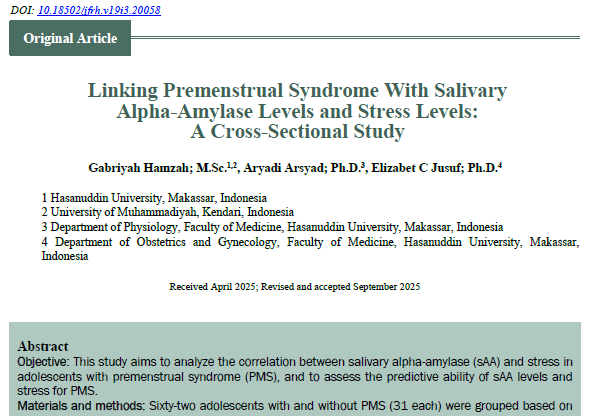
Article title: Linking Premenstrual Syndrome With Salivary Alpha-Amylase Levels and Stress Levels: A Cross-Sectional Study
Journal: Journal of Family & Reproductive Health 2025;19(3):208–215
Publisher: Tehran University of Medical Sciences, Iran
Publication date: September 2025
DOI: https://doi.org/10.18502/jfrh.v19i3.20058
Authors: Gabriyah Hamzah; Aryadi Arsyad; Elizabet C Jusuf
Aryadi Asryad
Email: aryadi.arsyad@med.unhas.ac.id