
A stiff neck can seem like a small problem. But for someone living with persistent muscle pain, even turning the head, working at a computer, or getting through an ordinary day can become uncomfortable. One possible cause is myofascial pain syndrome (MPS), a condition linked to sensitive areas in muscles known as trigger points.
These trigger points are like tight, irritable spots inside a muscle. They can cause pain, muscle tension, stiffness, and limited movement. Commonly affected muscles include those around the neck and upper back. For people experiencing this type of pain, the big question is simple: what treatment works best?
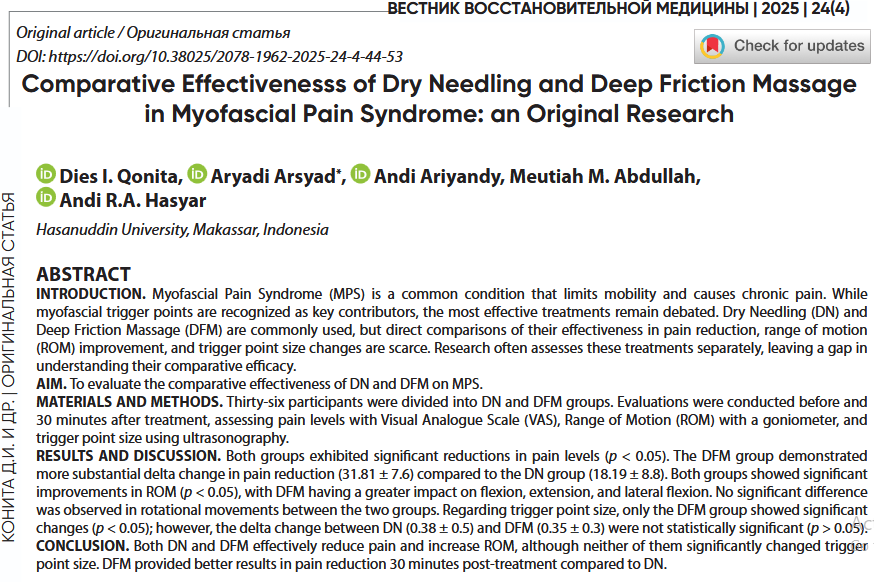
A recent study published in the Bulletin of Rehabilitation Medicine compared two commonly used approaches: Dry Needling (DN) and Deep Friction Massage (DFM). The researchers studied 32 adults aged 20–55 years who had neck pain lasting up to three months and had confirmed myofascial trigger points.
Dry needling uses a thin needle inserted into affected muscle areas. Deep friction massage, in contrast, uses manual pressure and friction applied to the affected tissue. Although both methods are widely used, direct comparisons between them have been limited.
So, what happened when the researchers put them head-to-head?
The results were encouraging for both treatments. Pain decreased significantly after treatment in both groups. However, the reduction was greater in the deep friction massage group. The average change in pain was 31.81 ± 7.6 in the DFM group, compared with 18.19 ± 8.8 in the dry needling group.
Movement also improved. Both groups showed significant improvements in neck range of motion, particularly in flexion, extension, and lateral flexion. Deep friction massage produced greater improvements in these movements. However, there was no significant difference between the two treatments for rotational movement.
Interestingly, the researchers also examined whether either treatment could actually change the size of the trigger points using ultrasound. Although changes were observed in the DFM group, the difference between the two treatments was not statistically significant. In other words, feeling less pain does not necessarily mean that the trigger point itself has disappeared.
The study offers a useful message for people dealing with myofascial pain: effective treatment does not always have to mean invasive treatment. Both techniques produced short-term benefits, while deep friction massage showed a stronger immediate effect on pain.
This research contributes to SDG 3: Good Health and Well-Being, which promotes healthy lives and well-being for people of all ages. By exploring practical ways to reduce pain and restore movement, research like this can support better rehabilitation and help people return to their daily activities.
Still, the study measured outcomes only 30 minutes after treatment. More research is needed to determine whether these benefits last for days, weeks, or longer.
For now, the comparison gives patients and rehabilitation professionals something important to consider: when muscles hurt, the best solution may not always come from a needle—sometimes, skilled hands can make a powerful difference.
Article Metadata
Article title: Comparative Effectiveness of Dry Needling and Deep Friction Massage in Myofascial Pain Syndrome: an Original Research
Journal: Bulletin of Rehabilitation Medicine 2025;24(4):44–53
Publisher: National Medical Research Center for Rehabilitation and Balneology, Ministry of Health of the Russian Federation
Publication date: 16 Agustus 2025
DOI: https://doi.org/10.38025/2078-1962-2025-24-4-44-53
Authors: Dies I. Qonita; Aryadi Arsyad; Andi Ariyandy; Meutiah M. Abdullah; Andi R.A. Hasyar
Aryadi Asryad
Email: aryadi.arsyad@med.unhas.ac.id