Taking medicine every day can be challenging, especially for people who need long-term treatment for hypertension. Telmisartan is a commonly used medicine for controlling high blood pressure, but it has one important limitation: it does not dissolve well in water. As a result, only about 42–58% of orally administered telmisartan becomes available in the body. Scientists are therefore looking for better ways to deliver this important medicine.
One promising idea comes in a surprisingly tiny form: microneedles. These are arrays of microscopic needles designed to create temporary pathways through the skin. Unlike conventional injection needles, microneedles are short enough to avoid reaching the deeper skin layers where most nerves and blood vessels are located. This makes them a potentially more convenient and patient-friendly approach to drug delivery.
A recent study takes this concept a step further by combining hydrogel-forming microneedles with a cyclodextrin-based drug reservoir. The research article, “Application of Biomaterials in the Development of Hydrogel-Forming Microneedles Integrated with a Cyclodextrin Drug Reservoir for Improved Pharmacokinetic Profiles of Telmisartan,” was published in ACS Biomaterials Science & Engineering, by ACS Publications, on March 11, 2024.
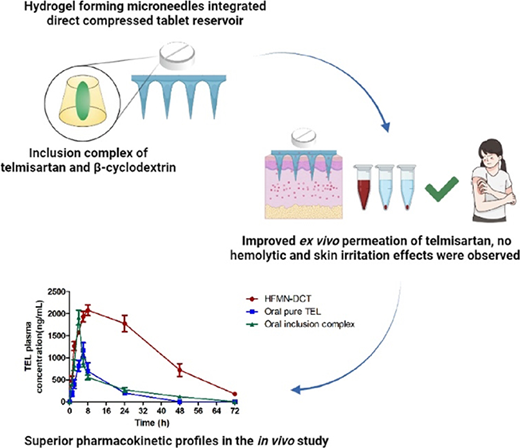
So, how does the system work? The researchers used biocompatible polymers, including polyvinylpyrrolidone (PVP) and polyvinyl alcohol (PVA), to create hydrogel-forming microneedles. When applied to the skin, the needles absorb fluid from the skin and swell, forming a pathway that allows telmisartan to move from a drug reservoir into the skin and eventually toward the bloodstream.
The researchers also addressed telmisartan’s poor solubility using β-cyclodextrin. Think of cyclodextrin as a tiny molecular “carrier” with an inner cavity that can accommodate poorly water-soluble drugs. The study found that a telmisartan-to-β-cyclodextrin ratio of 1:4 produced the greatest improvement in solubility, while the inclusion complex increased telmisartan release by up to 20 times in laboratory testing.
The results became even more interesting when the complete system was tested. The optimized microneedle–reservoir combination achieved approximately 83.28% telmisartan permeation through rat skin in an ex vivo study. In living rats, the system produced a higher maximum blood concentration and a much greater overall drug exposure than oral pure telmisartan. The measured AUC reached 82,928.01 h·ng/mL, compared with 12,569.90 h·ng/mL for the oral pure drug.
These findings support SDG 3: Good Health and Well-Being by showing how biomaterials and innovative drug-delivery technology could potentially make long-term hypertension treatment more effective and convenient. However, the researchers emphasize that further toxicity and pharmacodynamic studies are still needed before this technology can be considered for clinical use.