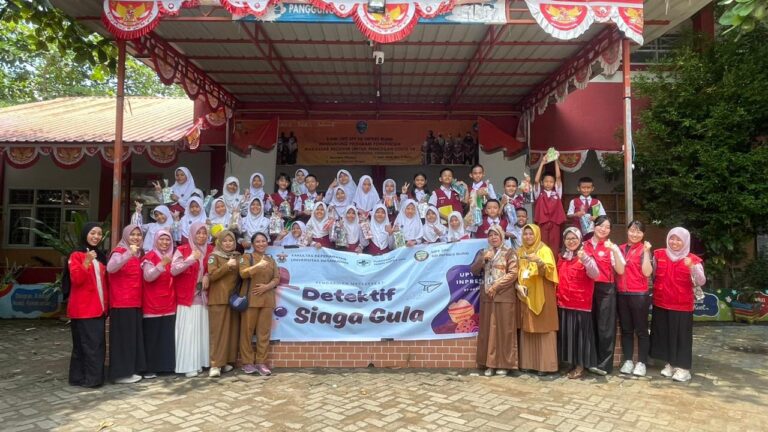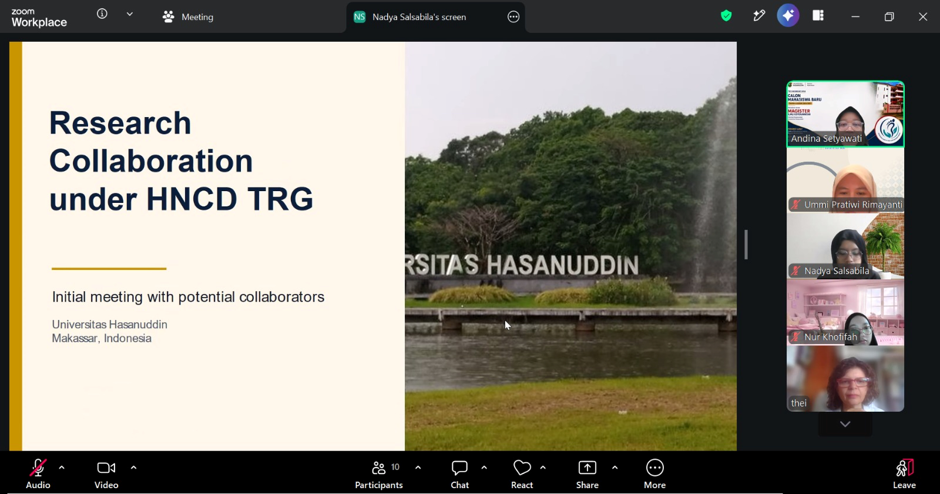
Makassar – The Holistic Nursing for Chronic Diseases Research Group (HNCD TRG), Faculty of Nursing, Universitas Hasanuddin, successfully organized the Dissemination and Alignment of Perspectives on Joint TRG Publications on 22 July 2026 through a Zoom Meeting. The activity brought together 10 participants, consisting of three international partners, four lecturers, and three students, to strengthen global research collaboration, scientific publication, and future multicountry research initiatives. Conducted in an open and collaborative academic environment, the meeting aimed to establish a shared understanding of the scope, mechanisms, and expected contributions of each participant in joint research and publication activities.
At the beginning of the session, the Universitas Hasanuddin team introduced HNCD TRG as the academic umbrella for the collaboration. Chaired by Prof. Dr. Elly L. Sjattar, HNCD TRG serves as a research platform dedicated to advancing evidence-based nursing research, particularly in chronic disease management, while promoting sustainable international academic partnerships. The discussion emphasized that collaborative activities should extend beyond producing scientific publications to building a long-term international research network capable of generating impactful research and competitive international grant opportunities.
The research team presented several priority research themes with strong potential for collaborative publications, including diabetes self-management, the utilization of culturally based functional foods, the safety of combining functional foods with diabetes medications, and the development of culturally sensitive research instruments. Several ongoing manuscripts were also introduced as the foundation for future collaborative work. These included a scoping review on culturally based functional food utilization in diabetes self-management and a qualitative study exploring the relationships among rice consumption, culture, natural foods, family influence, and glycaemic control among patients with type 2 diabetes mellitus. These presentations stimulated productive discussions on conceptual frameworks, behavioural science approaches, research methodology, and opportunities to expand the studies into multicountry collaborations.
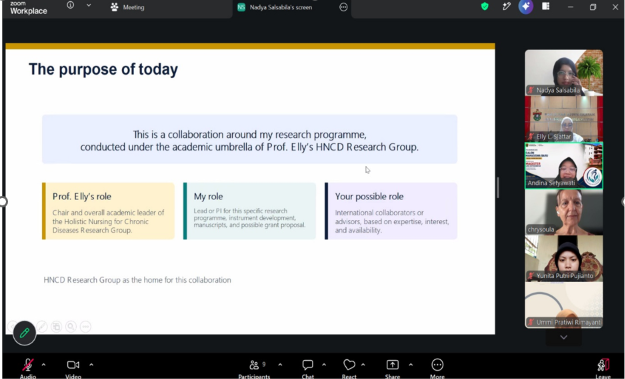
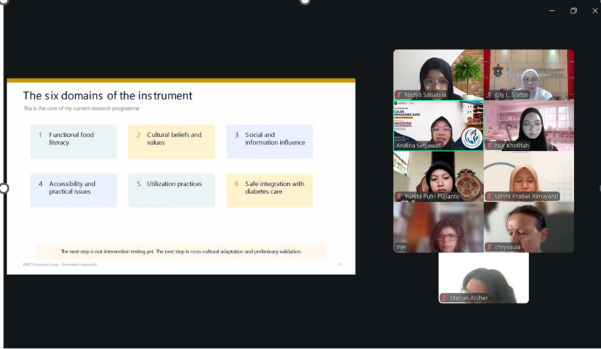
Valuable contributions were provided by Prof. Chrysoula Tsiou and Dr. Maria Kitsou from the University of West Attica, Greece, together with Marian Archer, RGN, INP, MSc-ACP, from St George’s, University of London, United Kingdom. Drawing upon their respective expertise, they shared recommendations on strengthening conceptual frameworks, cross-cultural interpretation, behaviour-change approaches, manuscript review, instrument development, and scientific writing to enhance the quality and international visibility of future publications. The participants also discussed plans for cross-cultural adaptation and preliminary validation of research instruments across several countries while exploring opportunities to jointly prepare competitive international research grant proposals.
Student engagement formed another important component of the activity. Nadya Salsabila, Nur Khofifa, and Yunita Putri Pujianto actively participated in discussions and were introduced to various stages of international collaborative research, including literature searching, reference management, manuscript preparation, research documentation, and academic communication. Their participation reflects HNCD TRG’s commitment to nurturing future researchers with the competencies required for international scientific collaboration and high-quality scholarly publications.
The meeting concluded with a shared commitment to continue communication through transparent co-authorship, regular online meetings, collaborative manuscript development, and the preparation of international research proposals. The participants also agreed to define clear roles and responsibilities according to each member’s expertise to ensure meaningful intellectual contributions in future collaborative projects. This initiative represents an important milestone in establishing a sustainable international research network under HNCD TRG while strengthening Universitas Hasanuddin’s contribution to global health research. Furthermore, the activity supports the United Nations Sustainable Development Goals (SDGs), particularly SDG 1 (No Poverty) by promoting research that addresses the socioeconomic burden of chronic diseases, SDG 4 (Quality Education) through research capacity building and student engagement, and SDG 17 (Partnerships for the Goals) by fostering sustainable international collaboration, knowledge exchange, and joint scientific innovation.