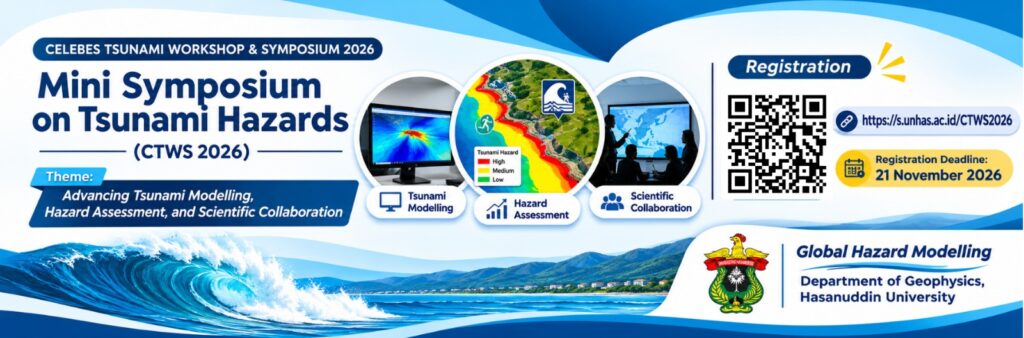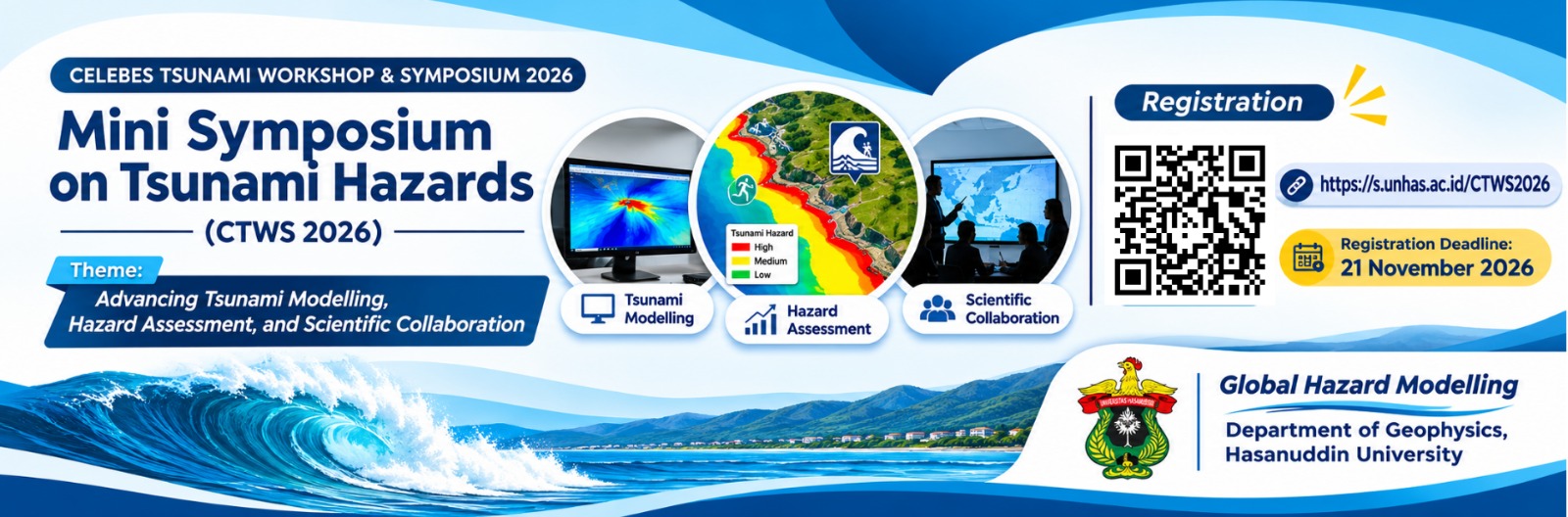

Makassar, 18 November-The Global Hazard Modelling (GLOHAMOD) Research Group, in collaboration with the Department of Geophysics, Faculty of Mathematics and Natural Sciences (FMIPA), Hasanuddin University, will organise the Celebes Tsunami Workshop & Symposium (CTWS) 2026 from 25 to 27 November 2026.
With the theme “Advancing Tsunami Modelling, Hazard Assessment, and Scientific Collaboration,” CTWS 2026 aims to enhance technical expertise in numerical tsunami modelling, encourage the exchange of scientific knowledge, and foster research partnerships in tsunami hazard assessment and disaster risk reduction.
The three-day event will comprise two main activities: the Workshop on Tsunami Modelling with JAGURS, taking place from 25 to 27 November 2026, and the Mini Symposium on Tsunami Hazards, scheduled for Friday, 27 November 2026.
Tsunami Modelling Workshop Led by Researcher from Singapore
The workshop will feature Ignatius Ryan Pranantyo, Ph.D., a research fellow at the Earth Observatory of Singapore (EOS), Nanyang Technological University (NTU), Singapore, as the main instructor.
Focusing on numerical tsunami modelling using JAGURS (Jointly Advanced Model for Tsunami Simulation), the workshop will combine fundamental theoretical concepts with practical modelling applications. Participants will explore tsunami simulation techniques through lectures, hands-on exercises, and evaluation sessions designed to strengthen their understanding of numerical modelling approaches.
Participation in the workshop is limited to Hasanuddin University’s academic community. The training is intended to develop practical modelling skills and support ongoing and future research on tsunami generation, propagation, and associated hazards.
Mini Symposium on Tsunami Hazards Welcomes Presenters and Participants
Alongside the technical workshop, GLOHAMOD Research Group and the Department of Geophysics will host the Mini Symposium on Tsunami Hazards on Friday, 27 November 2026, starting at 13:30 Central Indonesia Time (WITA), at the Senate Meeting Room, SB Building, 1st Floor, FMIPA, Hasanuddin University.
Unlike the internal workshop, the symposium is open to academics, researchers, students, and representatives of government agencies and other institutions involved in tsunami research and disaster risk reduction.
The symposium welcomes participation in two categories: presenters, who will share research findings or scientific studies, and non-presenting participants, who will attend presentations and engage in scientific discussions.
Scientific contributions may address a broad range of tsunami-related topics, including numerical modelling, tsunami source mechanisms, hazard assessment, coastal inundation, mitigation approaches, and disaster risk reduction.
Each presenter will have a maximum of 15 minutes, comprising a 10-minute presentation and a five-minute question-and-answer session. Registration for both presenters and non-presenting participants is open until 21 November 2026 through the following link: https://s.unhas.ac.id/CTWS2026. Presenters are required to submit an abstract of no more than 250 words through the registration form.
Promoting Research Exchange and Future Collaboration
CTWS 2026 is designed not only as a technical training programme but also as a forum for exchanging research findings, discussing emerging scientific challenges, and identifying opportunities for collaboration in tsunami hazard studies.
The mini symposium will conclude with an interactive discussion focused on potential research partnerships, particularly in numerical tsunami modelling, hazard assessment, and disaster mitigation.
Through this initiative, GLOHAMOD Research Group and the Department of Geophysics at Hasanuddin University seek to strengthen their contributions to tsunami research while expanding scientific networks with researchers and institutions at national and international levels. The event is also expected to provide a valuable opportunity for students and early-career researchers to interact with experienced scientists, exchange perspectives, and explore new research directions that contribute to improving tsunami hazard understanding and disaster resilience in Indonesia and the wider region.