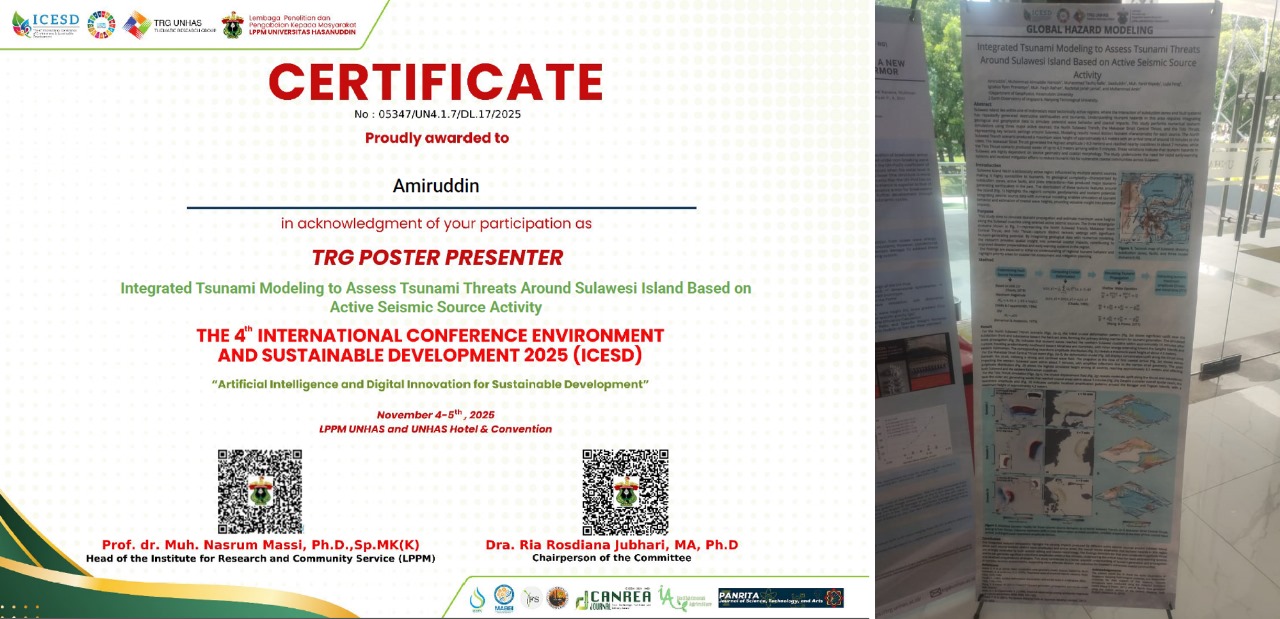

The TRG Global Hazard Modelling (GLOHAMOD) team actively contributed to global disaster research through its participation in The 4th International Conference on Environment and Sustainable Development (ICESD), held at Unhas Hotel, Hasanuddin University, on November 4–5, 2025. This prestigious international event brought together researchers, academics, and practitioners from around the world to discuss sustainability challenges and environmental risk assessments at regional and global levels.
During the conference, TRG GLOHAMOD presented a scientific poster entitled “Integrated Tsunami Modeling to Assess Tsunami Threats Around Sulawesi Island Based on Active Seismic Source Activity.” The study, falling under the scope of environmental risk assessment, emphasizes the importance of integrating seismic data, fault characteristics, and wave propagation models to understand potential tsunami hazards.
The research employed comprehensive numerical modeling techniques, incorporating the latest seismic data, active fault characteristics, and wave propagation dynamics, to provide accurate hazard estimations. The results demonstrated the vulnerability of Sulawesi’s coastal regions, offering critical insights for early warning systems, spatial planning, and disaster mitigation strategies. These findings underscore Hasanuddin University’s commitment to advancing research that supports sustainable communities, aligning with SDG 4 (Quality Education) by disseminating knowledge to the global academic community and SDG 17 (Partnerships for the Goals) through international collaborations.
The conference attracted participation from 150+ international delegates, including scholars, practitioners, and students from multiple countries, fostering valuable exchanges and potential future collaborations. The TRG team’s engagement at ICESD 2025 highlights the role of Hasanuddin University in building global partnerships and promoting scientific solutions for sustainable development and disaster resilience.
By presenting this cutting-edge research, the TRG GLOHAMOD team reinforced its role in global hazard modelling and contributed to the ongoing development of scientific knowledge critical to climate adaptation and disaster preparedness. The active involvement of international collaborators and student participants reflects a practical embodiment of SDG 4 and SDG 17, while creating opportunities for future joint research and technology transfer.
Overall, the participation of TRG GLOHAMOD at ICESD 2025 not only strengthens the visibility of Hasanuddin University in the international research arena but also provides actionable insights for mitigating natural hazards in Indonesia and beyond. This event exemplifies the effective integration of research, education, and international collaboration, in line with Hasanuddin University’s strategic objectives for sustainability and global impact.