

MAKASSAR, Indonesia 12 April 2026/FSRAG/ – Smart Banking Needs Smart Customers: Why Digital Literacy Matters
Banking is becoming faster, easier, and increasingly digital. With just a smartphone, people can transfer money, pay bills, check their balance, and manage their finances without visiting a bank branch. But does having access to digital banking automatically mean everyone can benefit from it? Not necessarily.
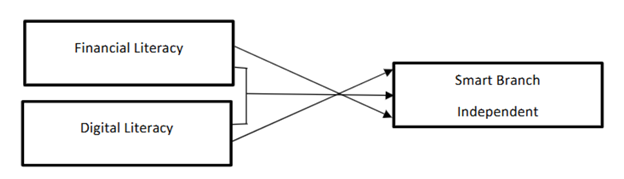
A study by Nahda Alyani Sharfina, Cepi Pahlevi, and Fauzi R. Rahim explores how financial and digital literacy influence people’s readiness to use smart banking services. The research, titled “Analysis Of The Influence Of Financial Literacy And Digital Literacy Of The Community On Smart Branch Mandiri,” was published in the International Journal of Business and Quality Research (IJBQR), Volume 1, Number 3, pages 131–145, by Cita Konsultindo Mandiri on August 4, 2023.
The researchers focused on Bank Mandiri customers in Mamuju, West Sulawesi, and Kendari, Southeast Sulawesi. Their study examined how financial knowledge and digital skills influence customer readiness to interact with smart branch facilities.
Smart branches are designed to connect traditional banking with digital services. Instead of relying entirely on bank tellers, customers can use automated machines and self-service terminals for various banking activities. These technologies can make banking more convenient and efficient. However, technology alone is not enough.
Customers need the knowledge and confidence to use it.
Financial literacy helps people understand money management, budgeting, and financial transactions. Meanwhile, digital literacy allows customers to interact more comfortably with automated banking systems. People with stronger digital skills may be more willing to explore self-service facilities, while those unfamiliar with digital interfaces may feel hesitant or even avoid them.
This creates an important lesson for banks: digital transformation must go hand in hand with customer education.
Smart branches should not only be viewed as places for automated transactions. They can also become learning spaces where customers gradually develop confidence in using digital financial services. With appropriate guidance and support, customers who once depended heavily on conventional banking counters may eventually become more independent digital banking users.
This issue is closely connected to United Nations Sustainable Development Goal 1 (SDG 1): No Poverty, particularly Target 1.4, which promotes equal access to economic resources, financial services, and appropriate technology. Improving financial and digital literacy can help communities participate more actively in the formal financial system and manage their resources more effectively.
The study therefore highlights a simple but powerful idea: financial inclusion is not only about providing technology it is also about ensuring people have the ability to use it.
As Indonesian banking continues to move toward smarter and more automated services, banks, governments, educators, and local communities need to work together. Combining accessible technology with financial and digital education can reduce adoption barriers and ensure that digital transformation benefits a wider part of society.
In the end, the smartest banking system is not necessarily the one with the most advanced technology. It is the one that makes people feel capable, confident, and included.
Reference
DOI: https://doi.org/10.63922/ijbqr.v1i03.436
Contact Info
- Name : Prof. Cepi Pahlevi, S.E., M.Si
- Phone/Mobile : +62 813-4193-6368
- Email : cepipahlevi@fe.unhas.ac.id