

MAKASSAR, Indonesia 22 June 2026/FSRAG/ – Every day, people buy food and drinks without thinking much about the companies behind these products. The food and beverage industry is one of the more resilient parts of the economy because demand for essential consumer products can remain relatively stable even when economic conditions become uncertain. But for these companies, an important question remains: does taking on more debt or increasing operating leverage actually make a company more valuable?
A study by Sun Dewi Putri, Cepi Pahlevi, and Fauzi R. Rahim provides an interesting answer. The research, titled “Effect of Operating Leverage and Financial Leverage on Firm Value through Financial Performance,” was published in Advances in Economics, Business and Management Research, Volume 331, pages 1130–1148, by Atlantis Press, part of Springer Nature, on July 30, 2025.
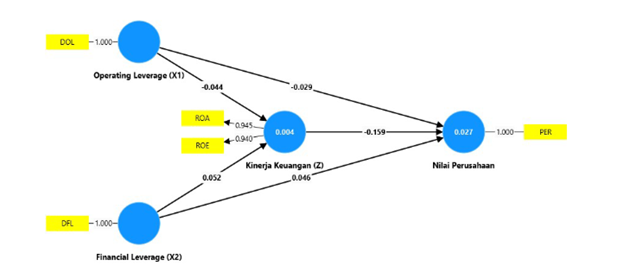
The researchers examined 34 food and beverage companies listed on the Indonesia Stock Exchange (IDX) using 170 audited financial reports covering 2019–2023. They focused on two types of leverage: operating leverage, which relates to how fixed operating costs affect business performance, and financial leverage, which reflects the use of debt to finance a company. They also examined financial performance through Return on Assets (ROA) and Return on Equity (ROE).
The most interesting finding is that profitability matters more than leverage alone.
Financial performance had a positive and statistically significant effect on firm value, with p = 0.009 and t = 2.630. This means companies that can efficiently use their assets and generate sustainable profits are more likely to receive positive attention from investors.
However, operating leverage and financial leverage did not have significant direct effects on financial performance or firm value. Financial performance also did not significantly mediate the relationship between leverage and firm value.
What does this mean in everyday business terms? Simply having more debt does not automatically make a company more valuable. Borrowing can provide additional capital, but if that money does not generate stronger profits, investors may see little reason to increase the company’s valuation.
For food and beverage companies, the lesson is particularly important. Rather than focusing excessively on increasing debt, managers should concentrate on using assets efficiently, controlling operating costs, protecting profit margins, and generating consistent returns.
These findings are also relevant to United Nations Sustainable Development Goal 17 (SDG 17): Partnerships for the Goals, particularly Targets 17.16 and 17.17. Strong financial governance depends on cooperation and transparent communication among companies, investors, financial institutions, regulators, and other stakeholders. Reliable financial information helps these groups make better decisions and build greater trust.
Ultimately, the study offers a simple message: leverage may provide financial power, but profitability creates value. For Indonesia’s food and beverage industry, sustainable earnings, efficient operations, responsible financial management, and transparent governance may be more important for long-term success than simply taking on more debt.
Reference
DOI: 10.2991/978-94-6463-758-8_92
Contact Info
- Name : Prof. Cepi Pahlevi, S.E., M.Si
- Phone/Mobile : +62 813-4193-6368
- Email : cepipahlevi@fe.unhas.ac.id