Makassar, Indonesia 22 April 2026/FCVC/-Rice is the backbone of food security in Indonesia, but climate change is making farming more difficult than ever. Floods and droughts are becoming more frequent, threatening farmers’ livelihoods and national food supply. A recent study shows that strong institutions and smart irrigation systems can help farmers adapt and survive. This article is based on the research titled “Enhancing Sustainability in Rice Farming: Institutional Responses to Floods and Droughts in Pump-Based Irrigation Systems in Wajo District, Indonesia,” published in the journal Sustainability by MDPI on 14 April 2025. The study focuses on how irrigation institutions support farmers in dealing with climate risks.
One major challenge identified in the study is water uncertainty. As explained on page 2, farmers face two extreme conditions: too much water during floods and too little during droughts. These conditions reduce crop yields and increase farming costs. This issue is closely related to SDG 13: Climate Action, which calls for urgent action to combat climate change and its impacts. To respond to these challenges, irrigation service providers (ISPs) play a key role. They manage water distribution using pump-based systems and create flexible payment methods for farmers. For example, as shown in the data on page 8, farmers may pay irrigation fees based on their harvest instead of fixed costs. This system helps share financial risks between farmers and service providers.
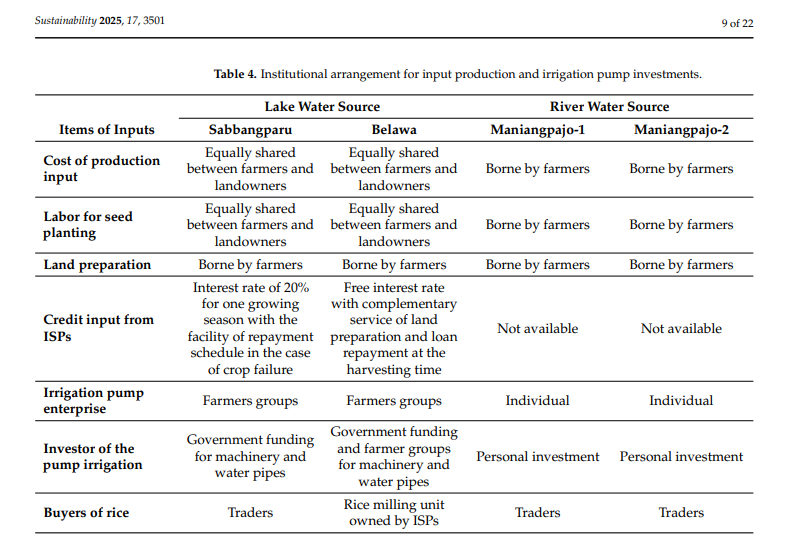
These institutional arrangements also support SDG 1: No Poverty. When farmers face crop failure due to floods or droughts, flexible payment systems and access to credit can prevent them from falling deeper into poverty. In some areas, such as Belawa, farmers even receive interest-free loans for farming inputs (page 9). This reduces financial pressure and allows them to continue farming. In addition, the study highlights how improved irrigation systems contribute to SDG 2: Zero Hunger. Stable water supply ensures that rice production continues even during difficult seasons. According to the findings on page 11, farms with better irrigation access produce higher yields and generate more income. This helps ensure food availability for communities. Strong institutions are at the heart of these solutions. The research emphasizes that clear rules, fair cost-sharing, and cooperation between farmers and service providers are essential for success. This directly supports SDG 16: Peace, Justice, and Strong Institutions, which promotes effective and inclusive governance. Without strong institutions, irrigation systems can fail due to poor management and lack of trust.
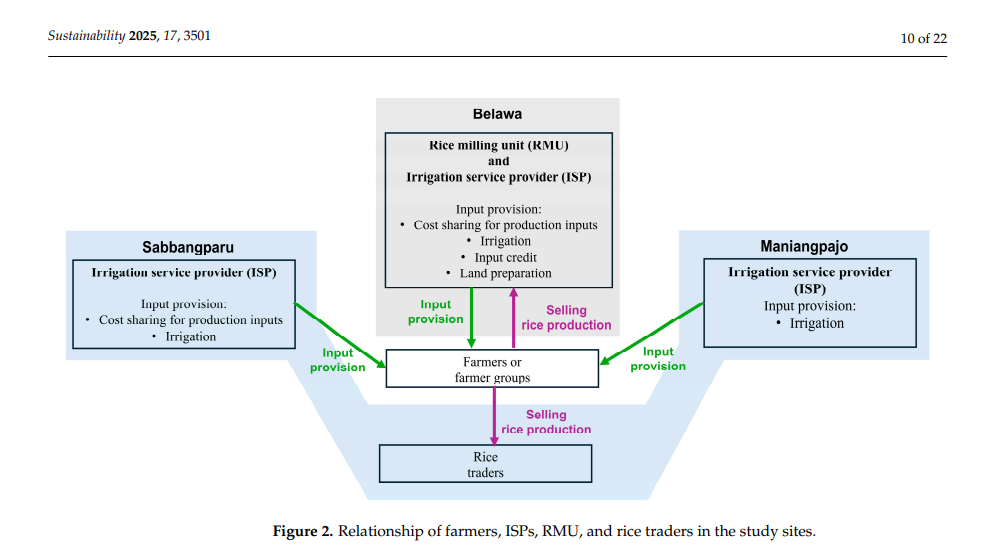
However, the study also reveals challenges. Not all farmers have equal access to financial support or irrigation services. In privately managed systems, farmers often pay higher fees and receive less assistance. This inequality highlights the need for better policies and stronger collaboration between government and private sectors.
In conclusion, climate change is a serious threat to rice farming, but it is not impossible to overcome. By strengthening institutions, improving irrigation systems, and supporting farmers financially, we can build a more resilient agricultural system. Achieving SDG 1, SDG 2, SDG 13, and SDG 16 is not just a global goal—it is a practical path toward ensuring that farmers can thrive and communities can stay fed, even in times of crisis.
Reference:
DOI: https://doi.org/10.3390/su17083501
Contact:
Prof. Rahim Darma
+62 852-5564-6556
rdarma@unhas.ac.id