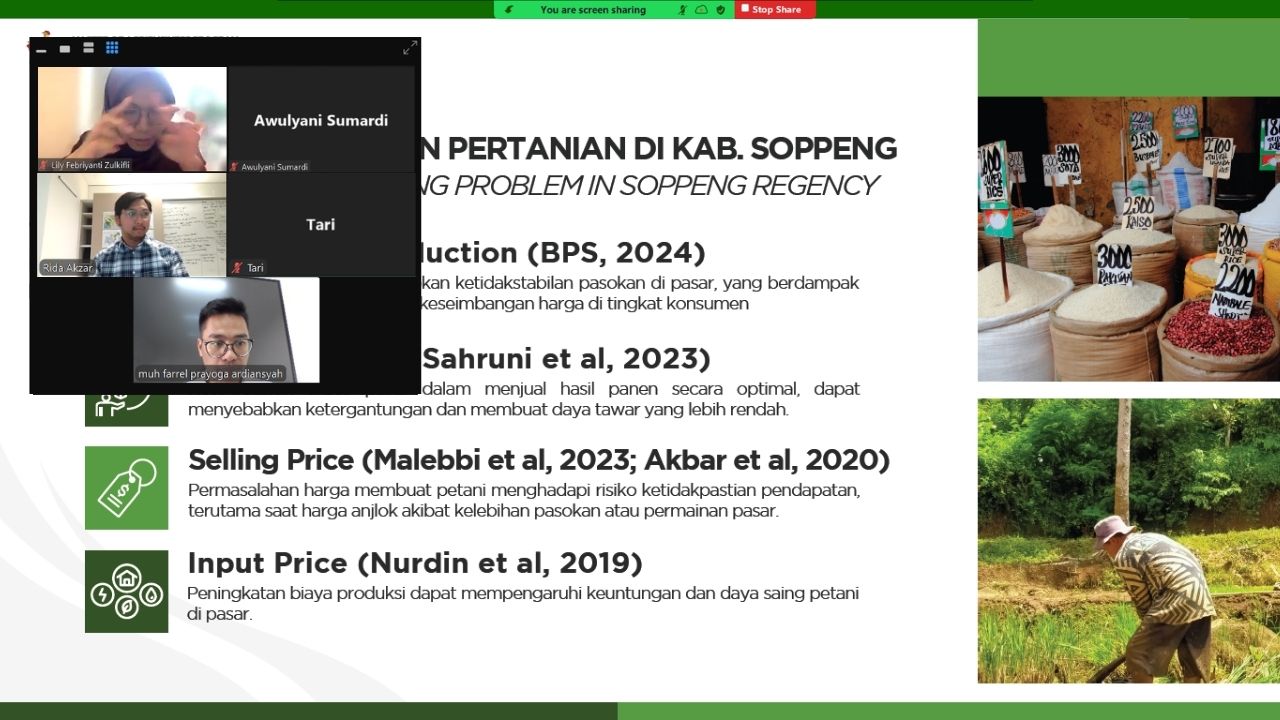

Makassar, Indonesia 12 June 2025/FCVC/–The Food Crops Value Chain Research Group convened an online discussion on the challenges of marketing agricultural products in Soppeng Regency on May 2, 2025, bringing together 8 participants from diverse academic backgrounds. The event served as a collaborative platform for lecturers, students, and an international partner to exchange knowledge and explore potential hypotheses surrounding farmer marketing behavior. Designed to bridge empirical field issues with academic inquiry, the discussion aimed to strengthen research relevance while addressing real-world agricultural marketing constraints. The session was facilitated by Muh. Farrel Prayoga Ardiansyah, who initiated the discussion by presenting a synthesis of marketing challenges based on field observations and secondary data. The discussion included 9 participants including students, researchers, lecturers, and international collaborator. The master students—Lily Febriyanti, Awulyani Sumardi, A. Riani, Asdiana, and Dian Mustika—also shared perspectives related to research design and emerging topics for the academic work.
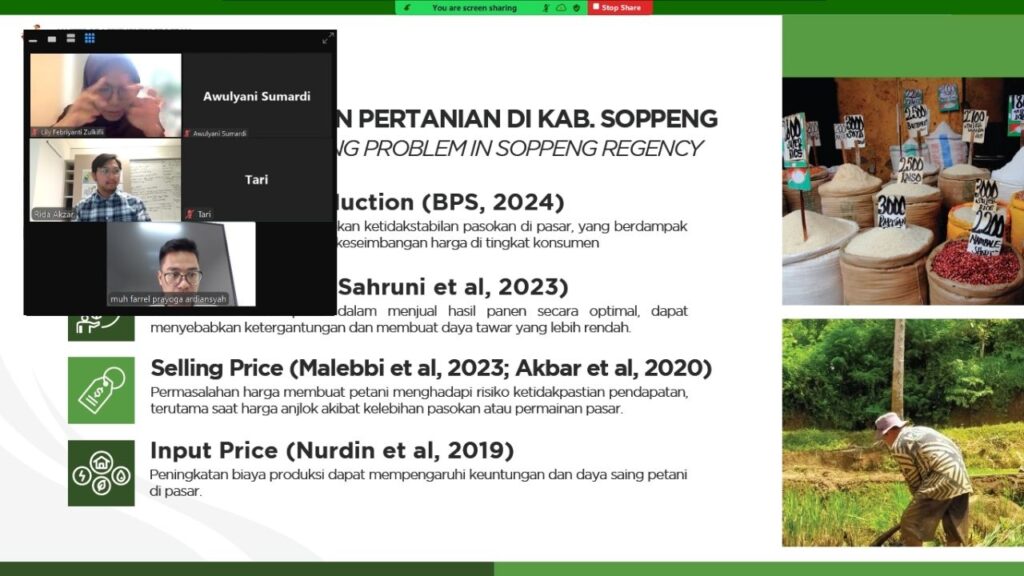
A key highlight of the discussion was the persepctives from Dr. Rida Akzar (The Centre for Global Food and Resources, The University of Adelaide, Australia), who provided valuable international perspectives on agricultural marketing systems. Drawing from cross-country experiences, He emphasized that many challenges faced by farmers such as market dependency and behavioral constraints are also prevalent in other agricultural contexts globally. This comparative lens enriched the discussion and helped position local issues within a broader analytical framework. The discussion explored several core constraints affecting farmer marketing decisions, including unstable selling prices, fluctuating production levels, rising input costs, limited market access, and disparities in market information. Additionally, Muh. Farrel Prayoga Ardiansyah highlighted the role of “embedded services” within farmer–collector trader relationships, where economic transactions are intertwined with social obligations. Dr. Rida Akzar (The Centre for Global Food and Resources, The University of Adelaide, Australia) further elaborated on how social cohesion in rural communities shapes marketing behavior, often influencing decision-making beyond purely economic rationality.

The outcomes of this discussion are expected to serve as a valuable reference for both the research group and student-led research projects. By identifying key determinants of farmer marketing behavior, the session contributes to the development of more robust research frameworks and evidence-based hypotheses. Furthermore, these insights hold potential for informing policy recommendations aimed at improving market access, enhancing farmer bargaining power, and strengthening agricultural value chain performance. This activity is closely linked to broader issues in food systems, agricultural sustainability, and inclusive economic development. It contributes to SDG 1 (No Poverty) by addressing strategies to improve farmers’ income opportunities, SDG 4 (Quality Education) through research-based learning and student engagement, and SDG 17 (Partnerships for the Goals) by fostering international collaboration and knowledge exchange. These linkages highlight the importance of interdisciplinary dialogue in advancing sustainable and equitable agricultural systems.
Looking ahead, the insights generated from this discussion will support the refinement of research agendas, strengthen collaborative networks, and guide the formulation of policy-relevant outputs. By integrating local knowledge with global perspectives, the Food Crops Value Chain Research Group continues to contribute to impactful, evidence-based solutions for agricultural value chain development.