
MAKASSAR, Indonesia June 6 2026/FINRA/ – In today’s business world, profit is no longer measured only by how much money a company earns. People now also want to know how a company treats the environment, supports society, and manages itself responsibly. This is where ESG disclosure becomes important. ESG stands for Environmental, Social, and Governance. In simple terms, it means how openly a company reports its actions related to sustainability, social responsibility, and good corporate management.
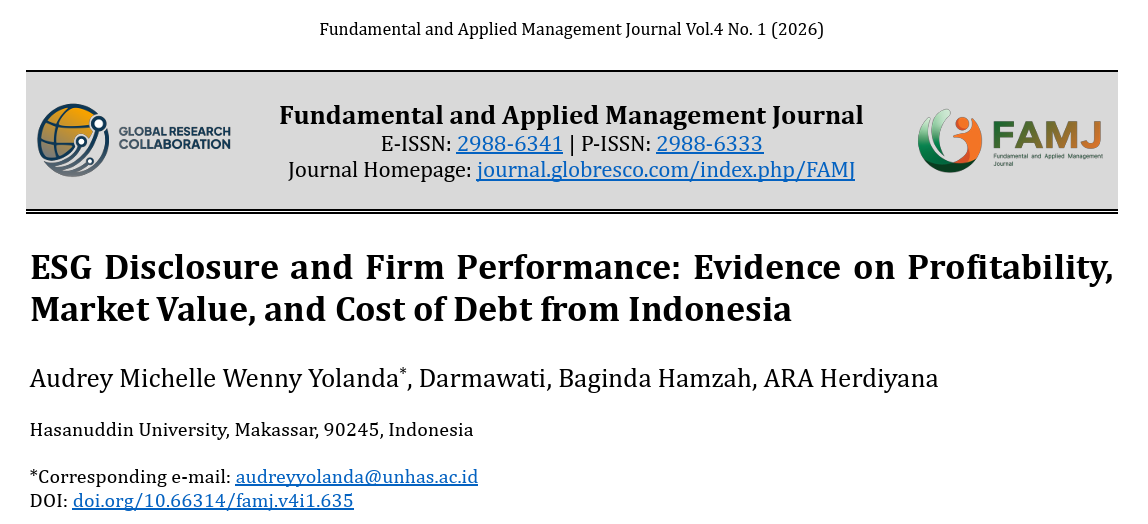
This popular scientific article is based on a published research article titled “ESG Disclosure and Firm Performance: Evidence on Profitability, Market Value, and Cost of Debt from Indonesia.” The article was published in the Fundamental and Applied Management Journal, issued by Global Research Collaboration, in Vol. 4 No. 1, 2026. The article shows that it was received on 25 January 2026, revised on 21 March 2026, and accepted on 25 March 2026. The study was conducted by Audrey Michelle Wenny Yolanda, Darmawati, Baginda Hamzah, and ARA Herdiyana from Hasanuddin University.
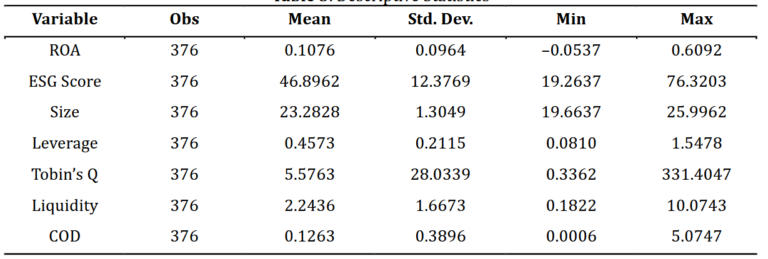
The study examined Indonesian non-financial companies listed in the Kompas100 Index from 2017 to 2023. It used 376 firm-year observations from 61 companies. The main question was simple but important: does ESG disclosure help companies perform better financially? The researchers looked at three things: profitability, market value, and cost of debt.
The findings are interesting. ESG disclosure has a positive and significant effect on profitability. This means that companies that are more transparent about their environmental, social, and governance activities tend to perform better internally. Why? Because transparency can improve trust, reduce business risks, strengthen management control, and help companies use their resources more efficiently. In other words, ESG reporting is not just a formal document. It can become a tool for better business decisions.
However, the study also found that ESG disclosure does not yet strongly influence market value and borrowing costs in Indonesia. Investors and lenders may still focus more on traditional financial information, such as profit, assets, debt, and cash flow. This shows that ESG awareness in Indonesia’s financial market is growing, but it has not been fully integrated into investment and credit decisions.
This finding is closely related to SDG 17: Partnerships for the Goals. Strong ESG disclosure requires cooperation among companies, investors, regulators, creditors, and society. When all parties use sustainability information seriously, business decisions can become more responsible and future-oriented. It is also connected to SDG 15: Life on Land, because environmental disclosure encourages companies to report how their operations affect nature and ecosystems.
The main lesson is clear: transparency creates value. Indonesian companies should not see ESG disclosure only as an obligation. It should be treated as a strategic way to build trust, improve performance, and support sustainable development. At the same time, investors, banks, and regulators need to make ESG information more meaningful in financial decision-making. When transparency is rewarded, responsible business becomes not only good for society, but also good for profit.
Source: