
What would you do if your job was to question decisions made by the people who manage your workplace? That is the uncomfortable position of many internal auditors. They help companies check whether operations are properly controlled, yet they work closely with managers whose decisions they may need to challenge. Independence, it turns out, is not always as simple as a rule in a handbook.
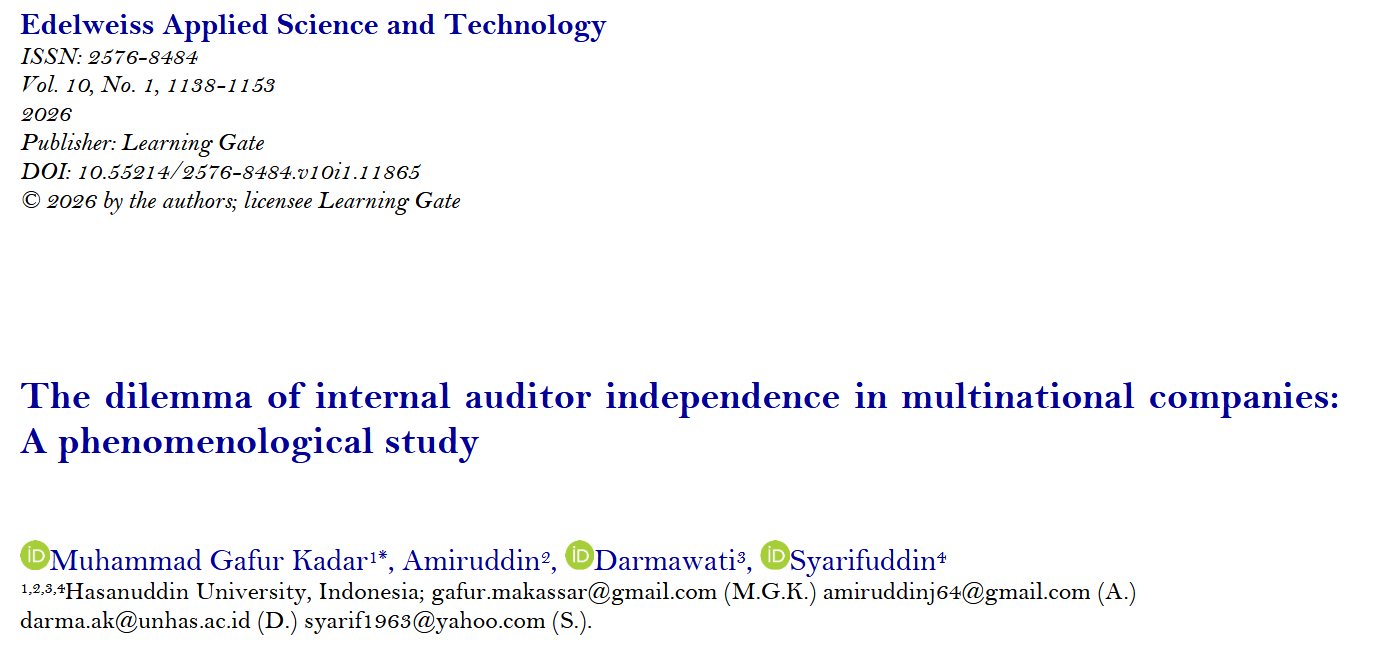
In the article “The dilemma of internal auditor independence in multinational companies: A phenomenological study,” Muhammad Gafur Kadar, Amiruddin, Darmawati, and Syarifuddin explore this tension. The research appeared in Edelweiss Applied Science and Technology, published by Learning Gate on 23 January 2026. Through interviews with auditors and managers at a multinational company operating in Makassar, Indonesia, the researchers examined how professionals experience pressure and preserve their judgment.
The setting makes the dilemma easy to understand. Auditors had a reporting relationship with an audit function in Singapore, helping protect their independence. But their daily work still depended on cooperation with local managers in Indonesia. How could they challenge a decision without losing access to the information needed to do their jobs?
The findings point to three connected skills. First, language matters: auditors often use careful, respectful words to explain difficult findings without hiding the facts. Second, power matters: they negotiate with managers who control budgets and operational decisions. Third, professional values matter: auditors maintain credibility by following ethical standards and keeping procedures up to date. Together, these show that independence requires ongoing judgment, not simply distance from management.
One example illustrates the difference between surrendering and finding a workable solution. When a recommendation to add staff was rejected because of cost, auditors explored alternatives, including security cameras and written logbooks. The goal was still to strengthen oversight. Flexibility in how to solve a problem did not necessarily mean abandoning the problem itself.
This insight connects with Sustainable Development Goal 4 (SDG 4: Quality Education). Learning does not end with a professional certificate. Auditors may need continuing education in ethical decision-making, communication, changing technology, and working across cultures. The study specifically recommends strengthening reflective skills and cross-cultural ethics training. Such learning can help professionals explain concerns clearly while holding on to their principles.
Importantly, this was a qualitative study of experiences in one company. It did not establish that particular training programmes prevent fraud or that every multinational company faces identical pressures. Its value lies in showing what independence feels like when workplace relationships, rules, and responsibilities collide.
For organizations, the message is practical: protect clear reporting lines, encourage honest discussions, and support staff who raise uncomfortable questions. For auditors, courage does not always mean speaking loudly. Sometimes it means telling the truth carefully, keeping the evidence intact, and refusing to let professional judgment disappear behind politeness.
Source Reference
Kadar, M. G., Amiruddin, Darmawati, & Syarifuddin. (2026). The dilemma of internal auditor independence in multinational companies: A phenomenological study. Edelweiss Applied Science and Technology, 10(1), 1138–1153. https://doi.org/10.55214/2576-8484.v10i1.11865