
A company promises to protect nature, treat workers fairly, and run its business responsibly. Does telling the public about those promises make the company more successful? In Indonesia, new research suggests that openness about sustainability is linked to healthier profits—but the stock market and lenders are not necessarily impressed.
The study, “ESG Disclosure and Firm Performance: Evidence on Profitability, Market Value, and Cost of Debt from Indonesia,” was written by Audrey Michelle Wenny Yolanda, Darmawati, Baginda Hamzah, and Andi Raina Ananda Herdiyana. It was published online on 30 March 2026 in the Fundamental and Applied Management Journal, issued by Global Research Collaboration. The researchers asked whether reporting on environmental, social, and governance issues—known as ESG—makes a measurable difference to companies’ finances.
Think of ESG reporting as a company showing its homework. The environmental part covers matters such as resource use and environmental responsibility. The social part concerns people, while governance covers how decisions are made and monitored. Sharing this information gives outsiders a clearer picture of corporate priorities. But reporting an action is not the same as proving that it helped the environment.
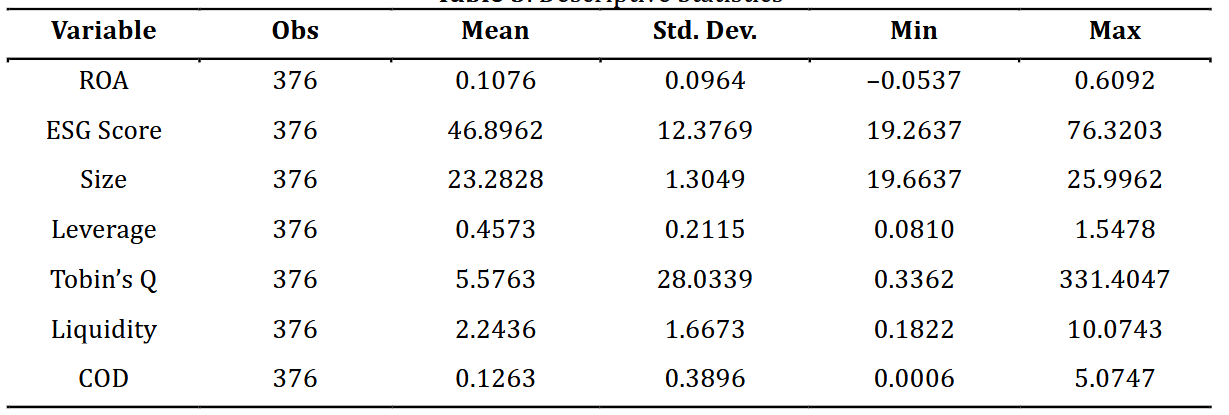
The researchers studied 61 non-financial companies from Indonesia’s Kompas100 stock index, using 376 company-year observations between 2017 and 2023. They examined three financial outcomes: profitability, market value, and borrowing costs.
The clearest result concerned profitability. Companies with more extensive ESG disclosure tended to report stronger profits relative to their assets. The authors suggest that clearer reporting may go hand in hand with improved planning, risk management, and operational efficiency. However, the analysis cannot prove that publishing ESG information caused profits to rise; successful businesses may simply have more resources to prepare detailed reports.
The picture was less clear outside the company. The link between ESG disclosure and stock-market value was positive but varied across statistical models. Meanwhile, no reliable relationship appeared between greater disclosure and cheaper borrowing. Investors and banks may still place greater weight on traditional financial figures than on sustainability information.
These findings offer a useful connection to Sustainable Development Goal 15 (SDG 15: Life on Land), which calls for protecting land ecosystems and biodiversity. Businesses can contribute by taking environmental impacts seriously and reporting them openly. Yet this study did not measure forest protection, biodiversity, or actual ecological improvements. Its SDG 15 relevance is therefore a practical implication, not an environmental result.
For the public, the lesson is to ask two questions, not one: What does a company disclose, and what has it actually achieved? For businesses, sustainability reports should be a starting point for better decisions, not just a polished document. And for investors and lenders, looking beyond short-term financial numbers could encourage more informed assessments.
Being transparent may support stronger business performance. The harder challenge is making sure the story told in a report matches what happens in the real world.
Source Reference
Yolanda, A. M. W., Darmawati, Hamzah, B., & Herdiyana, A. R. A. (2026). ESG disclosure and firm performance: Evidence on profitability, market value, and cost of debt from Indonesia. Fundamental and Applied Management Journal, 4(1), 158–172. https://doi.org/10.66314/famj.v4i1.635