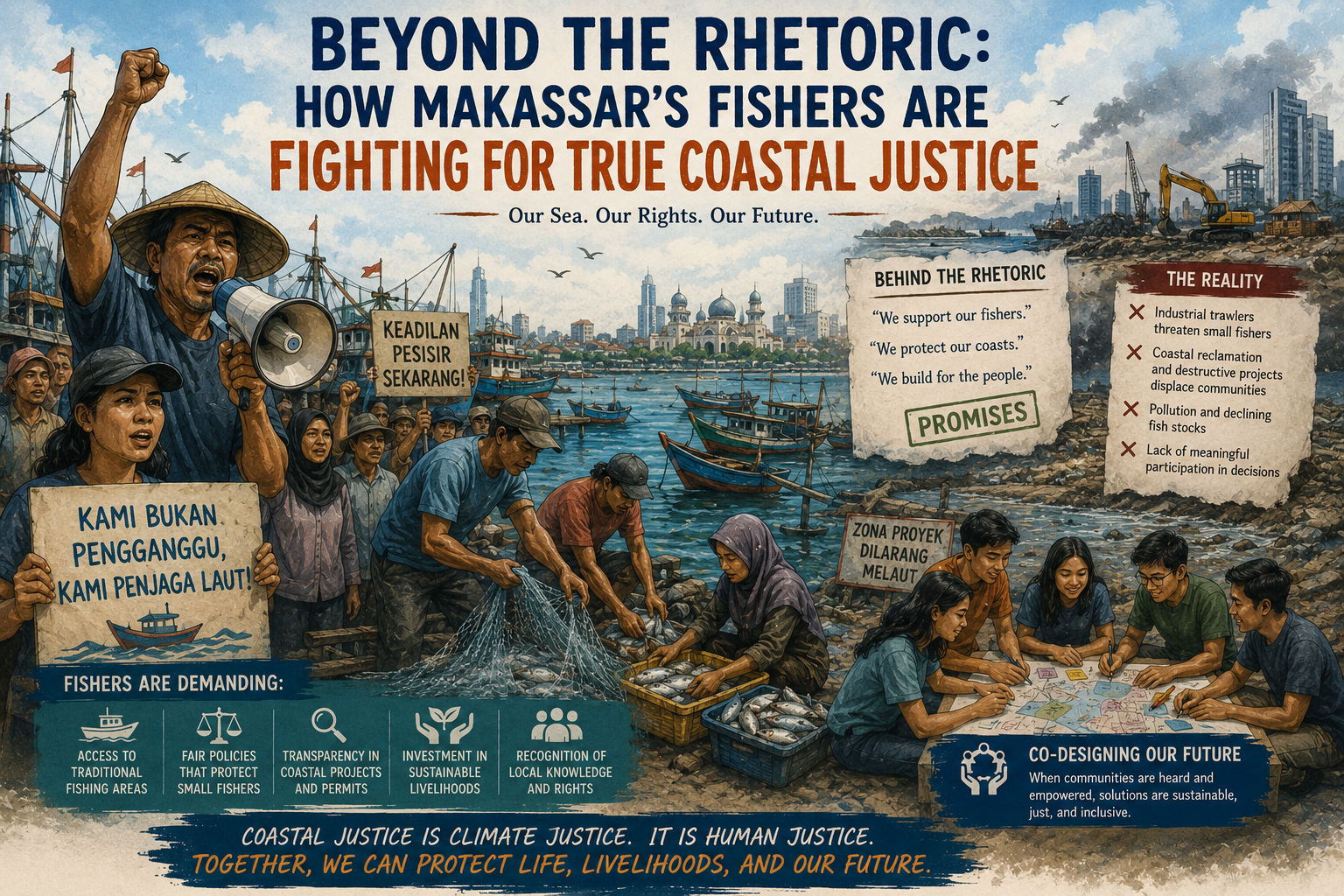

Makassar/Indonesia/13-03-2026/PCD-RG —– Along the vibrant waterfront of Makassar City, rapid urban expansion and massive land reclamation projects are dramatically altering both the physical coastal landscape and the daily lives of local communities. This critical socio-ecological dynamic is explored in-depth by researchers Nailah Zayyan and Amril Hans in their publication titled “Between Symbolism and Substance: Rethinking Participatory Governance in Makassar’s Coastal Areas.” Published on March 13, 2026, by Atlantis Press in the proceedings of the World Conference on Governance and Social Sciences 2025 (WCGSS 2025), the research uncovers how top-down spatial planning policies frequently prioritize commercial economic growth at the expense of social justice and environmental sustainability.
Major mega-infrastructure initiatives, such as the Center Point of Indonesia (CPI) project and the ongoing shoreline reclamation around Lae-Lae Island, have transformed traditional waters into prime real estate and commercial zones. However, this rapid economic expansion comes at a heavy cost to vulnerable coastal residents. Artisanal fishers in historic coastal neighborhoods like Lae-Lae, Cambaya, and Buloa report severe declines of 30% to 40% in their daily fish catches. Shrinking fishing grounds, severe shoreline abrasion, and accelerating coastal sedimentation are destroying the fragile marine environment that has sustained generations of local families.
This escalating environmental breakdown directly threatens SDG 14: Life Below Water, an international goal dedicated to conserving oceans, seas, and marine resources for sustainable development. Although government authorities formally include public participation in planning documents, the study demonstrates that community involvement is largely symbolic. Drawing on Arnstein’s ladder of citizen participation, public forums operate mainly as administrative formalities or one-way policy announcements. With over 60% of meeting participants consisting of government officials and corporate consultants, traditional fishers remain effectively excluded from genuine decision-making processes.
Faced with persistent structural exclusion, coastal residents are actively resisting passive displacement. The study highlights an emerging model termed “collaborative-resistance governance,” where communities combine strategic negotiation with grassroots advocacy. Mobilized by civil society groups like the Save the Coast Alliance and active local women’s fisher collectives, residents organize participatory mapping projects and public campaigns. Crucially, this resistance is fueled by the indigenous Bugis-Makassar philosophy of siri’ na pacce—a deeply held cultural values system centered on human dignity, shared honor, and collective empathy.
Ultimately, achieving sustainable coastal management requires moving far beyond tokenistic consultations and elite corporate interests. True sustainability demands a fundamental shift toward authentic collaborative governance that integrates indigenous wisdom, protects traditional livelihoods, and empowers marginal voices. Rebalancing power asymmetries between the state, private developers, and local citizens is essential to resolving urban coastal conflicts. Only when coastal communities are recognized as equal partners can Makassar realize a truly just, resilient, and sustainable maritime future.
Reference:
DOI: 10.2991/978-2-38476-545-4_105
Contact:
Prof. Dwia Aries Tina Pulubuhu
+62 87856272912 (PCD-RG)
dwiatn@unhas.ac.id