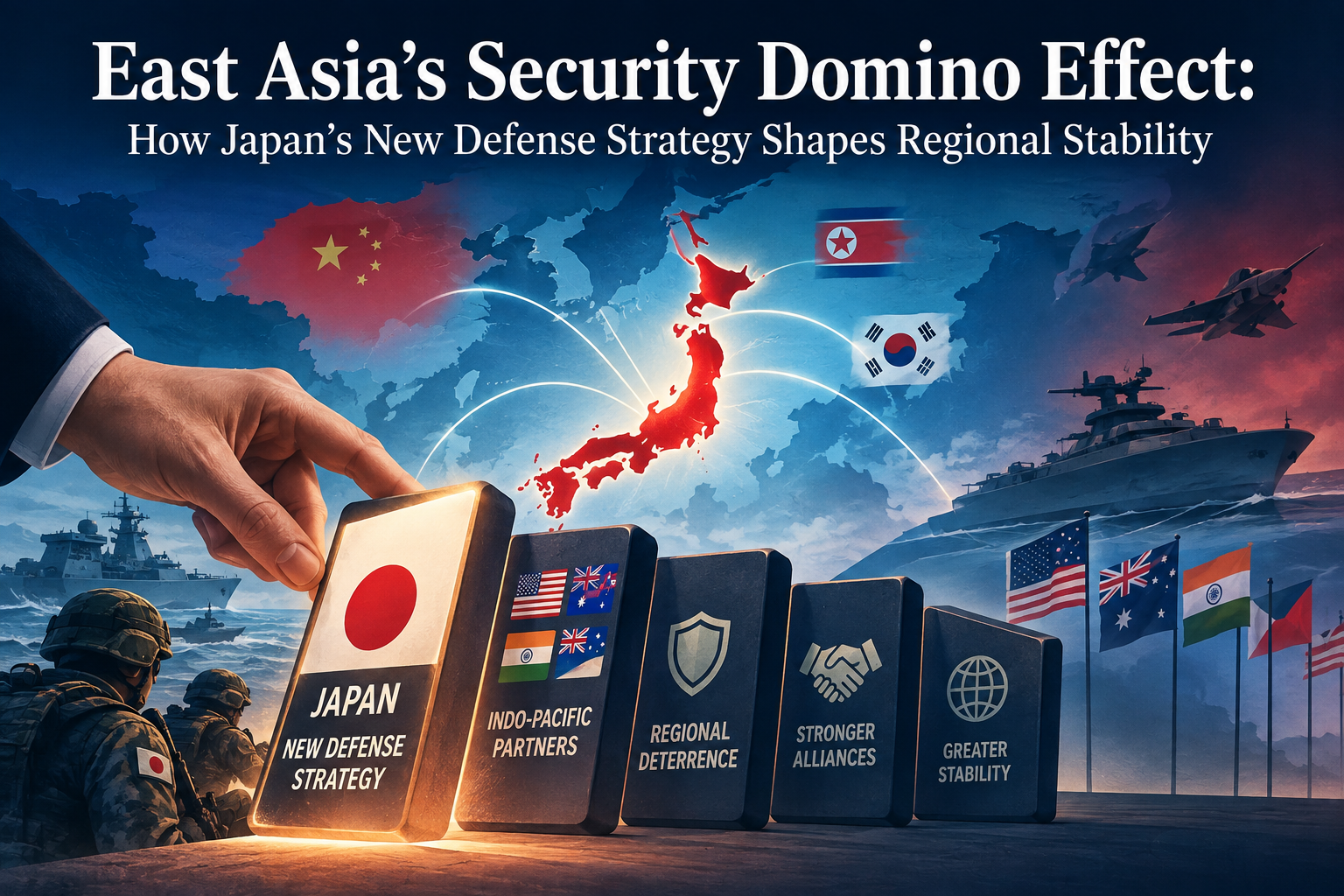

Makassar/Indonesia/08-21-2025/PCD-RG —– East Asia has long been a vibrant hub of economic growth and technological innovation, yet beneath this prosperous surface lies a fragile web of security tensions. In recent years, growing territorial disputes, missile tests, and shifting superpower rivalries have pushed the region into a delicate balance. When one nation takes a significant step to bolster its military defense, its neighbors naturally react with suspicion, triggering a classic “security dilemma”. To make sense of this shifting environment, international relations scholars have closely analyzed how Japan’s recent defense transformation is sending profound shockwaves across neighboring countries like China, North Korea, and Russia.
A comprehensive academic study detailing this complex phenomenon is titled The Influence of Japan’s Transformational National Security Strategy on East Asian Regional Security, published in the Journal of Peace, Security and Democracy by the Center for Peace, Conflict, and Democracy Universitas Hasanuddin on August 21, 2025. The research explores Japan’s landmark 2022 policy pivot under Prime Minister Fumio Kishida. By updating three fundamental national security documents, Japan committed to nearly doubling its defense spending to two percent of its national gross domestic product (GDP) and acquiring advanced counterstrike capabilities. While Tokyo maintains that these measures are purely defensive actions designed to safeguard national sovereignty, the study reveals how nearby nations perceive them as a troubling shift toward a far more proactive military stance.
This strategic overhaul triggered immediate and assertive counteractions throughout the region. China responded by accelerating its overall military modernization, expanding naval patrols around the disputed Senkaku Islands, and conducting large-scale military drills near the Taiwan Strait. North Korea doubled down on its aggressive defense posture, intensifying missile test launches and reiterating its readiness to deploy tactical nuclear weapons if threatened. Simultaneously, Russia expanded its military infrastructure in the Kuril Islands and deepened strategic cooperation with Beijing through joint naval maneuvers in the Sea of Japan. Consequently, rather than easing tension, Japan’s defense buildup unintentionally fueled regional distrust, sparking a rising arms race among East Asian neighbors.
Addressing these mounting geopolitical friction points is essential not only for regional tranquility, but also for broader global prosperity and development. The need for regional security and cooperative diplomacy aligns directly with SDG 17 (Partnerships for the Goals), which highlights that achieving sustainable global development requires peace, stability, strong international cooperation, and inclusive dialogue. An escalating arms race in East Asia threatens vital maritime trade routes, diverts precious public capital away from social welfare programs, and creates deep diplomatic divides. As the research demonstrates, genuine long-term peace cannot be secured through military competition alone. To break this persistent cycle of fear, leaders across East Asia must commit to transparent communication, multilateral security frameworks, and lasting diplomatic partnerships that foster mutual trust for future generations.
Reference:
DOI: https://doi.org/10.63280/jpsd.v1i2.43491
Contact:
Prof. Dwia Aries Tina Pulubuhu
+62 87856272912 (PCD-RG)
dwiatn@unhas.ac.id