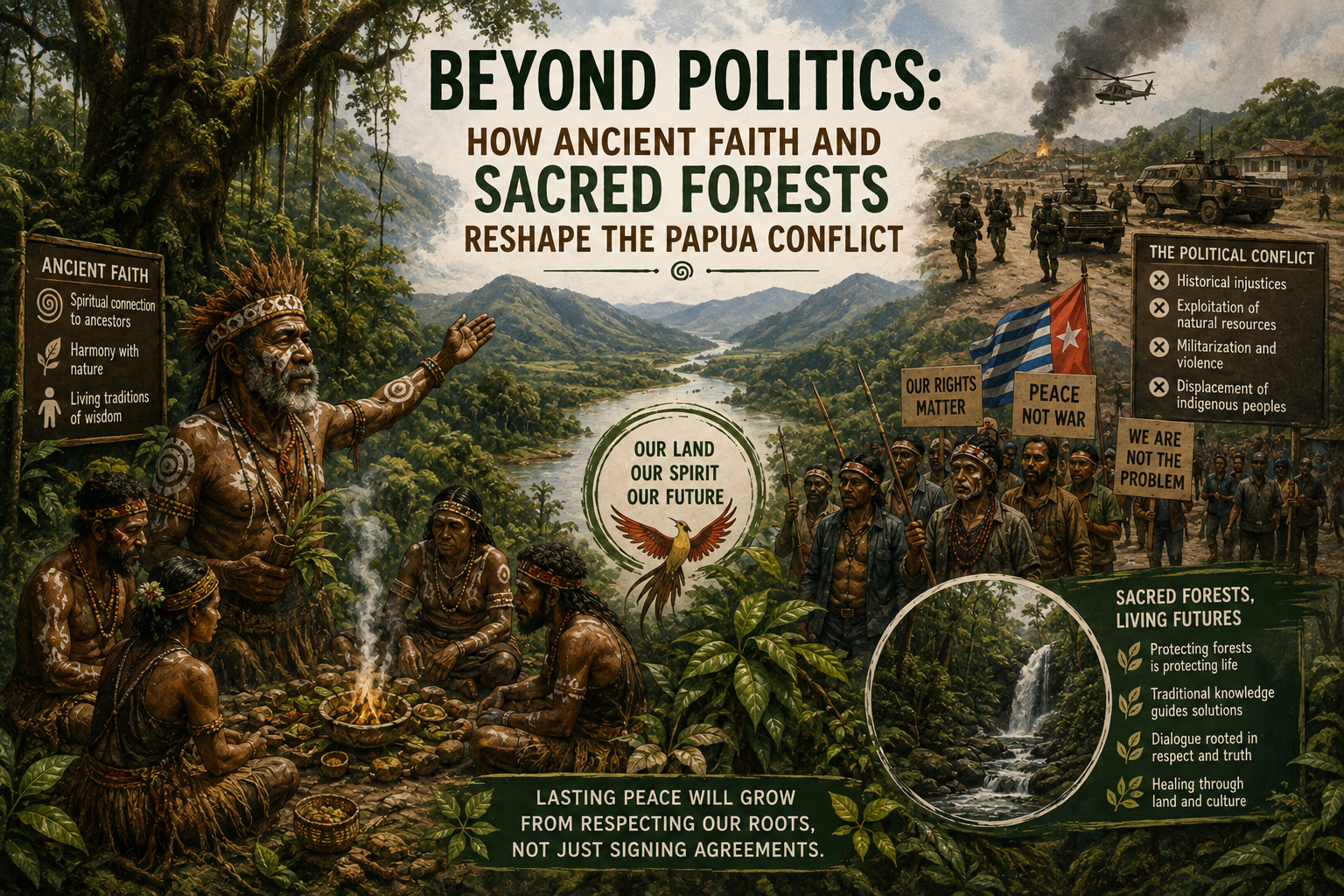

Makassar/Indonesia/31-10-2025/PCD-RG —– When most people hear about the ongoing conflict in Papua, they immediately envision modern political struggles, territorial disputes, human rights issues, and complex military operations. However, the true essence of freedom for indigenous Papuans runs far deeper than conventional geopolitics. Originally, the desire for autonomy was not born in modern legislative halls or political parties, but within sacred rainforests, ancestral rituals, and a profound cosmological connection to the environment. Understanding this unique cultural evolution offers a fresh, human-centered lens on one of Indonesia’s most complex and enduring social challenges.
This fascinating cultural shift is thoroughly analyzed in a milestone scholarly article titled “Transformation of Papuan Independence Values: Looking at the Conflict in Papua through Post-secular Society Perspective”. Published on October 31, 2025, in JSW (Jurnal Sosiologi Walisongo) by the Sociology Laboratory, Faculty of Social and Political Sciences, Walisongo State Islamic University Semarang, this research reveals how indigenous spiritual beliefs transformed into modern political movements. Utilizing expert interviews with tribal elders, religious figures, community leaders, and youth activists across Manokwari and Jayawijaya, the authors demonstrate how sacred traditions—such as the messianic Koreri movement of Biak—underwent a steady process of secularization. Over time, influenced by colonial governance, Christian missionary education, and modern statecraft, these spiritual visions of cosmic harmony were reinterpreted as political symbols demanding state sovereignty.
Crucially, this deep-rooted relationship between indigenous identity and the natural environment aligns seamlessly with SDG 15 (Life on Land), which strives to protect, restore, and promote the sustainable use of terrestrial ecosystems and managed forests. For native Papuans, land and rainforests are far more than economic assets or geographical territories; they represent a sacred ancestral heritage vital to human existence. Traditional definitions of freedom (merdeka) were intrinsically tied to ecological harmony—the fundamental right to live peacefully with nature, manage customary lands, and protect forest livelihoods. When development policies, resource exploitation, or land acquisitions disregard these customary tenure rights, they trigger intense social friction. Therefore, advancing SDG 15 (Life on Land) in Papua demands recognizing indigenous land stewardship, proving that environmental conservation is inseparable from preserving indigenous identity and cultural dignity.
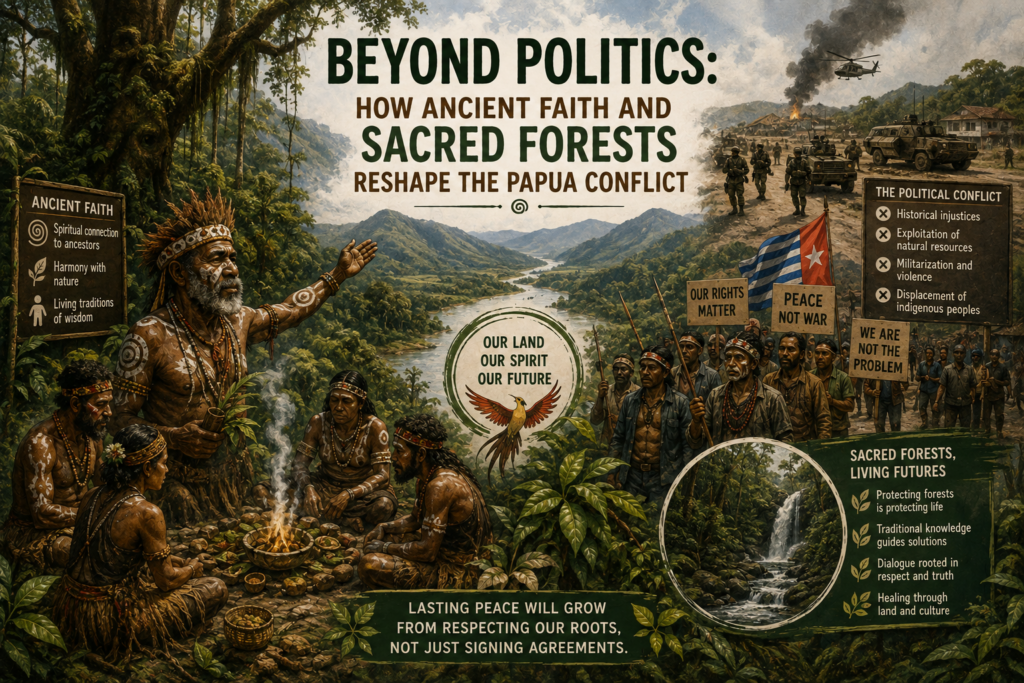
Ultimately, viewing Papuan aspirations through a post-secular perspective proves that lasting peace cannot be achieved through repressive security measures or top-down economic development alone. Applying Jürgen Habermas’s post-secular framework reminds us that religious and cultural identities do not simply disappear in modern times; instead, they continue to shape public discourse and social justice movements. True reconciliation requires honoring the spiritual, cultural, and ecological roots that underpin political demands. By safeguarding customary land rights, promoting inclusive dialogue, and recognizing indigenous traditions, policy makers can bridge historical divides. Embracing both environmental sustainability and cultural respect will pave the way toward a peaceful, equitable future for Papua.
Reference:
DOI: https://doi.org/10.21580/jsw.2025.9.2.20677
Contact:
Prof. Dwia Aries Tina Pulubuhu
+62 87856272912 (PCD-RG)
dwiatn@unhas.ac.id