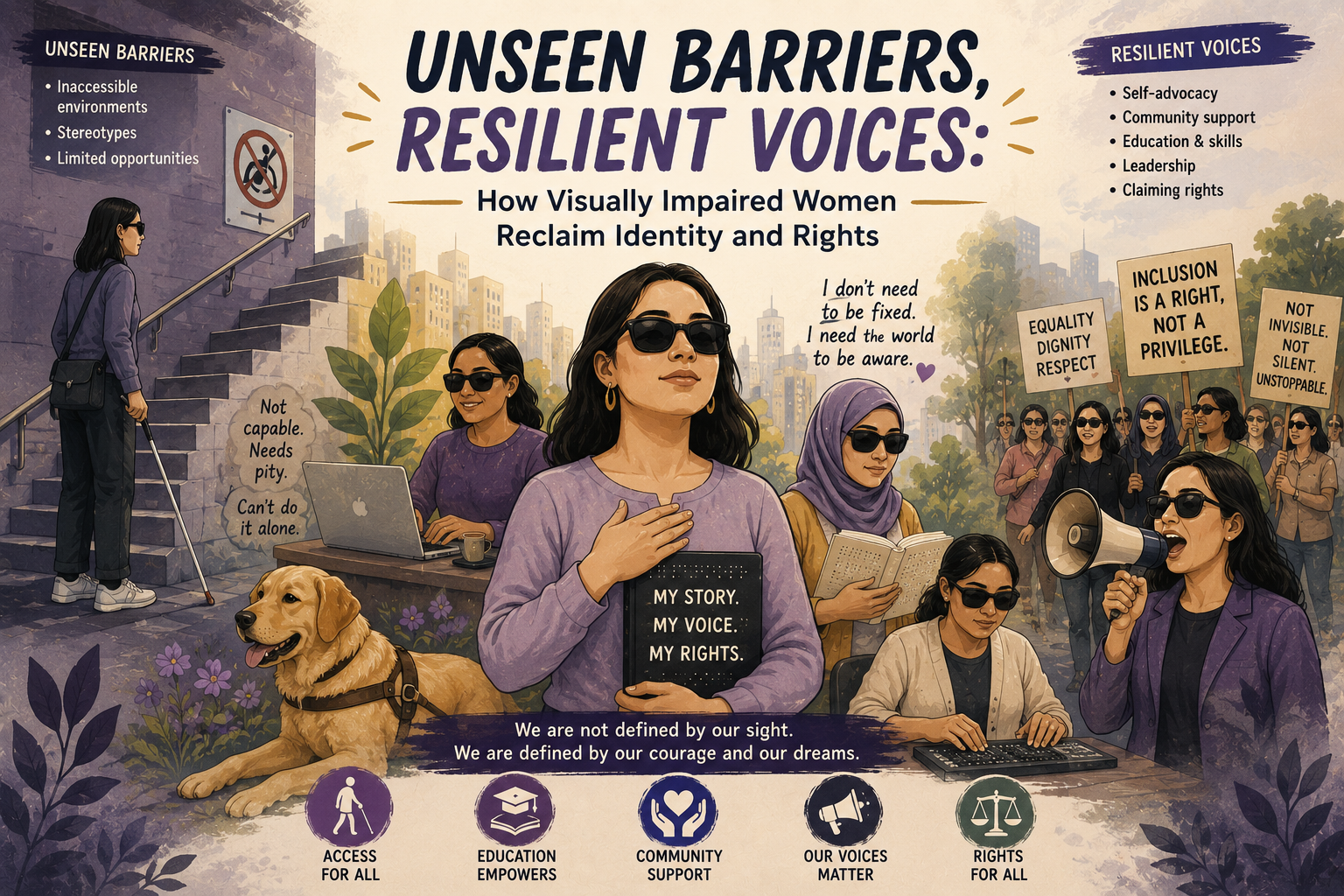

Makassar/Indonesia/30-09-2025/PCD-RG —– For many marginalized groups, navigating everyday life involves confronting deep-seated societal barriers. However, women living with visual impairments face a unique, multi-layered hardship where gender inequality directly intersects with disability stigma. An insightful academic paper titled “Understanding Discrimination: A Phenomenological Study on the Lived Experiences of Women with Visual Impairments,” published on 30 September 2025 in Jurnal Nirta: Studi Inovasi by Nirta Learning Center, offers a poignant look into this reality. By utilizing a qualitative phenomenological approach, the researchers investigated the daily lives of eight members from the Indonesian Women with Disabilities Association (HWDI) in Polewali Mandar, West Sulawesi. The study captures how these women experience, interpret, and actively overcome pervasive social exclusion. By giving voice to their lived experiences, the research challenges prevailing social stigmas and advocates for meaningful societal reform.
The study demonstrates that discrimination is not merely a collection of isolated events, but an ongoing social process unfolding across domestic, community, and economic domains. Participants shared deeply personal accounts of feeling invisible, devalued, and stripped of personal autonomy. Within families, traditional biases often lead to early exclusion; for instance, some parents withheld schooling under the mistaken belief that visually impaired individuals cannot learn. Other women suffered legal invisibility due to a lack of official identification cards, effectively blocking their access to essential social welfare assistance. In public settings, disrespect manifested through economic exploitation, such as vendors giving them burnt goods or buyers paying with toy money, treating their physical condition as an opportunity for deceit.
These discriminatory practices explicitly highlight the urgent need to achieve SDG 4 (Quality Education), which strives to ensure inclusive and equitable quality education and promote lifelong learning opportunities for all. Depriving visually impaired girls of schooling traps them in economic vulnerability and reinforces the harmful stereotype that persons with disabilities are permanent societal burdens. Achieving this goal is essential because education equips individuals with critical life skills, self-advocacy, and financial independence. Ensuring accessible learning environments, specialized educational materials, and inclusive institutional support is vital to restoring personal autonomy and fostering genuine civic participation. Quality education serves as the ultimate catalyst to shatter generational cycles of poverty, social prejudice, and systemic marginalization.
Despite these crushing systemic obstacles, the study emphasizes that visually impaired women are active agents of change rather than passive victims. Through personal self-reflection, strong spiritual faith, and solidarity within HWDI, they construct positive self-concepts and adaptive survival strategies. Organizations like HWDI serve as transformative spaces for identity recovery, enabling members to learn about their legal rights, build confidence, and engage in collective advocacy. Ultimately, this compelling research reminds us that creating a truly inclusive society requires removing structural hurdles, championing SDG 4 (Quality Education), and recognizing that dignity and equal rights belong to every human being regardless of physical ability.
Reference:
DOI: https://doi.org/10.61412/jnsi.v5i1.312
Contact:
Prof. Dwia Aries Tina Pulubuhu
+62 87856272912 (PCD-RG)
dwiatn@unhas.ac.id