
PCD-RG Researcher Serves as a Speaker at the Southeast Asia-Japan Security Dialogue 2026
Navigating the increasingly complex geopolitical dynamics of the Indo-Pacific requires robust regional cooperation and multifaceted strategic dialogues. Addressing these pressing regional challenges, the Centre for International Relations Studies (CIReS) at Universitas Indonesia, in a prestigious collaboration with the Sasakawa Peace Foundation (SPF) Japan, hosted the “Southeast Asia–Japan Security Dialogue 2026”. Themed “Connecting the Seas, Engaging Partners,” this intensive forum was held from February 9 to 10, 2026, in Jakarta, Indonesia. The high-level dialogue successfully convened an exclusive group of 20 to 30 participants, comprising security analysts, military officers, academics, and policy practitioners from Indonesia, Japan, the Philippines, Singapore, and Vietnam, all united to formulate relevant policy recommendations for regional stability.
Representing Eastern Indonesia’s academic prowess, Agussalim Burhanuddin, a Lecturer at the Department of International Relations at Universitas Hasanuddin and a dedicated researcher at PCD-RG/CPCD, was exclusively invited as a guest speaker. His participation underscored the vital contribution of Indonesian scholars in strategic Indo-Pacific conversations. Agussalim featured prominently in Panel Discussion 1, titled “Maritime Security and Economic Prosperity: Safeguarding Supply Chains in a Connected World.” In this pivotal session, he engaged in profound intellectual discourse alongside distinguished figures, including Navy Capt. Keitaro Ushirogata from the Japan Maritime Self-Defense Force Command and Staff College, Hoang Do from the Diplomatic Academy of Vietnam, and Air Chief Marshal (Ret.) Chappy Hakim from the Indonesian Air Power Studies Center.
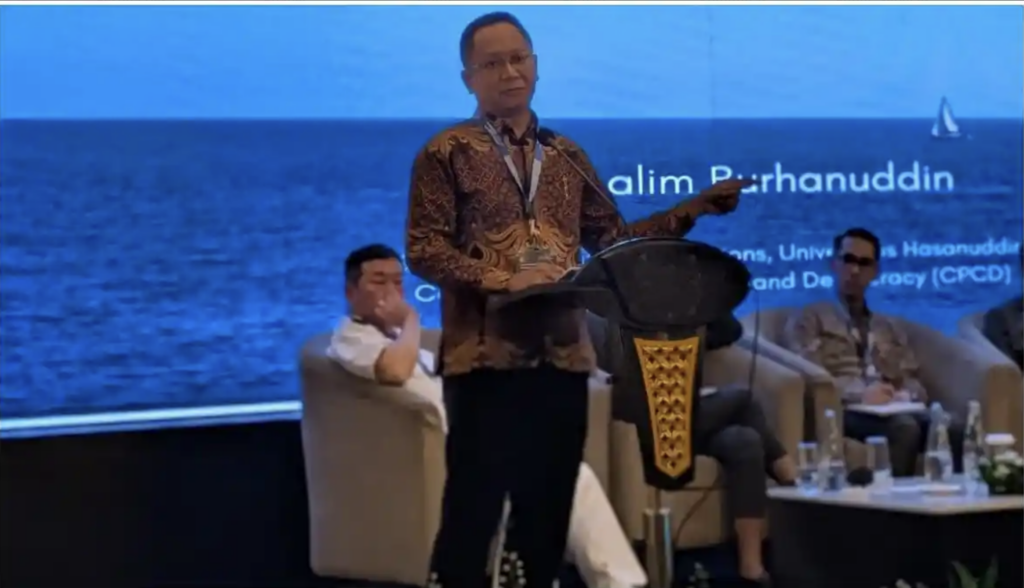
During his comprehensive presentation titled “Securing Indonesia’s ALKI II as a Strategic Sea Corridor for Resilient Supply Chains,” Agussalim highlighted the critical importance of the Indonesian Archipelagic Sea Lanes (ALKI II). He scientifically argued that securing this strategic maritime corridor is fundamental for sustaining regional economic connectivity. Crucially, he advocated for a paradigm shift in maritime security—urging a move away from purely military-centric orientations toward highly inclusive, collaborative approaches. By actively involving civil society, research institutions, and academic communities, he emphasized that Southeast Asian maritime policies must seamlessly integrate human security and social stability to withstand global uncertainties and protect grassroots welfare.
This strategic international forum is directly aligned with the United Nations Sustainable Development Goals (SDGs). By uniting cross-border academic institutions, military personnel, and policy experts to secure global supply chains and regional peace, the dialogue explicitly embodies SDG 17: Partnerships for the Goals. Furthermore, the active integration of academic perspectives into high-level defense diplomacy profoundly supports SDG 4: Quality Education, showcasing how rigorous university research can actively shape and inform complex, real-world geopolitical policy architectures.
Ultimately, the active involvement of the PCD-RG researcher in this prestigious 2026 security dialogue significantly solidifies Indonesia’s position as a proactive actor in global diplomacy. It powerfully demonstrates Universitas Hasanuddin’s unwavering commitment to expanding international networks, advancing applied policy research, and continuously driving collaborative efforts for enduring peace in Southeast Asia and the broader Indo-Pacific region.