
Makassar/Indonesia/15-01-2026/PCD-RG —– In an era marked by erratic global climate patterns, severe environmental degradation, and growing resource scarcity, securing a stable food supply has become one of humanity’s most pressing challenges. While modern industrialized farming often treats agricultural land purely as an economic commodity to maximize short-term yield, traditional communities demonstrate that sustainable food systems require a far deeper connection with nature. A ground-breaking academic study titled THE SACRED ECOLOGY: FOOD SECURITY BASED ON LOCAL ONTOLOGY IN SOUTH SULAWESI, published in LEX LOCALIS-JOURNAL OF LOCAL SELF-GOVERNMENT by the Institute for Local Self-Government Maribor on January 15, 2026, reveals how indigenous cosmology offers a transformative perspective on contemporary food systems. By viewing agriculture through a deeply spiritual lens, the Bugis people in South Sulawesi show us that caring for the earth is both a sacred moral duty and a practical survival strategy.
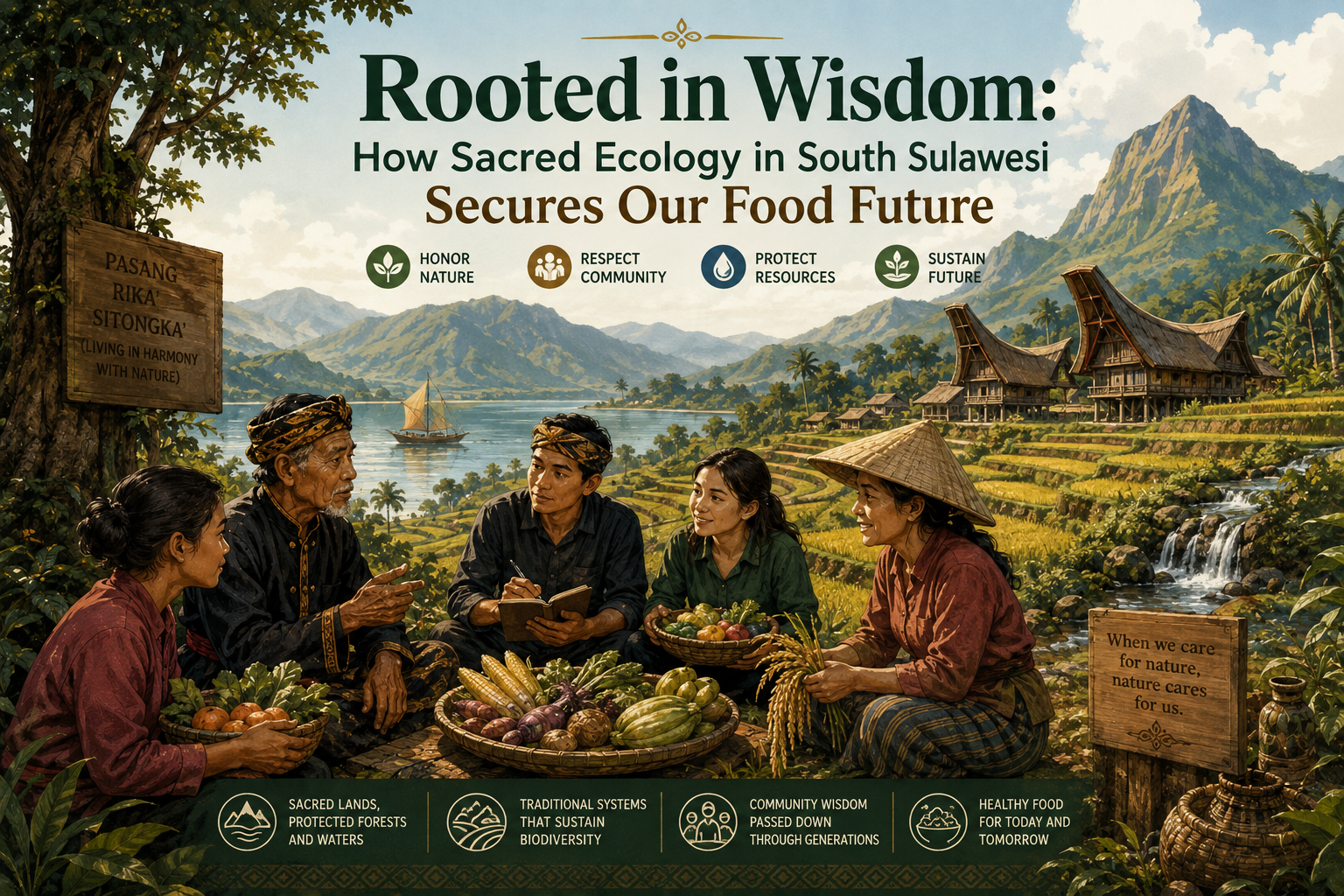
In the agrarian regions of Sidenreng Rappang and Enrekang, soil, seeds, water, and seasonal cycles are never viewed as lifeless mechanical tools. Instead, they are honored as living entities endowed with spirits, biospheric consciousness, and intrinsic value. Traditional rituals such as maddoja bine (sacred seed preparation) and mappeong (harvest thanksgiving) reflect an enduring commitment to eco-spirituality. Central to Bugis cosmology is the myth of Sangiang Serri, the rice goddess whose sacred sacrifice birthed the primary staple food that feeds millions. Farming is thus conducted not as aggressive exploitation, but as a harmonious act of cosmic respect. Local farmers utilize ancestral calendar systems like tallu tallu, carefully aligning their planting cycles with environmental signals and cosmological directions to maintain ecological balance.
This ancestral philosophy directly supports SDG 15 (Life on Land), an international goal dedicated to protecting, restoring, and promoting the sustainable management of terrestrial ecosystems and halting land degradation. Indigenous cultural values like siri’ (moral self-respect) and ade’ (customary order) serve as powerful social mechanisms preventing environmental destruction and deforestation. In Enrekang Regency, the ancient teachings of legendary figures like Puang Palipada explicitly prohibit taking more than one’s fair share from nature, creating strict taboos against over-farming. By recognizing the sanctity of the land, indigenous communities naturally safeguard local biodiversity, soil health, and forest conservation without relying solely on top-down regulations.
As global food insecurity intensifies due to climate disruption, technocratic market solutions alone are clearly insufficient. This insightful research demonstrates that long-term food security relies heavily on spiritual harmony and ethical responsibility toward nature. Bridging traditional local wisdom with modern agricultural policy creates resilient, community-led food networks capable of surviving ecological crises. By honoring the land as a sacred living entity rather than exploiting it as a commercial asset, humanity can rebuild its vital bond with the earth and guarantee sustainable food for generations to come.
Reference:
DOI: https://doi.org/10.52152/z7mbzj15
Contact:
Prof. Dwia Aries Tina Pulubuhu
+62 87856272912 (PCD-RG)
dwiatn@unhas.ac.id