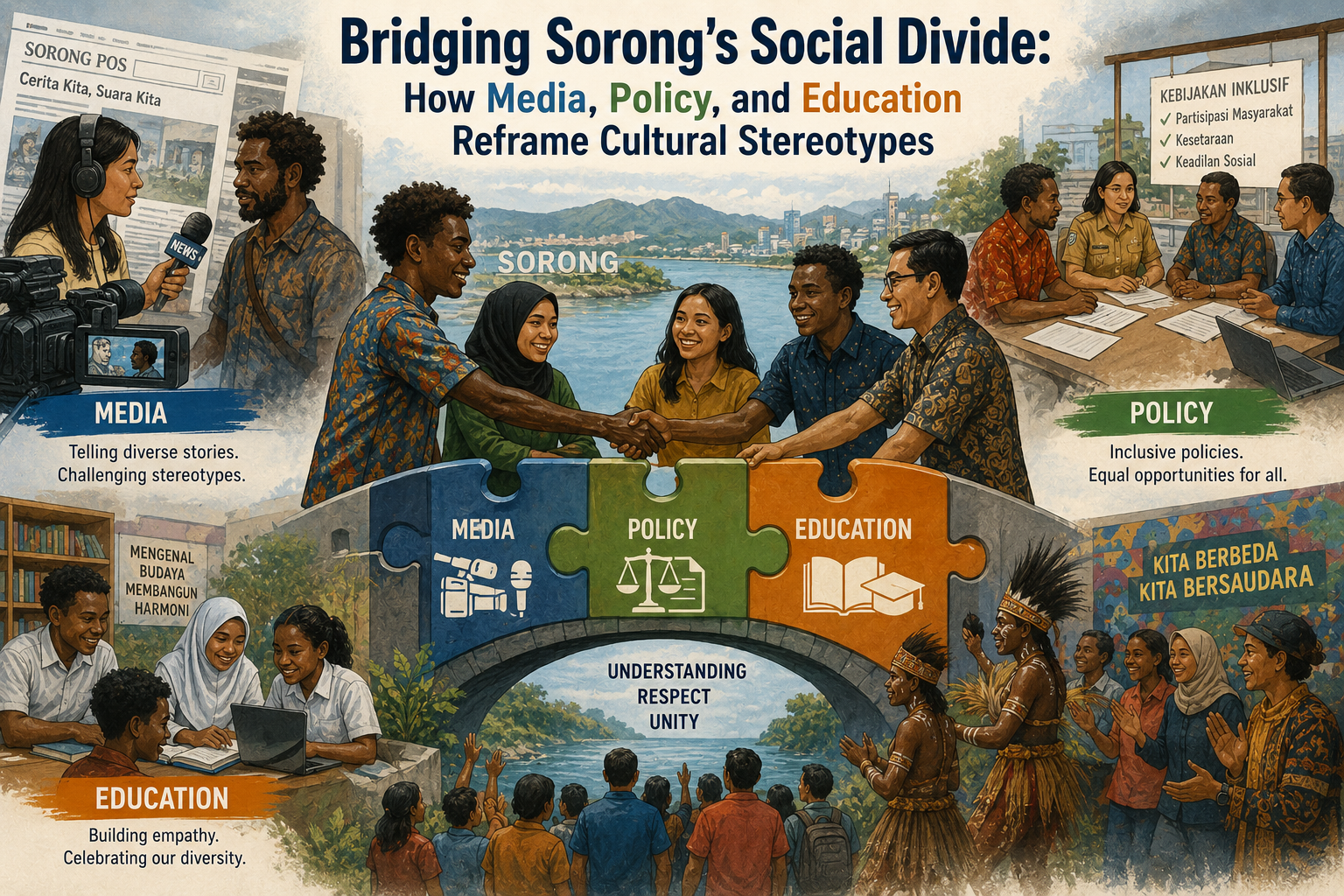

Makassar/Indonesia/28-03-2025/PCD-RG —– Walk through the vibrant, coastal streets of Sorong in Southwest Papua, and you will immediately encounter a proud civic motto: “Sorong Kota Bersama” (Sorong City Together). As rapid internal migration continuously reshapes this urban hub, indigenous Papuans and non-Papuan settlers find themselves sharing daily life in an increasingly complex multicultural environment. Maintaining long-term peace in such dynamic settings requires creative public media communication—a discipline that looks far beyond surface-level tension to build mutual empathy, dismantle harmful social assumptions, and foster genuine civic inclusion.
Unpacking how these distinct demographic groups view each other is the central focus of a qualitative study titled “Stereotip Antara Penduduk Asli dan Pendatang di Kota Sorong –Papua Barat Daya”. Published on March 28, 2025, in Jurnal Audiens by Program Studi Ilmu Komunikasi UMY, this research investigates the mutual perceptions, cultural stereotypes, and social expectations that actively shape intergroup relations across Sorong.
For indigenous Papuans, community acceptance hinges on two main criteria: ethnic bloodlines and meaningful civic contribution. While non-Papuans remain ethnically labeled as settlers regardless of how long they reside in the region, immigrants who build permanent lives, respect local traditions, and invest in the community are genuinely embraced as integral members of Sorong’s social fabric. Indigenous residents deeply appreciate the specialized knowledge, medical care, and commercial vitality brought by immigrant populations. However, subtle feelings of socio-economic marginalization can resurface whenever newcomers overwhelmingly dominate private commerce, formal employment sectors, and local political seats.
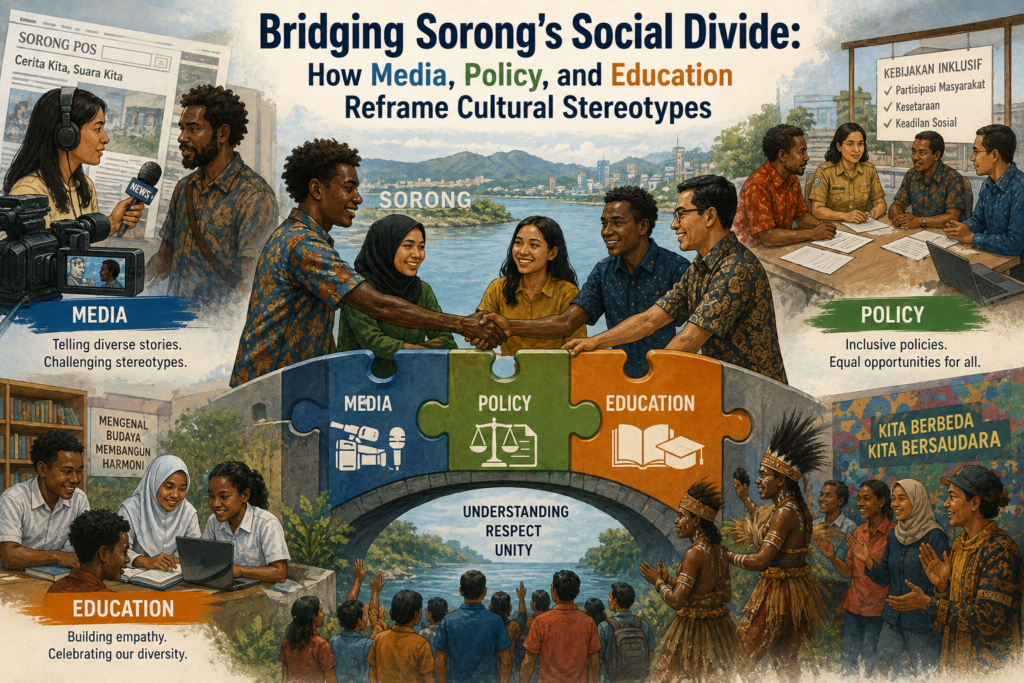
Flip the perspective, and non-Papuan immigrants offer equally revealing insights regarding their indigenous neighbors. Newcomers frequently praise the exceptional personal warmth, fierce loyalty, and reciprocal generosity of Papuan residents, observing that initial stern facial expressions quickly give way to deep hospitality once authentic personal relationships are formed. At the same time, immigrants highlight a persistent disparity in formal educational attainment among indigenous youth, which frequently limits their competitive edge within formal business and governmental arenas. Crucially, the research emphasizes that social clashes in Sorong rarely spring from deep-seated ethnic hatred; instead, they are almost always triggered by isolated personal disputes, alcohol misuse, or weak local oversight.
Closing this capability gap serves as a vital bridge toward enduring harmony, aligning directly with global commitments under Sustainable Development Goal 4: Quality Education. By strategically directing Special Autonomy (Otsus) funding into accessible, top-tier schooling, digital literacy, and professional vocational training, regional leaders can empower indigenous youth to take leading roles across economic, administrative, and creative sectors. Equal access to quality education guarantees that local residents participate meaningfully in their homeland’s rapid growth.
Public media strategists and local policymakers must recognize that social stereotypes are flexible constructs rather than permanent barriers. By pairing transparent civic dialogue and empathetic storytelling with bold investments in education, multicultural cities like Sorong can turn ethnic diversity into an enduring engine for collective unity and shared prosperity.
Reference:
DOI: https://doi.org/10.18196/jas.v6i1.580
Contact:
Prof. Dwia Aries Tina Pulubuhu
+62 87856272912 (PCD-RG)
dwiatn@unhas.ac.id