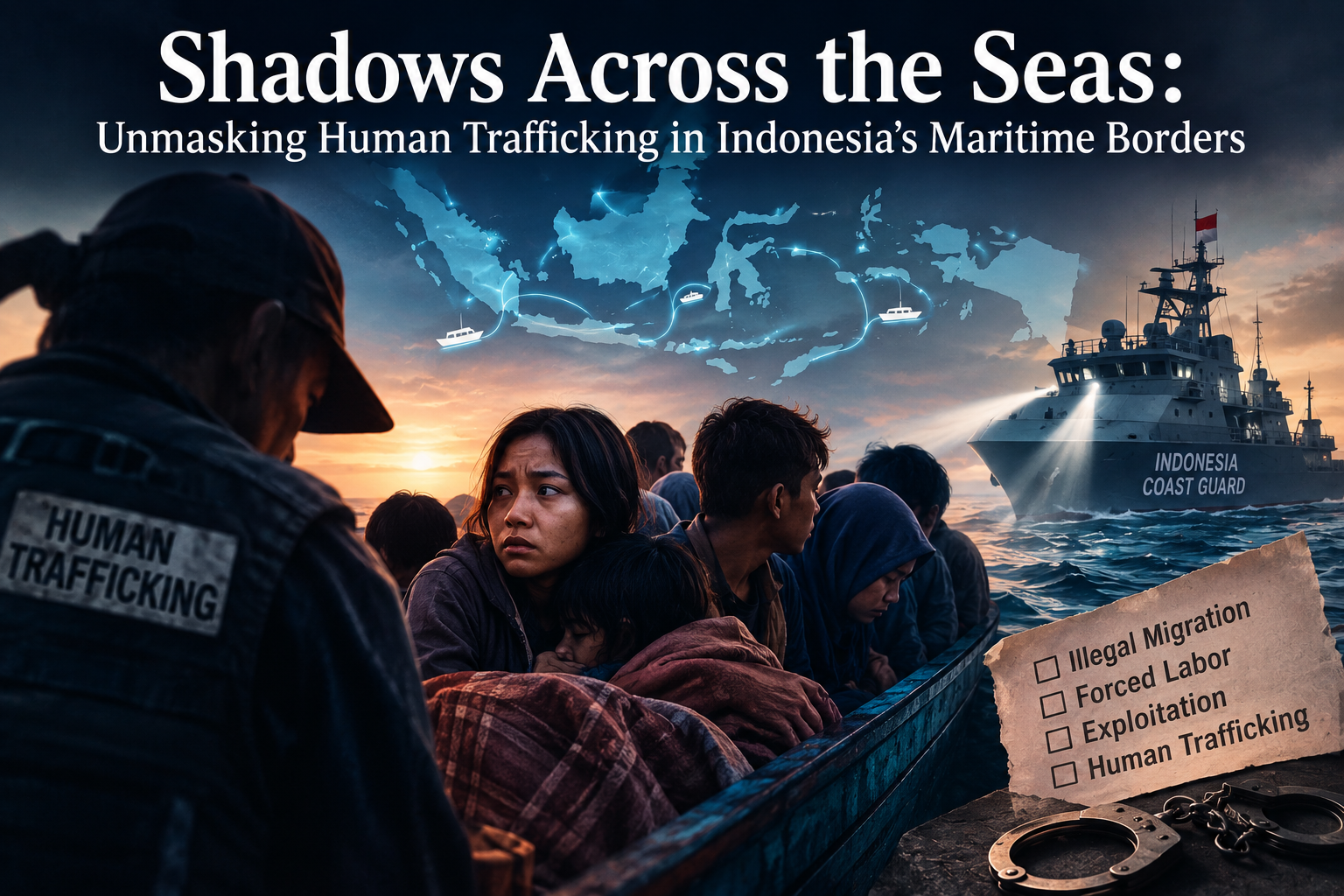

Makassar/Indonesia/07-03-2025/PCD-RG —– Indonesia’s breathtaking archipelago, spanning over 17,000 islands and vast marine corridors, is widely celebrated for its rich natural splendor and vibrant maritime culture. However, behind this tranquil oceanic backdrop lies a dark, persistent human rights crisis: illicit smuggling and human trafficking along vulnerable coastal borders. This critical issue is thoroughly examined in a scholarly article titled Smuggling and Human Trafficking in Indonesia’s Maritime Borders in the Regions of East Nusa Tenggara and North Kalimantan, published in Socius: Jurnal Penelitian Ilmu-Ilmu Sosial by Yayasan Daarul Huda Kruengmane on July 3, 2025. The groundbreaking study sheds light on how complex transnational crime networks systematically exploit geographical gaps and socio-economic vulnerabilities across East Nusa Tenggara (NTT) and North Kalimantan.
The study reveals that maritime border zones face severe security risks due to limited surveillance infrastructure, vast coastlines, and deeply entrenched socio-economic hardships. In NTT, which serves as a strategic transit route toward Timor-Leste and Australia, pervasive rural poverty and a severe shortage of formal employment opportunities push desperate jobseekers into dangerous, undocumented migration pathways. Alarmingly, official national statistics indicate that 97% of recorded human trafficking victims in Indonesia between 2019 and 2023 were women and children. These vulnerable individuals are lured with fraudulent promises of high-paying overseas employment, only to suffer severe physical, financial, and sexual exploitation. Meanwhile, in North Kalimantan, shared cultural roots, historical family ties, and informal cross-border trade with Malaysia obscure the distinction between legal daily mobility and organized human smuggling.
To unpack this intricate dilemma, the study integrates Lee’s Migration Theory and Granovetter’s Social Network Theory. The analytical framework demonstrates that criminal syndicates operate through highly adaptable “hybrid networks”. First, perpetrators utilize “strong ties”—such as close relatives, trusted friends, or local community members—to recruit unsuspecting victims through emotional closeness and deceptive promises. Subsequently, they leverage “weak ties”—including corrupt border agents, unscrupulous labor brokers, and illegal transport operators—to traffic victims across maritime borders undetected. This sophisticated combination creates a resilient criminal ecosystem that successfully evades traditional law enforcement mechanisms.
Addressing this grave humanitarian crisis connects directly to SDG 1: No Poverty. The research emphasizes that structural poverty and income inequality represent the foundational push factors forcing individuals into life-threatening migration channels. Without sustainable local livelihood options, empowering vocational training, and social protection programs, criminal networks will continually exploit local economic desperation.
Ultimately, safeguarding Indonesia’s maritime frontiers requires moving beyond traditional military surveillance toward holistic, human-centered interventions. By boosting local economic growth, raising community awareness through targeted educational campaigns, and expanding bilateral law enforcement cooperation with neighboring nations, Indonesia can effectively eradicate human trafficking and safeguard human dignity along its vulnerable coastal borders.
Reference:
DOI: https://doi.org/10.5281/zenodo.15804126
Contact:
Prof. Dwia Aries Tina Pulubuhu
+62 87856272912 (PCD-RG)
dwiatn@unhas.ac.id