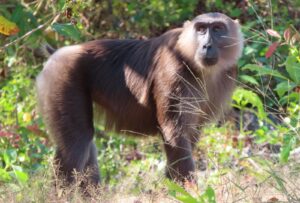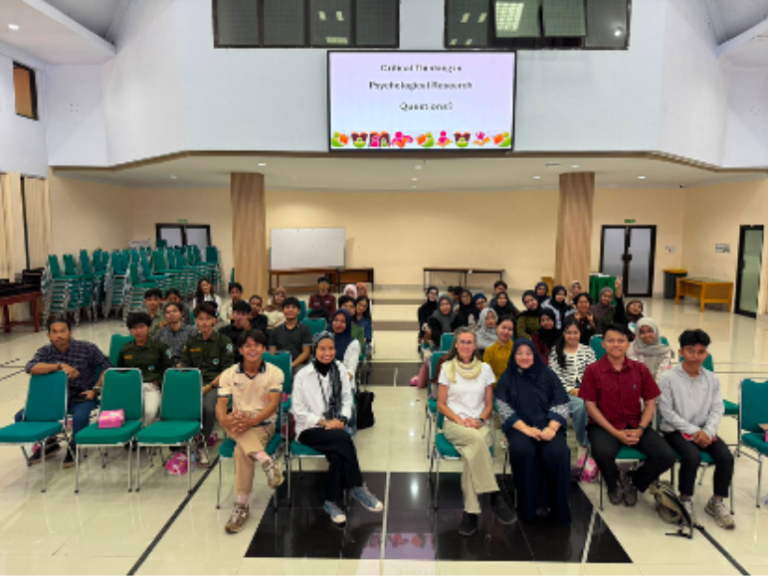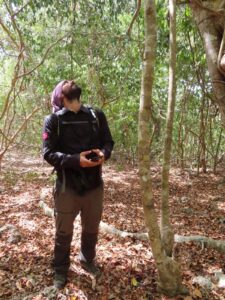
In the forests of TAHURA Bontobahari, South Sulawesi, Indonesia, PhD student: César Rodríguez del Castillo from Universidad Veracruzana, México is carrying out a long-term behavioral study in collaboration with the Wildlife Ecology and Conservation Research Group (WildEV RG), Hasanuddin University. Purpose of the activity: to investigate the social dynamics, feeding ecology, and ranging behavior of wild moor macaques (Macaca maura) in order to better understand how this endemic primate adapts to its environment and manages social relationships within the group. Date of activity: long-term field research ongoing since 2019, with the current study phase continuing during the recent research period. Number of participants: not specified in the provided information. Location of activity: TAHURA Bontobahari, South Sulawesi, Indonesia.
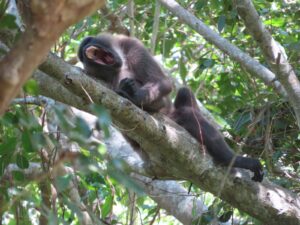
Building on earlier observations of sleeping behavior, César’s current research focuses on affiliative and aggressive interactions among adult and subadult macaques in a monitored group of 45 individuals. By observing the animals over time, the study seeks to determine whether moor macaques follow a tolerant dominance style, a social pattern that has been suggested in previous research on Sulawesi macaques. This question is important because dominance style shapes how animals share food, form social bonds, avoid conflict, and remain cohesive as a group. Understanding these behaviors helps researchers explain not only how the species survives, but also how it organizes itself in a changing forest landscape.
The study also examines the plant species consumed by the macaques and evaluates how the abundance and distribution of food resources influence their movements, ranging patterns, and home range size. In simple terms, the research asks how the forest supports the monkeys, and how the monkeys respond when food is more concentrated or more scattered across the landscape. These ecological details are vital for conservation, because they reveal the link between habitat quality and animal behavior. When feeding resources are reduced or fragmented, macaques may be forced to travel farther, compete more intensely, or move into areas closer to human activity.
This work directly supports SDG 15: Life on Land, because it contributes to the protection of endemic wildlife and the sustainable management of forest ecosystems. It also contributes to SDG 4: Quality Education, as it strengthens scientific learning, field training, and knowledge exchange through student-led research. In addition, the project reflects SDG 17: Partnerships for the Goals, since it is built on international collaboration between Universidad Veracruzana and Hasanuddin University through WildEV RG. These partnerships make it possible to combine expertise, field experience, and conservation priorities across countries.
The study is more than an academic exercise. It provides practical knowledge that can support future conservation planning, habitat protection, and long-term management of Sulawesi’s unique biodiversity. By revealing how moor macaques live, feed, and interact, César’s research helps build a stronger scientific foundation for protecting one of Indonesia’s most remarkable endemic primates and the forest it depends on.