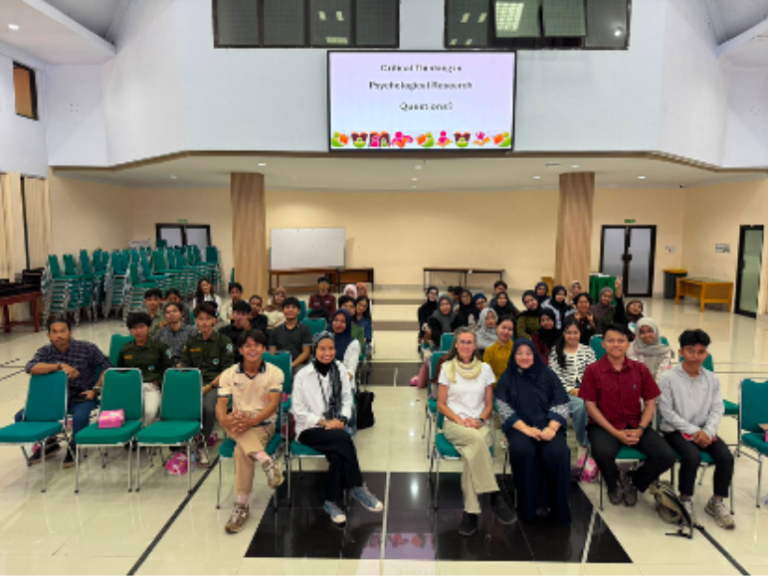
In the educational forest of Hasanuddin University (Hutan Pendidikan UNHAS), South Sulawesi, Indonesia, master’s student: Gemma Sala Pallarès carried out an in-depth behavioral study from February to June 2025 in collaboration with Hasanuddin University (WildEV RG), the University of Leipzig (Germany), and the University of Lincoln (UK). The activity, titled Gestures of Connection: Decoding the Secret Language of Sulawesi’s Endangered Moor Macaques, was designed to understand how wild moor macaques (Macaca maura) use gestures to build and maintain social bonds. Location: Hutan Pendidikan UNHAS, South Sulawesi, Indonesia. Purpose of activity: to examine gestural communication and its role in social interaction, bonding, and conservation understanding. Date of activity: February–June 2025.
Using focal animal sampling and video-based behavioral analysis, the study carefully documented 322 grooming bouts and 606 present grooming gestures. The findings reveal that these gestures are not random movements, but meaningful signals that help shape social relationships within the group. Gestures made outside grooming bouts were especially effective in encouraging affiliative interactions, while increased gesturing during ongoing grooming sessions helped extend their duration. Even more notably, macaques often maintained their postures longer when grooming did not begin immediately, a pattern that suggests communicative persistence. In simple terms, the animals appeared to continue signaling until their message was understood, showing a level of flexibility and intentionality in their social communication.
These results are scientifically important because they deepen our understanding of the cognitive and social abilities of moor macaques, a species endemic to Sulawesi and increasingly threatened by habitat loss, habitat fragmentation, and human encroachment. By showing that these macaques have a sophisticated gestural system, the study strengthens the argument that their conservation should be treated as both an ecological and behavioral priority. Protecting this species means protecting the forest ecosystem that supports its survival.
This work is closely connected to SDG 4: Quality Education, because it contributes to scientific learning, student research training, and public understanding of animal behavior. It also supports SDG 15: Life on Land, by generating knowledge that can help protect endangered native species and their terrestrial habitats. In addition, the project reflects SDG 17: Partnerships for the Goals, as it was made possible through international collaboration between Indonesian and European institutions. The research is therefore not only a study of primate communication, but also a model of how shared knowledge can support conservation action.
The findings are being prepared for submission to the International Journal of Primatology, and future research is planned to expand across additional moor macaque populations and explore how environmental and attentional factors influence gestural communication.