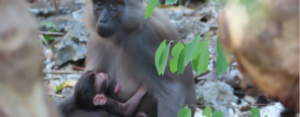
Between February and August 2025, a detailed behavioural study was conducted in the Bontobahari Forest Reserve, Bulukumba Regency, South Sulawesi, to better understand how moor macaque mothers care for their young. The research focused on 10 mother–infant pairs within a wild group of 29 identified moor macaques (Macaca maura), one of Sulawesi’s most threatened endemic primates. The study was led by Mariano Lara López, a master’s student, as part of a collaborative research effort involving Hasanuddin University’s WildEV RG, the University of Leipzig (Germany), and the University of Lincoln (UK). Number of participants: 1 master’s student, Mariano Lara López. Date of implementation: February–August 2025. International partners: Hasanuddin University’s WildEV RG, the University of Leipzig, and the University of Lincoln. Student name: Mariano Lara López.
The objective of the activity was to test whether moor macaque mothers invest differently in sons and daughters, a question linked to the species’ female philopatry, or the tendency of females to remain close to their natal group. In theory, this social structure could lead mothers to behave more warmly toward daughters and more strictly toward sons. To examine this possibility, the study used 10-minute focal animal sampling sessions recorded through BORIS software, and the data were analyzed using 12 generalized linear mixed models (GLMM). The location of the activity was Bontobahari Forest Reserve, a protected forest area that remains important for both wildlife conservation and long-term ecological research.
The results were clear and surprising. The study found no significant sex-based differences in either affiliative or agonistic maternal behavior. In other words, moor macaque mothers did not treat sons and daughters differently in the ways previously expected. The strongest pattern observed was developmental rather than sexual: as offspring grew older, maternal proximity gradually decreased. This reflects a natural transition from close infant dependence toward greater autonomy, a pattern common in many primate species.
These findings are important because they deepen scientific understanding of one of Sulawesi’s least-studied and most vulnerable native mammals. The absence of sex-biased parenting suggests that Macaca maura may be a highly socially tolerant species, and this information helps researchers better interpret the species’ social structure, resilience, and conservation needs. The study also shows the value of long-term behavioral research in protected areas, where careful observation can reveal subtle but meaningful patterns in wildlife life histories.
This activity contributes directly to SDG 15 (Life on Land) by supporting the protection of endangered species and the preservation of terrestrial ecosystems. It also advances SDG 4 (Quality Education) through student-led research and scientific training. The project reflects SDG 17 (Partnerships for the Goals) through international collaboration between Indonesian and foreign institutions. In a broader sense, it also supports SDG 1 (No Poverty) by strengthening the scientific foundation for conservation-based development and long-term ecosystem management that can benefit local communities.
Mariano is currently preparing a draft for publication, which will further share these findings with the wider scientific community and contribute to future conservation efforts for Sulawesi’s moor macaques.