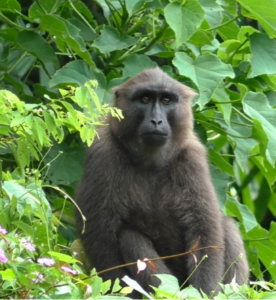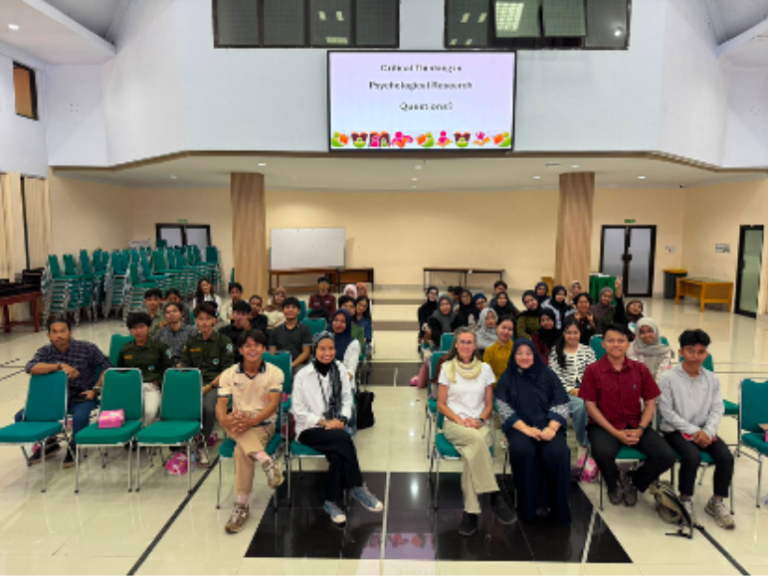
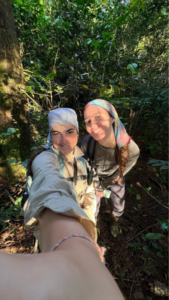
Between January and June 2025, a focused behavioral study was conducted on a wild group of 27 moor macaques (Macaca maura) living in the Teaching Forest (Hutan Pendidikan) near the village of Bengo, South Sulawesi. The research was led by Victoria Martínez Rubio, a master’s student, and carried out through a collaboration between Hasanuddin University’s WildEV RG, the University of Leipzig (Germany), and the University of Lincoln (UK). This work reflects the importance of international scientific cooperation in improving our understanding of one of Sulawesi’s most distinctive and endangered primates. Number of participants: 1 master’s student (Victoria Martínez Rubio). Date of implementation: January–June 2025. International partners: the University of Leipzig, the University of Lincoln, and Hasanuddin University’s WildEV RG. Student name: Victoria Martínez Rubio.
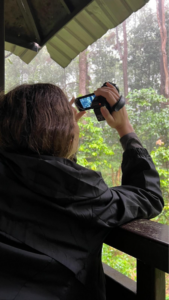
The objective of the activity was to investigate the gestural communication system of Macaca maura by documenting the composition of its gesture repertoire, the modalities used in communication, and the signs of communicative intentionality shown across different social situations. In simple terms, the study asked how these macaques “speak without words” in their daily lives, and what their gestures reveal about their social intelligence and flexibility. The location of the activity was the Teaching Forest near Bengo, South Sulawesi, where researchers observed the macaques in a natural forest setting.
The study identified 19 distinct gesture types used in affiliative, agonistic, play, and sexual interactions. Visual gestures were used more often than tactile ones, showing that sight plays a major role in how these animals communicate. Interestingly, age and sex did not explain much of the variation in gesture repertoire size or gesture modality. Instead, the social context was far more important. Visual gestures were used more frequently during resting periods, signallers were more likely to consider whether a recipient was paying attention in affiliative situations, and gestures were more effective at triggering responses in both friendly and conflict-related encounters. Together, these findings suggest a flexible and context-sensitive communication system.
This research is significant far beyond the forest canopy of South Sulawesi. By documenting the behavior of an endangered and little-studied primate, the study adds valuable knowledge to global biodiversity science and strengthens the basis for long-term wildlife conservation. It also helps explain how social communication may support survival in a changing environment. The findings are now being prepared for submission to a peer-reviewed journal, with future work expected to expand the study to longer-term observations, multiple groups, and a multimodal approach that includes gestures, vocal signals, and facial expressions.
This activity contributes directly to SDG 15 (Life on Land) by supporting the conservation of endemic forest wildlife and their habitats. It also supports SDG 4 (Quality Education) through student-led research, scientific training, and knowledge production. In addition, it reflects SDG 17 (Partnerships for the Goals) through strong collaboration between Indonesian and international institutions. More broadly, the project contributes to SDG 1 (No Poverty) by strengthening the scientific foundation for conservation-based development and responsible ecosystem management that can support long-term community well-being.