MAKASSAR, Indonesia 20 July 2026/VICTORY/ – Kashmir is often described as a territorial dispute between India and Pakistan, but its importance reaches far beyond a contested border. The region lies where South Asia, Central Asia, and China’s western frontier meet. This position places Kashmir close to major military routes, mountain passes, trade corridors, water systems, and infrastructure projects. Geography therefore helps explain why events in Kashmir can influence diplomacy and security across Asia.
This popular-science article is based on the research article “Kashmir at the Nexus of Geopolitics: Reinterpreting Mackinder’s Heartland Theory in the Asian Security Dilemma,” written by Mirela Imširović, Adnan Kapo, Georges Olemanu Lohalo, Souliya Mounnarath, and Muhammad Mutawalli Mukhlis. The article was published in the International Journal of Law and Society, Volume 5, Issue 1, pages 164–186. The journal is published by the NAJAHA Education Development Center in collaboration with APJHI, and the article was officially published on 20 May 2026.
The study revisits Halford Mackinder’s Heartland theory, which argued that control over the central landmass of Eurasia could provide major strategic power. It also considers Nicholas Spykman’s Rimland concept, which emphasizes the coastal and peripheral zones surrounding Eurasia. Kashmir does not sit neatly inside either category. Instead, it occupies a border space where land-based and maritime-oriented strategies overlap.
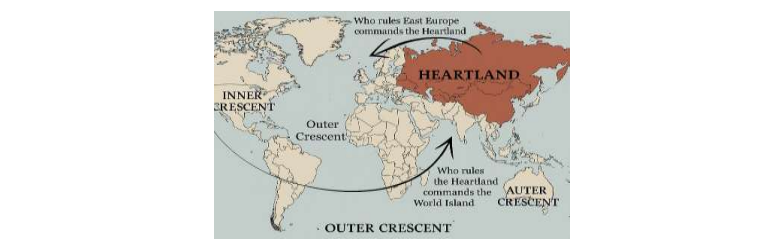
The maps reproduced on page 6 illustrate the Heartland and Rimland ideas, while the map on page 13 shows Kashmir near the Line of Control and the Line of Actual Control involving India, Pakistan, and China. Together, these images make the article’s central point visible: Kashmir is not geographically isolated. It connects several strategic regions and brings the security interests of three major Asian powers into close contact.
This creates a classic security dilemma. When one country builds roads, strengthens military positions, or develops partnerships to improve its security, another may interpret those actions as a threat. The response may then involve additional troops, weapons, or infrastructure, encouraging a cycle of distrust even when none of the parties initially intends a wider conflict.
The article also explains that geopolitics cannot be separated from international law. Kashmir involves competing claims concerning sovereignty, territorial integrity, self-determination, humanitarian protection, and human rights. International legal rules provide important standards, but their implementation is often limited when strong strategic interests collide.
This research supports SDG 1: No Poverty, because prolonged instability can damage livelihoods, trade, and economic resilience. It contributes to SDG 3: Good Health and Well-Being by drawing attention to the human consequences of insecurity and militarization. It advances SDG 4: Quality Education by making geopolitical and legal debates more understandable, and SDG 17: Partnerships for the Goals by emphasizing dialogue and cooperation among states, international organizations, researchers, and communities.
The central lesson is simple: Kashmir matters not only because of who claims it, but because of where it is and because lasting regional security requires geography, law, diplomacy, and human dignity to be considered together.
Reference:
Contact :
Dr. Nur Azisa
+62 896-5492-8727
nur.azisa@unhas.ac.id