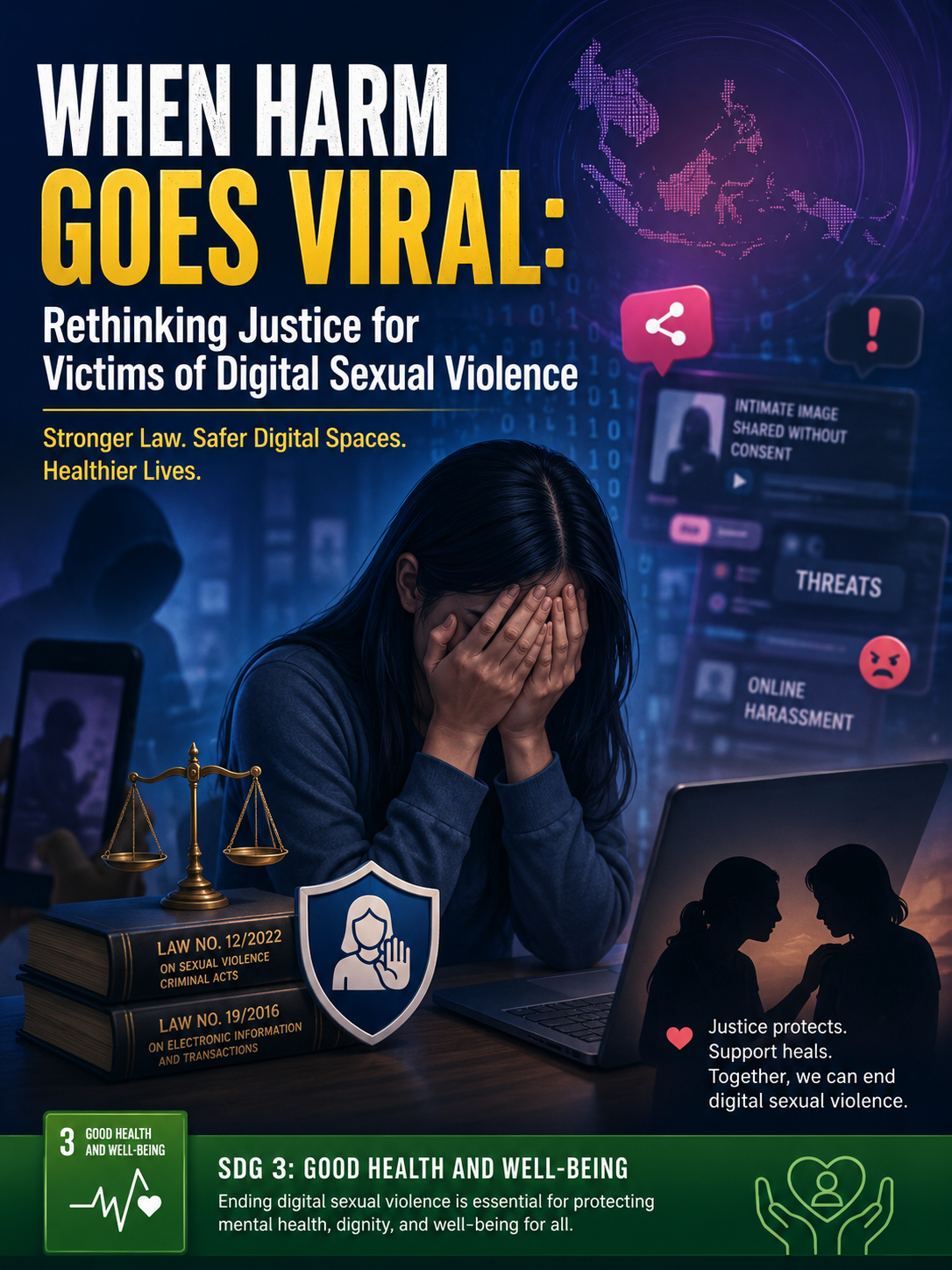

MAKASSAR, Indonesia 16 Juli 2026/VICTORUY/-One private photo can be copied, forwarded, and seen by thousands of people within minutes. For victims, the damage does not disappear when a post is deleted. Screenshots, cloud storage, anonymous accounts, and repeated sharing can keep the fear alive for months or even years. This is why digital sexual violence should never be dismissed as “online drama.” It is a serious violation of privacy, dignity, safety, and personal freedom.
This popular article is adapted from the academic article “Reforming Justice for Digital Sexual Violence in Southeast Asia: Indonesia’s Legal Protection Framework and Regional Lessons.” It was published in the journal International Law Discourse in Southeast Asia by Universitas Negeri Semarang and became available online on July 6, 2026. The article examines Indonesia’s legal response to electronic-based sexual violence and compares it with approaches developed in Canada, Germany, Malaysia, Thailand, and Japan. The journal is published by Universitas Negeri Semarang through its Faculty of Law.
Indonesia has taken an important step through Law No. 12 of 2022 on Sexual Violence Criminal Acts. The law recognizes electronic-based sexual violence as a specific crime. It covers acts such as recording or taking sexually explicit images without consent, sending sexual material against someone’s wishes, using technology for sexual stalking, and distributing intimate content to threaten, deceive, or control another person.
However, the study identifies an important weakness. Existing penalties mainly rely on imprisonment and fines. These sanctions punish offenders, but they may not always stop repeated abuse when online communication tools remain central to the crime. A perpetrator may continue creating accounts, contacting the victim, sharing harmful material, or using digital platforms to intimidate others.
An Indonesian revenge-porn case shows this legal difficulty. A district court attempted to prevent the offender from using internet-connected communication devices. The restriction was later removed on appeal because Indonesian law did not clearly authorize that additional punishment. The decision reveals a key lesson: courts need effective tools to prevent continuing harm, but those tools must be expressly regulated by law.
Experiences from other countries offer useful guidance. Canada and Germany allow courts to impose supervised restrictions on internet or communication access in certain cases. Japan has developed more specific laws addressing intimate-image abuse. At the same time, Malaysia and Thailand show that rules written too broadly may threaten freedom of expression or create inconsistent enforcement.
Indonesia therefore needs a careful approach, not a permanent or automatic internet ban. Any digital restriction should be linked directly to the offence, limited in duration, supervised, open to review, and proportionate to the risk of repeated harm.
This issue is closely connected to SDG 3: Good Health and Well-being. Digital sexual violence can damage mental health, create lasting fear, disrupt education and work, and isolate victims from their communities. Stronger laws, safer platforms, and recovery-oriented support can help protect well-being. Justice in the digital age must not only punish past wrongdoing; it must also stop continuing harm and help victims rebuild their lives.
Reference:
DOI: https://doi.org/10.15294/ildisea.v5i1.42711
Contact :
Dr. Nur Azisa
+62 896-5492-8727
nur.azisa@unhas.ac.id