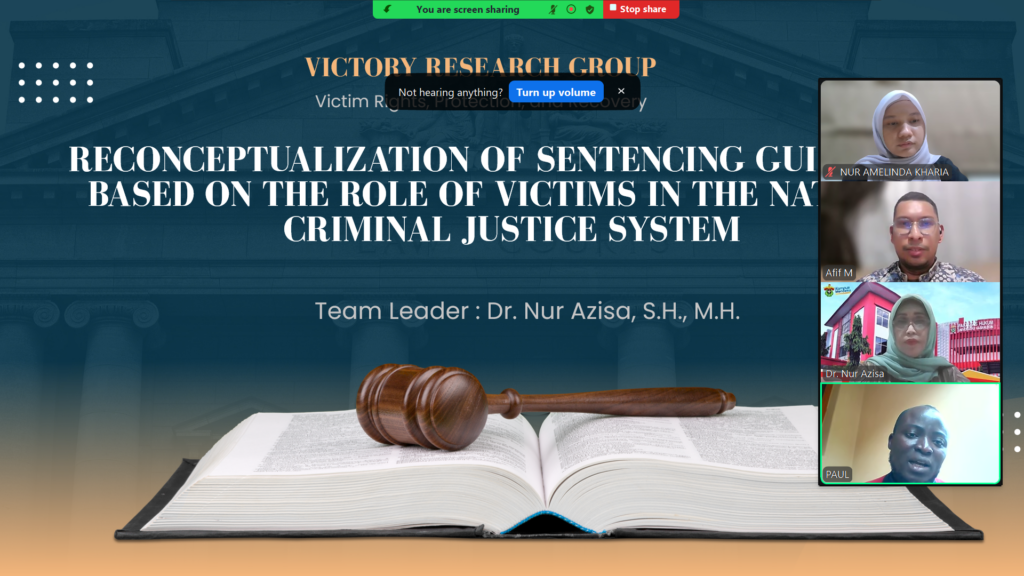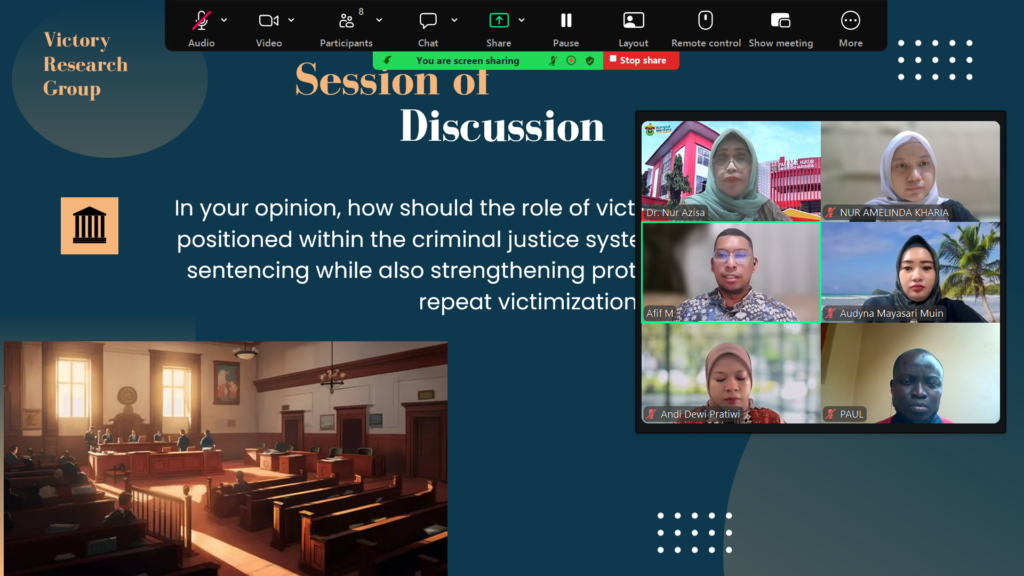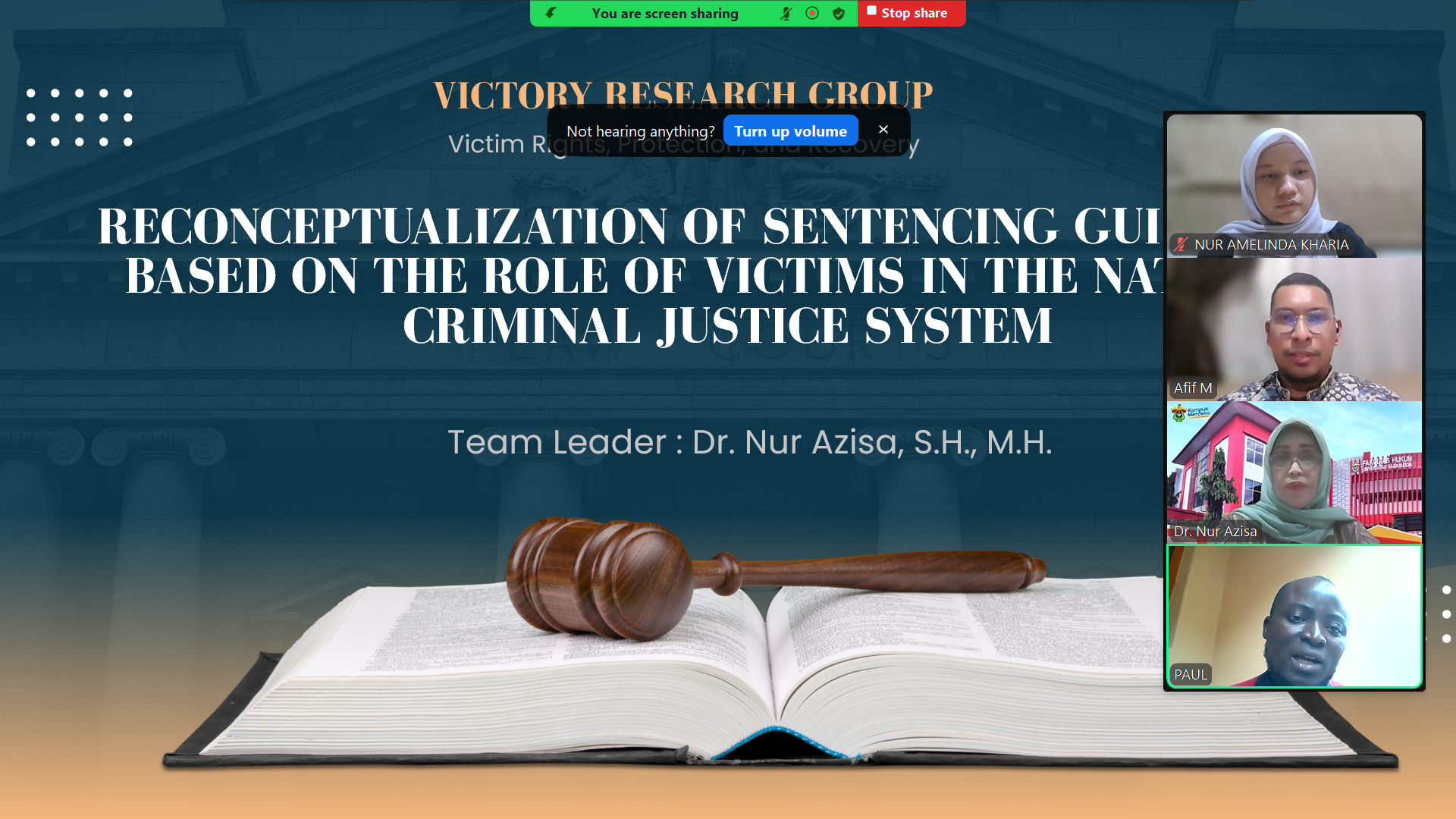

On 22 July 2026, Victory research Group Faculty of Law, Hasanuddin University, conducted an international expert meeting with Paul Atagamen Aidonojie, Ph.D.from Kampala University, Uganda, to strengthen comparative research on the role of victims in the occurrence of criminal offences. The activity was held through a Zoom Meeting and chaired by Dr. Nur Azisa, Head of the TRG Team. The meeting provided an academic forum for examining how the Indonesian and Ugandan legal systems assess victim participation without weakening victim protection.
The meeting was attended by 8 participants, consisting of 1 international partner, Professor Paul from Uganda; 5 lecturers from the Faculty of Law, Hasanuddin University; and 2 students, Andi Dewi and Nur Amelinda Kharia. Their participation reflected a collaborative approach involving international partners, legal scholars, and students in developing victimology and criminal law research.
Professor Paul introduced himself as a Nigerian-born associate professor who has taught for three years at Kampala International University. He explained that Uganda has a well-organized legal system and effectively uses law as an instrument of social control. Based on his observations, this contributes to a lower crime rate in Uganda compared with Nigeria.
A major point of discussion concerned the position of victims in criminal justice. According to Professor Paul, Ugandan law does not automatically attribute all responsibility to the accused without examining the factual background of the offence. Investigators may assess whether the victim initiated or contributed to the escalation of the incident. He illustrated this through a fraud case in which a person initially presented as the victim was later identified as the actual offender who had deceived his friend. This example highlighted the importance of objective investigation before assigning legal status and responsibility.
Professor Paul explained that provocation may serve as a defence when the offender reacts spontaneously and immediately. Retaliation several days later is regarded as revenge and cannot qualify as an immediate response to provocation. Prior conflict is likewise insufficient as a defence because it preceded the offence. Negligence may be considered in limited circumstances when the victim unintentionally placed themselves in a situation contributing to the offence, provided the contribution resulted from carelessness rather than deliberate intention.
The participants emphasized that assessing the victim’s role must never become victim blaming. Instead, it should support proportionate sentencing, accurate fact-finding, protection from repeated victimization, and balanced justice for victims and defendants. A structured Statement of the Victim’s Role in Crime was discussed as a possible instrument for investigators, prosecutors, probation officers, and judges.
This activity supported SDG 1: No Poverty by addressing the legal vulnerability of victims; SDG 4: Quality Education through international knowledge exchange and student participation; SDG 16: Peace, Justice and Strong Institutions, through strengthening a fair, objective, and accountable criminal justice system,; and SDG 17: Partnerships for the Goals through academic collaboration between Hasanuddin University and its Ugandan partner. The meeting is expected to encourage joint research, scientific publications, and policy recommendations for a more humane and evidence-based criminal justice system.