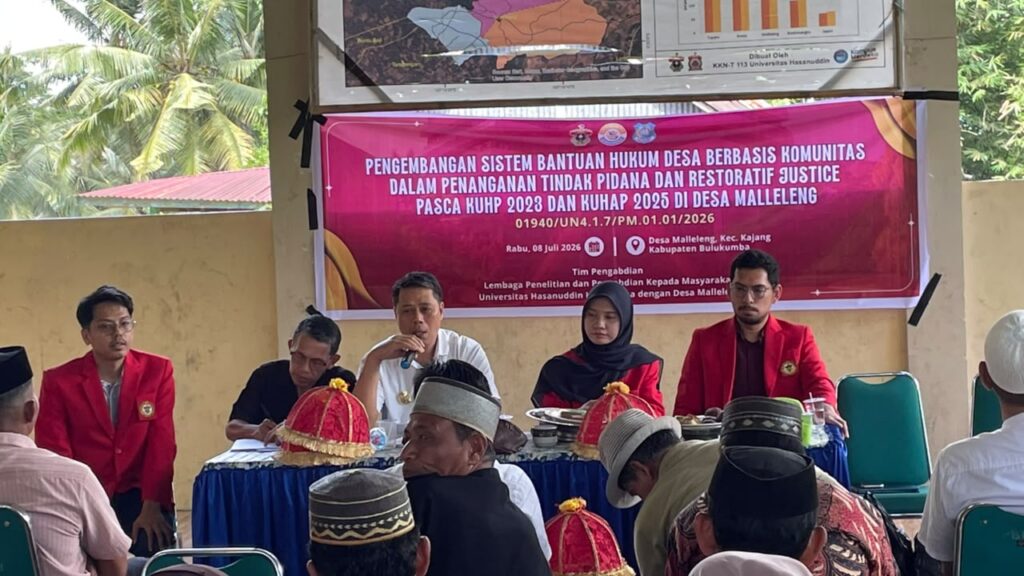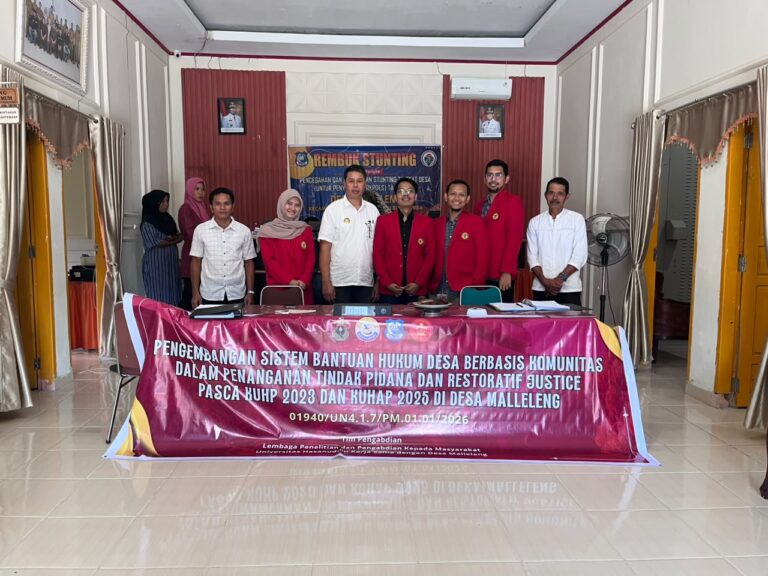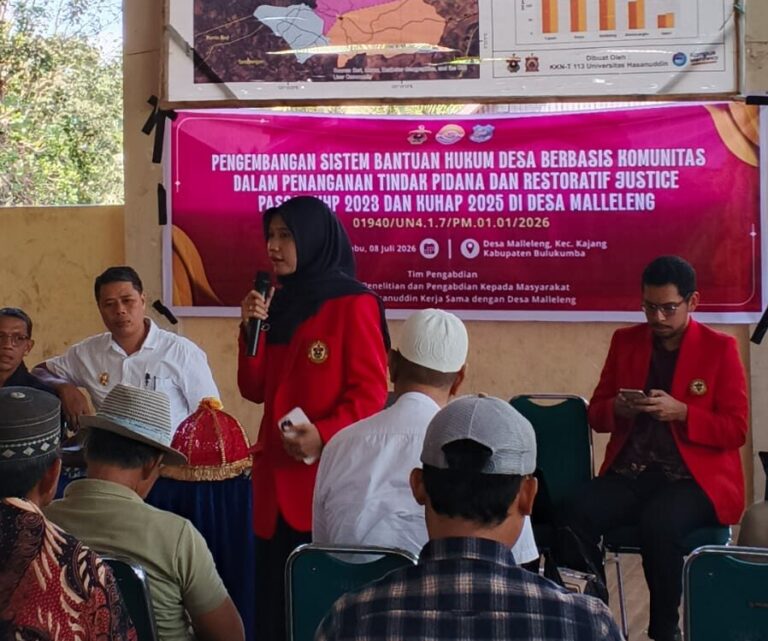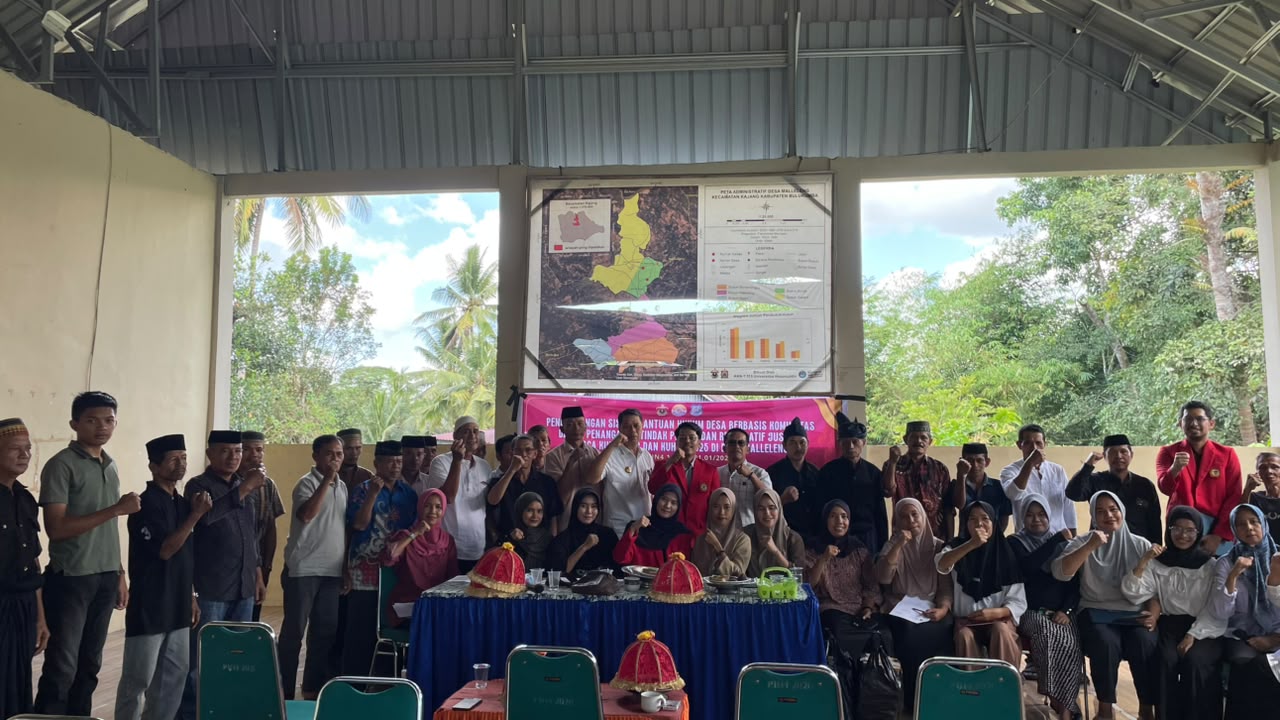

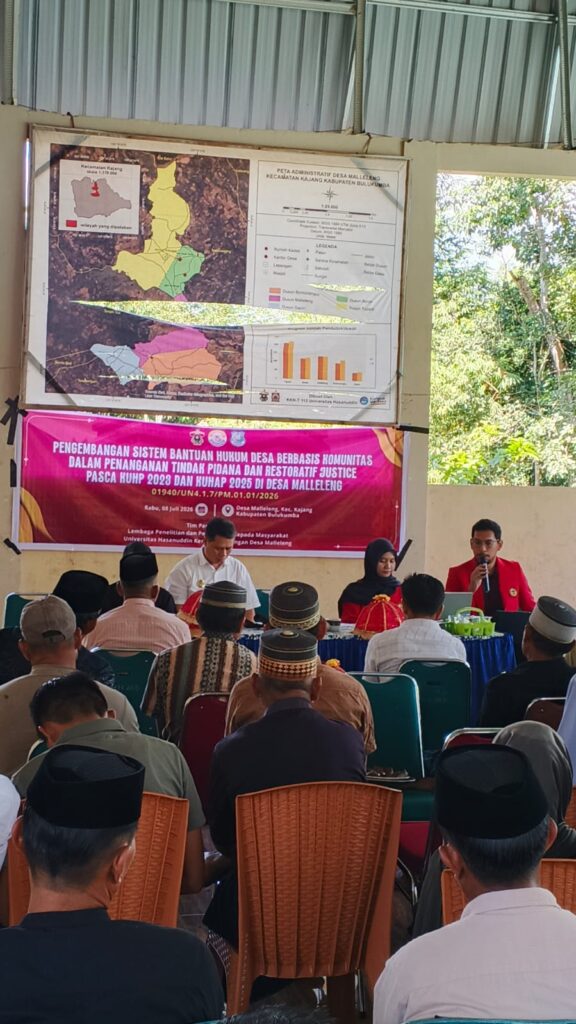
On 8 July 2026, the Faculty of Law, Universitas Hasanuddin, conducted a community service program entitled “Developing a Community-Based Village Legal Aid System for Handling Criminal Offences and Restorative Justice after the 2023 Criminal Code and the 2025 Criminal Procedure Code in Malleleng Village.” The activity was held at the Malleleng Village Hall, Kajang District, Bulukumba Regency, with support from the Institute for Research and Community Service of Universitas Hasanuddin. The program formed part of the university’s commitment to implementing the tridharma of higher education through direct engagement with local communities.
The activity was officially opened by Baso, S.T., Head of Malleleng Village, who expressed appreciation for the presence of the Universitas Hasanuddin community service team. He emphasized that the program was an important step toward improving public legal awareness and strengthening the role of the village in responding to legal problems arising within the community.
A total of 32 participants attended the activity, representing the village government, community leaders, and residents of Malleleng Village. The program used an intensive discussion method, enabling participants not only to receive legal information but also to ask questions and discuss practical issues encountered in village administration and community life.
During the main session, Afif Muhni, S.H., M.H., a lecturer at the Faculty of Law, Universitas Hasanuddin, delivered a presentation on the prevention and handling of corruption at the village level. He explained that the risks of corruption may emerge when public authority, village finances, procurement processes, or development programs are managed without adequate transparency, accountability, and community oversight. He therefore encouraged village officials to ensure that every stage of planning, budgeting, implementation, and reporting is carried out in accordance with applicable legal standards.
Afif Muhni also emphasized that preventing corruption is not solely the responsibility of law enforcement institutions. Village officials, community representatives, local leaders, and residents all have an important role in promoting open governance and monitoring the use of public resources. Clear access to information, accurate financial records, participatory decision-making, and responsible complaint mechanisms were identified as essential elements of a preventive village governance system.
The discussion further highlighted the importance of legal literacy in helping communities distinguish administrative mistakes from conduct that may involve abuse of authority or criminal responsibility. Participants were encouraged to seek legal consultation at an early stage whenever uncertainty arises in the management of village programs or public funds.
The activity supported SDG 1: No Poverty by promoting accountable village financial management that protects resources intended for community welfare. It advanced SDG 4: Quality Education through public legal education and field-based learning. It contributed to SDG 16: Peace, Justice and Strong Institutions by encouraging transparency, accountability, and lawful governance at the village level. It also strengthened SDG 17: Partnerships for the Goals through cooperation between Universitas Hasanuddin and the Malleleng Village Government.
Through this program, the university and village government sought to build a more transparent, participatory, and legally accountable system of village governance.