MAKASSAR, Indonesia Jun 30 2026/tfed/ – Have we ever wondered what happens when a fish is caught before it has had the chance to reproduce? For skipjack tuna (Katsuwonus pelamis), one of the most important pelagic fish species in Indonesian fisheries, this simple question is closely linked to the future of the stock and the livelihoods of coastal communities that depend on the sea.
A recent study suggests that the answer can be found by looking at two very different sources of information: the reproductive tissues of fish under a microscope and ocean conditions observed from hundreds of kilometers above the Earth. The study, entitled “Identifying local migration and habitat use of reproductive skipjack tuna (Katsuwonus pelamis) in the Bone Bay–Flores Sea, Indonesia,” conducted by Rachmat Hidayat and colleagues, was published in the Egyptian Journal of Aquatic Research, Volume 52, Issue 2, June 2026.
When Is a Skipjack Ready to Reproduce?
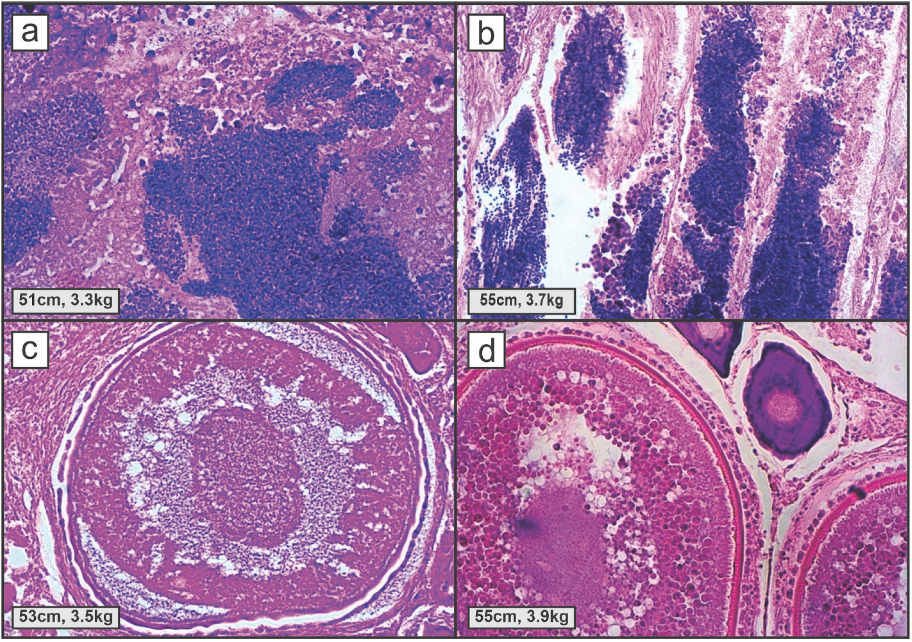
The researchers analyzed 45,225 skipjack tuna from 942 fishing locations between 2015 and 2019 and examined 200 gonad samples using histological techniques. Under the microscope, they found that fish with a fork length of approximately 50 cm or more showed clear signs of reproductive maturity.
However, one finding deserves particular attention. Only about 32% of the fish recorded in the catch data were ≥50 cm, while approximately 68% were below this size threshold. This means that most of the fish recorded in the catches had not yet reached the size associated with reproductive maturity. The finding highlights the importance of considering fish size in fisheries management, although the size structure of the catch may also be influenced by fishing gear characteristics and selectivity.
Reading the Ocean from Space
Knowing when the fish become mature is only half of the story. The researchers then used MODIS-Aqua satellite data to determine where mature skipjack tuna prefer to live.
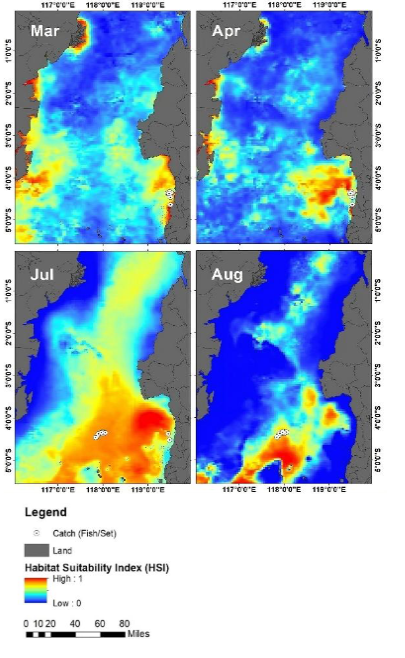
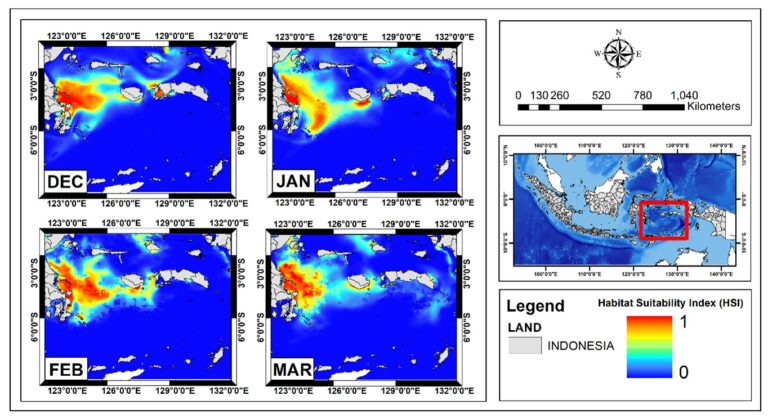
The results showed that mature skipjack tuna were commonly found in waters with sea surface temperatures of approximately 29.2–30.6 °C and chlorophyll-a concentrations of 0.18–0.32 mg m⁻³. Using the Pelagic Hotspot Index and Center of Gravity approaches, the study also revealed an intriguing seasonal movement pattern.
At the beginning of the year, the center of potential habitat tended to be located in southern waters, particularly in the Flores Sea. From May onward, the center of activity gradually shifted northward toward Bone Bay, remained there from around August to October, and then moved southward again toward the end of the year. This recurring pattern indicates that the Bone Bay–Flores Sea region serves as an important corridor for the reproductive activity and habitat use of mature skipjack tuna.
Protecting Our Blue Future
These findings are not simply about locating fish. The study demonstrates how biological information and satellite technology can help determine when fish should be harvested and when important habitats may need greater protection.
The researchers recommend a biologically informed minimum catch size of approximately ≥50 cm, spatiotemporal protection of reproductive habitats, and the use of remote sensing to support more adaptive fisheries monitoring. Such approaches could give more fish the opportunity to reproduce before being harvested.
These efforts directly support SDG 14: Life Below Water, while also contributing to SDG 1: No Poverty through the sustainability of coastal livelihoods, SDG 3: Good Health and Well-being through the long-term availability of marine food resources, SDG 4: Quality Education through the advancement of marine research and education, and SDG 17: Partnerships for the Goals through collaboration among universities and government institutions. Within a broader ecosystem-management framework, marine sustainability is also connected to SDG 15: Life on Land, particularly through the importance of maintaining ecological linkages among terrestrial, coastal, and marine ecosystems.
Ultimately, technology can show us where fish are likely to be found. But science offers something even more important: an understanding of when we should harvest them and when we should give them the opportunity to sustain the next generation.
Reference
Hidayat, R., Zainuddin, M., Safruddin, Mustapha, M.A., Srioktoviana, S.K., Yuniar, A., Fajrianti, D., & Fitrianti Abudarda, A.R. (2026). Identifying local migration and habitat use of reproductive skipjack tuna (Katsuwonus pelamis) in the Bone Bay–Flores Sea, Indonesia. Egyptian Journal of Aquatic Research, 52(2), 205–214.
DOI:
https://doi.org/10.1016/j.ejar.2026.02.003
Contact
Rachmat Hidayat
Faculty of Marine Science and Fisheries
Universitas Hasanuddin
Email: rachmathidayat@unhas.ac.id