Climate variability reshapes oceanographic conditions and influences the abundance and distribution of small pelagic fish across the world.
MAKASSAR, Indonesia Aug 29 2026/TRG/ – Small pelagic fish such as sardines, anchovies, mackerel, scads, and lemuru may be small in size, but they carry an enormous ecological and economic responsibility. They transfer energy from plankton to larger predators, support coastal fisheries, and contribute to food availability. Yet because many of these species spend much of their lives near the ocean surface, they are especially sensitive to changes in temperature and other environmental conditions.
A global review led by researchers from Hasanuddin University examined how climate variability and changing ocean conditions have influenced the distribution of dominant small pelagic fish from 1974 to 2022. The study brought together findings on European sardines, mackerel, anchovies, Decapterus species, and Sardinella from tropical, subtropical, and temperate waters.
Every Fish Has Its Preferred Ocean
The review found that small pelagic fish generally occupy specific environmental windows. Across the studies examined, their average optimal sea temperature was about 28.31 ± 1.97°C, with chlorophyll-a around 0.68 ± 0.37 mg m⁻³ and salinity around 31.44 ± 2.40 psu. These conditions matter because temperature affects metabolism and reproduction, while chlorophyll-a reflects primary productivity and food availability.
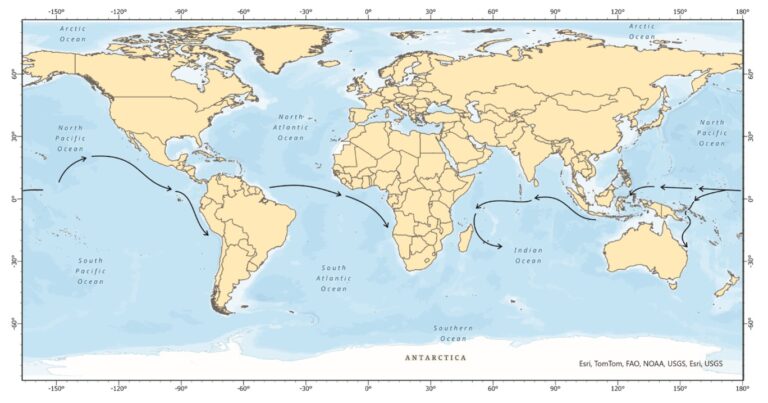
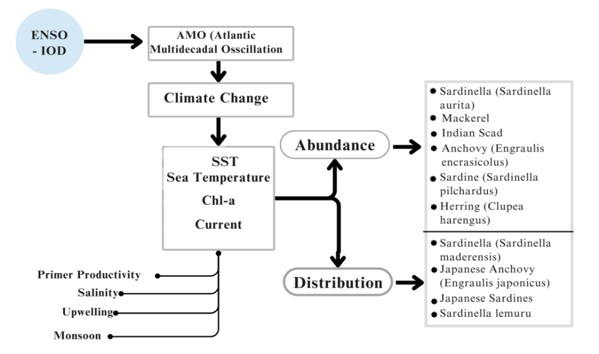
But these preferred conditions are increasingly being reshaped by climate variability. Large-scale phenomena such as the El Niño–Southern Oscillation (ENSO), Indian Ocean Dipole (IOD), Atlantic Multidecadal Oscillation (AMO), and monsoon systems alter sea surface temperature, chlorophyll-a, salinity, currents, and upwelling. As these conditions change, fish can respond by changing their abundance, migration routes, timing, or fishing-ground locations.
A Moving Map of Fish
One of the clearest signals identified in the review is a shift toward higher latitudes among warm-water small pelagic species as the ocean warms. This means productive fishing grounds that communities have relied on for years may not remain in the same places. The effects are not identical everywhere: local currents, upwelling, prey availability, fishing pressure, and species-specific tolerances can strengthen or weaken the climate signal.
The study also highlights why small pelagic fish matter far beyond the fishing boat. Changes in their abundance can ripple through the marine food web, affecting predators and the availability of affordable seafood. For coastal communities, shifting fish distributions can also mean longer searches at sea, changing fishing seasons, and greater uncertainty in income.
Preparing Fisheries for a Changing Ocean
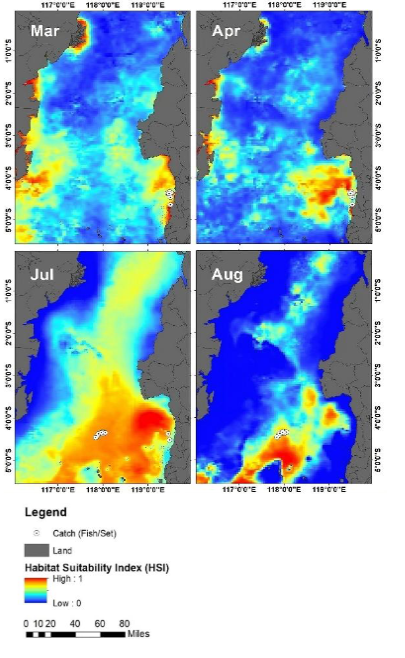
These findings reinforce the need for fisheries management that can adapt to a changing ocean. Satellite observations, oceanographic monitoring, climate indices, and predictive models can help anticipate where suitable habitats may emerge or decline.
The research is strongly linked to SDG 14: Life Below Water and also supports SDG 1: No Poverty through resilient fishing livelihoods, SDG 3: Good Health and Well-being through food and nutrition availability, SDG 4: Quality Education through ocean and climate knowledge, and SDG 17: Partnerships for the Goals through international scientific cooperation.
For small pelagic fisheries, climate change is not only about warmer water. It is about a moving map of where fish can live, and whether fisheries can move from reacting to those changes to anticipating them.
DOI:
https://doi.org/10.13057/biodiv/d250804
Mukti Zainuddin
Corresponding Author
Department of Fisheries, Hasanuddin University
Phone: +62 852-5591-3244
Email: mukti@unhas.ac.id