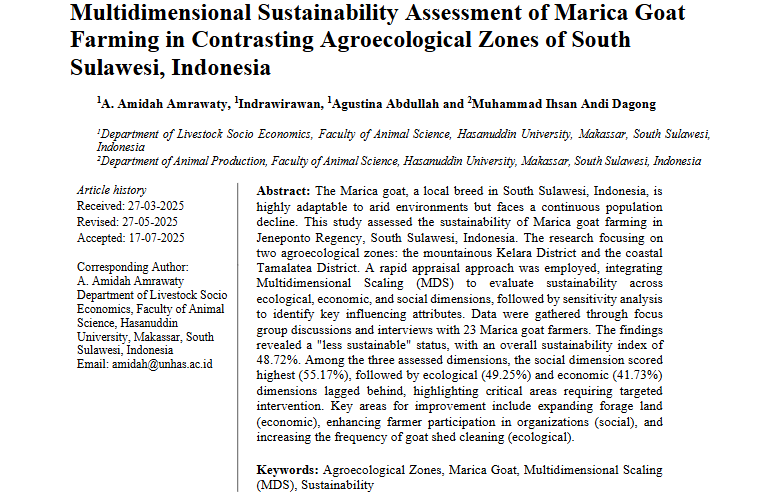
MAKASSAR, Indonesia March 11 2026 /SLF-RG/ – Deep in the arid hills of Jeneponto Regency, a small, resilient goat breed is quietly disappearing. The Marica goat, native to South Sulawesi, can survive harsh dry seasons with little food. But farmers are abandoning it for larger breeds. A new scientific study titled “Multidimensional Sustainability Assessment of Marica Goat Farming in Contrasting Agroecological Zones of South Sulawesi, Indonesia,” published in the American Journal of Animal and Veterinary Sciences by Science Publications on November 7, 2025, reveals that Marica goat farming is currently “less sustainable” and needs urgent help.
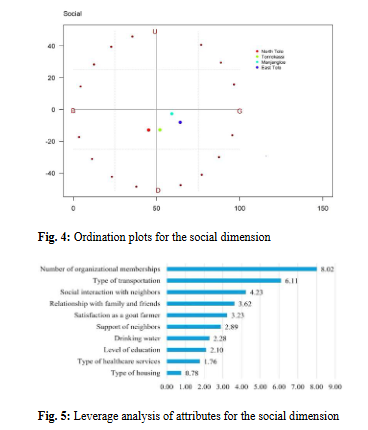
The research assessed 23 farmers across two zones: mountainous Kelara and coastal Tamalatea. Using multidimensional scaling, the study evaluated economic, social, and ecological dimensions. The overall sustainability index was only 48.72%. The social dimension scored highest at 55.17% (moderately sustainable), followed by ecology at 49.25% and the economy at just 41.73%—both in the “less sustainable” category.
What does this mean for the Marica goat—and for global goals? This research directly connects to SDG 15 (Life on Land) . Protecting endangered local breeds like the Marica goat preserves genetic diversity, which is essential for resilient agricultural systems. When a unique breed disappears, we lose traits like disease resistance and drought tolerance that could be vital for future food security.
The study identified key problems. Economically, farmers lack forage land, have limited income sources, and face unclear goat ownership rules. Socially, few farmers join organizations, transportation is poor, and neighbor-to-neighbor cooperation is weak. Ecologically, goat sheds are cleaned infrequently, manure is wasted instead of turned into fertilizer, and vaccination schedules are irregular.
The good news is that solutions exist. SDG 4 (Quality Education) plays a role here. Farmers need training on how to clean sheds properly, process goat waste into compost, and manage basic animal health. SDG 17 (Partnerships for the Goals) is equally critical. Local government, universities like Hasanuddin University, and agricultural extension services must work together to provide affordable training, better roads, and access to veterinary care.
One farmer in East Tolo village shared that he never knew goat manure could be sold as fertilizer. After learning from extension workers, he now earns extra income while keeping his farm cleaner. Small changes like this can scale up.
If no action is taken, the Marica goat may vanish within a generation. But with targeted support—more forage land, stronger farmer groups, and better sanitation practices—this unique breed can survive. Saving the Marica goat is not just about one animal. It is about protecting biodiversity, strengthening rural livelihoods, and building a more sustainable future for all.
Reference
DOI: https://doi.org/10.3844/ajavsp.2025.266.273
Contact:
Dr. Amidah Amrawaty
+62 811-4104-298
amidah@unhas.ac.id