MAKASSAR, Indonesia August 31 2026 /SLF-RG/ – For smallholder beef cattle farmers, a single calf born healthy can mean the difference between a productive season and a financial setback. Cattle are not just livestock; they are savings, insurance, and livelihood rolled into one. Yet making reproduction work reliably depends on far more than biology. It depends on skilled service providers, knowledgeable farmers, adequate facilities, and financial readiness working together.
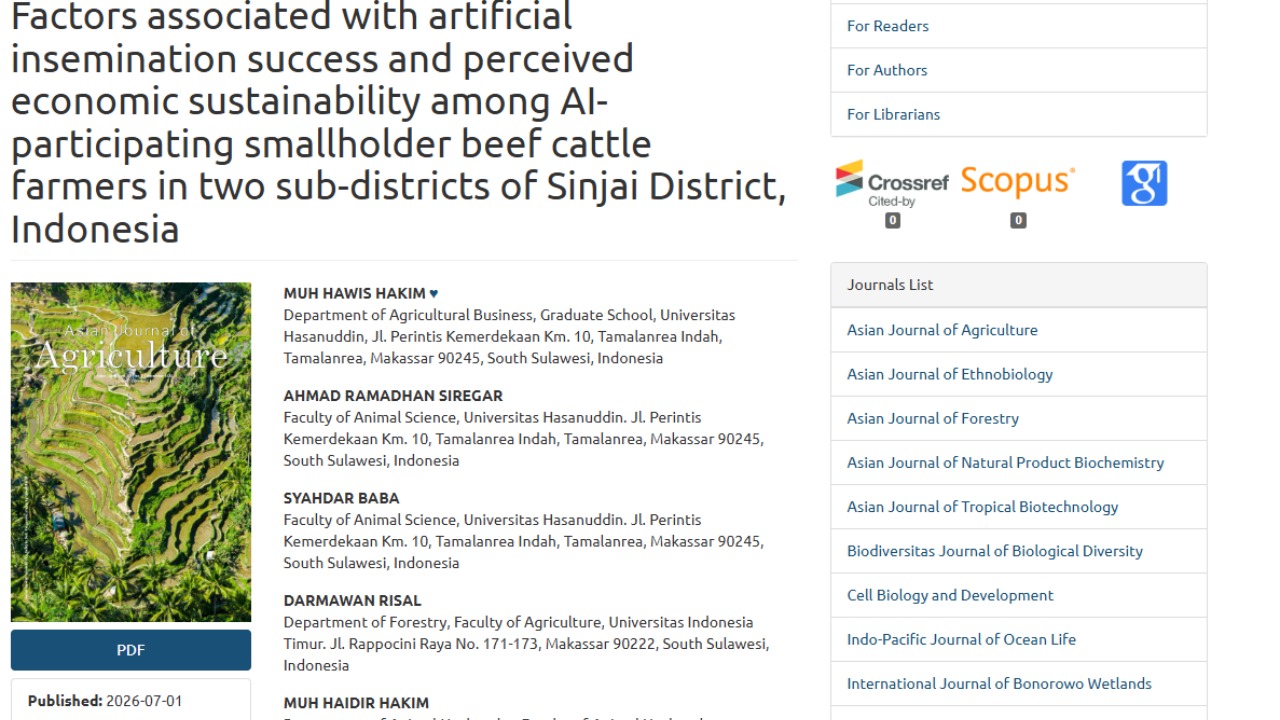
A study published in the Asian Journal of Agriculture, titled “Factors Associated with Artificial Insemination Success and Perceived Economic Sustainability among AI-Participating Smallholder Beef Cattle Farmers in Two Sub-Districts of Sinjai District, Indonesia” by Muh Hawis Hakim, Ahmad Ramadhan Siregar, Syahdar Baba, Darmawan Risal, Muh Haidir Hakim, and Ahmad Syakur, published in July 2026, set out to understand exactly what drives Artificial Insemination (AI) success and how that success connects to farmers’ perceived economic wellbeing. Surveying 94 AI-participating smallholder farmers in Sinjai Tengah and Tellulimpoe Sub-districts from October to December 2025, the research applied Partial Least Squares Structural Equation Modelling to examine multiple interacting factors simultaneously.
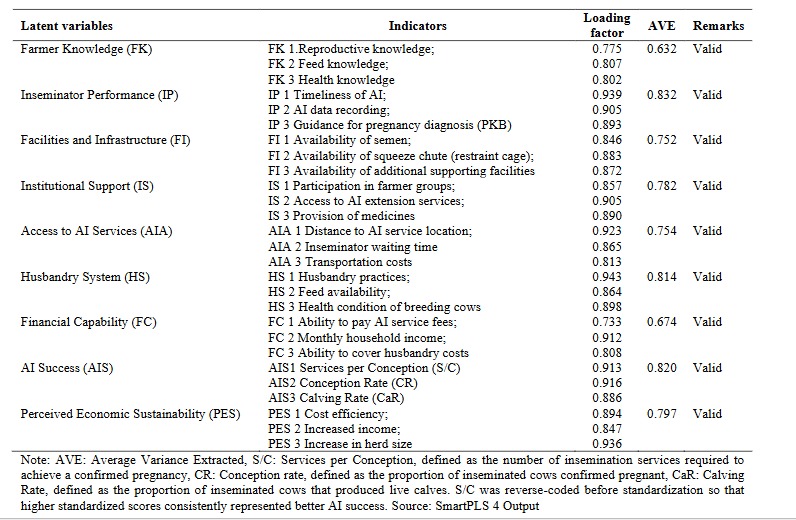
The results are clear and instructive. Among all factors studied, inseminator performance emerged as the strongest predictor of AI success, with a path coefficient of 0.487. This means that the timeliness of service, quality of reproductive data recording, and guidance provided for pregnancy diagnosis were the most decisive service-side factors in determining whether insemination resulted in successful conception and calving. Farmer knowledge ranked second, confirming that farmers who understand estrus detection, feeding, and animal health management create better conditions for reproductive success. Supporting facilities and infrastructure, financial capability, and husbandry practices also contributed significantly, while the model collectively explained 92.8% of the variation in AI success.
Critically, AI success was strongly and positively associated with perceived economic sustainability, explaining 60.7% of the variation in farmers’ perceived cost efficiency, income improvement, and herd growth. In practical terms: when AI works well, farmers feel it economically.
These findings are deeply aligned with Sustainable Development Goal 1 (SDG 1): No Poverty. For rural smallholder cattle farmers whose herds represent their primary financial asset, improving AI success rates is a direct pathway to reducing economic vulnerability. The research also connects to SDG 17 (Partnerships for the Goals), highlighting that AI success cannot be achieved by farmers alone. It requires coordinated partnerships between inseminators, extension officers, government livestock services, and farming communities. Without strong institutional collaboration, even knowledgeable and motivated farmers face structural barriers that limit reproductive outcomes.
The study carries an important message for policymakers and agricultural extension programs across Indonesia: investing in inseminator training, farmer education on reproductive management, and the provision of adequate AI facilities are not isolated technical improvements. They are integrated investments in rural economic resilience, food security, and sustainable agricultural development that serve communities from the ground up.
Reference
DOI: https://doi.org/10.13057/asianjagric/g100203
Contact:
Prof. Syahdar Baba
+62 812-4244-359
syahdarbaba@unhas.ac.id