MAKASSAR, Indonesia October 16 2026 /SLF-RG/ – In the highlands of Enrekang, dairy farming is more than an economic activity. It is a cultural tradition, a family legacy, and the backbone of a local food identity centered on dangke, a traditional fermented cheese unique to the region. Yet today, only 69 registered smallholder farms manage 257 dairy cattle across six subdistricts home to nearly 99,000 productive-age residents. The question of who will continue this tradition is urgent, and the answer is far from certain.
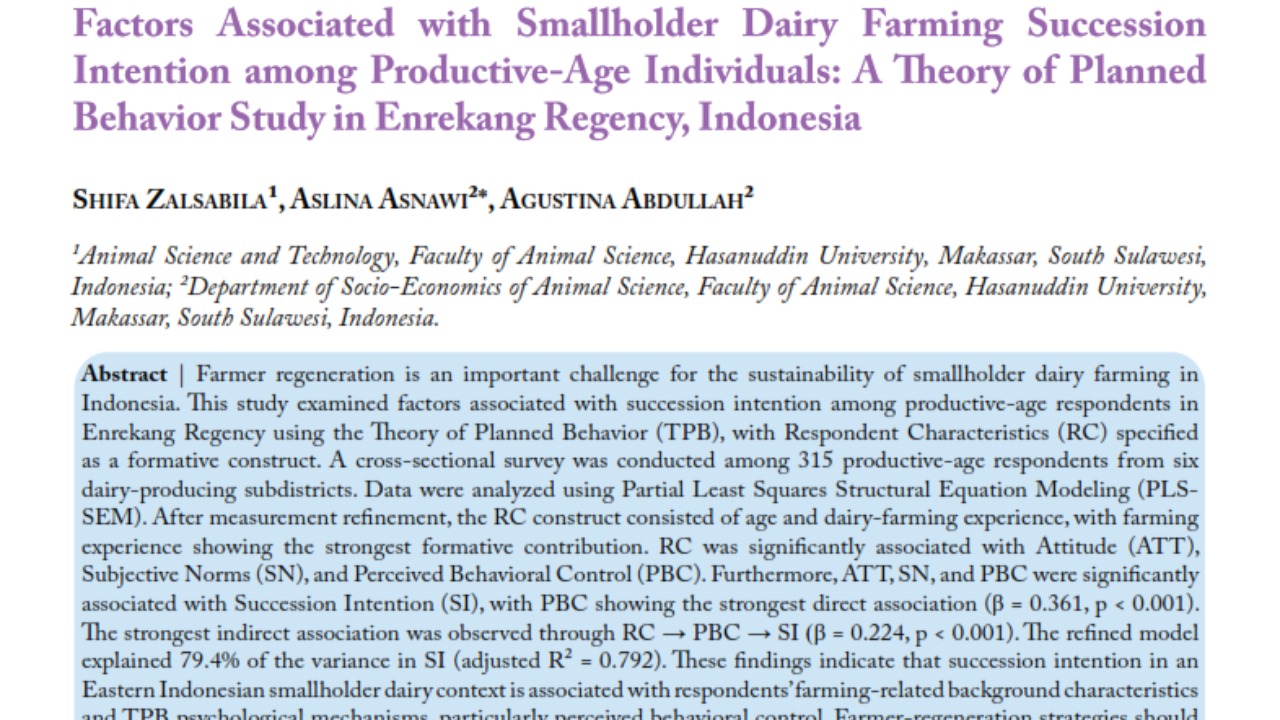
A study published in Advances in Animal and Veterinary Sciences, titled “Factors Associated with Smallholder Dairy Farming Succession Intention among Productive-Age Individuals: A Theory of Planned Behavior Study in Enrekang Regency, Indonesia” by Shifa Zalsabila, Aslina Asnawi, and Agustina Abdullah, published on October 13, 2026 by ResearchersLinks Ltd, set out to understand what psychological and background factors drive or discourage succession intention among productive-age individuals in dairy-producing communities. Surveying 315 respondents across six subdistricts from February to April 2026, the study applied the Theory of Planned Behavior (TPB) alongside Partial Least Squares Structural Equation Modelling to analyze the interplay of attitude, social norms, and perceived capability on succession intention.
The results are both illuminating and practical. Among the three TPB psychological factors, Perceived Behavioral Control (PBC) showed the strongest association with succession intention (β = 0.361), meaning that a person’s sense of capability, access to farming resources, and confidence in managing dairy farming operations are the most decisive drivers of whether they intend to continue or enter the sector. Subjective Norms (β = 0.330) ranked second, confirming that family expectations, peer support, and community encouragement remain powerful influences. Attitude (β = 0.315) followed closely, reflecting how positively or negatively someone evaluates dairy farming as a future livelihood. Together, these three factors explained 79.4% of the variation in succession intention, a remarkably strong result. Notably, among background characteristics, dairy-farming experience contributed most strongly to shaping all three psychological factors, particularly perceived behavioral control.
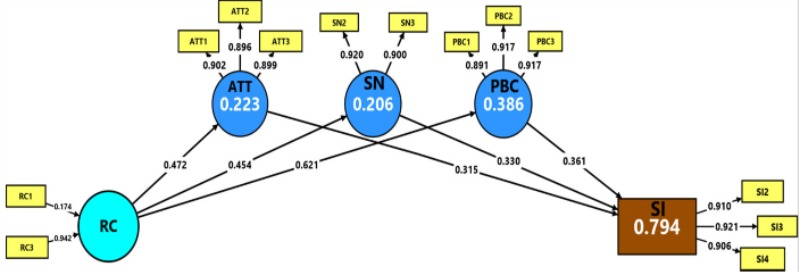
These findings align directly with Sustainable Development Goal 1 (SDG 1): No Poverty. Farmer regeneration in smallholder dairy communities is fundamentally a poverty-prevention issue. When succession fails and farms are abandoned, rural households lose a primary income source, food systems weaken, and cultural products like dangke face extinction. Ensuring that capable, motivated successors enter and sustain dairy farming is a concrete strategy for preserving rural livelihoods across generations. The research also connects to SDG 4 (Quality Education), as the study demonstrates that building successor capability through mentoring, training, and hands-on farming exposure directly strengthens the perceived behavioral control that most influences succession intention.
For policymakers and agricultural development agencies, the message is clear. Farmer regeneration strategies must go beyond land transfer and inheritance planning. They must invest in building young people’s technical confidence, expanding access to farming resources, and strengthening the social and family networks that encourage the next generation to see dairy farming as a viable, valued, and worthwhile future.
Reference
DOI: https://dx.doi.org/10.17582/journal.aavs/2026/14.11.2529.2540
Contact:
Dr. Agustina ABDULLAH
+62 812-4237-920
agustina.abdullah@unhas.ac.id