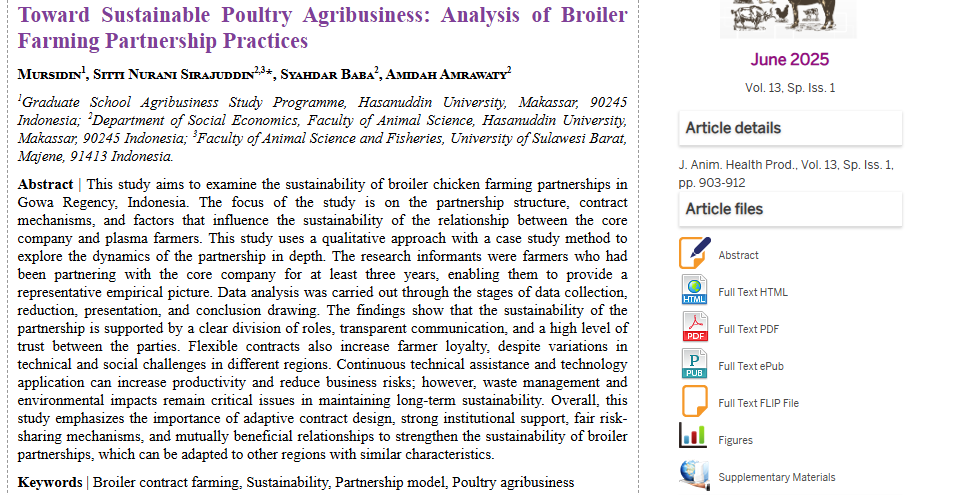
MAKASSAR, Indonesia March 14 2026 /SLF-RG/ – In the outskirts of Gowa Regency, a quiet but powerful shift is taking place inside broiler chicken farms. Farmers who once struggled with unpredictable markets and rising costs are now finding stability through partnership programs. But what makes these collaborations last? A new scientific study titled “Toward Sustainable Poultry Agribusiness: Analysis of Broiler Farming Partnership Practices,” published in the Journal of Animal Health and Production by ResearchersLinks Ltd on December 18, 2025, offers a compelling answer.
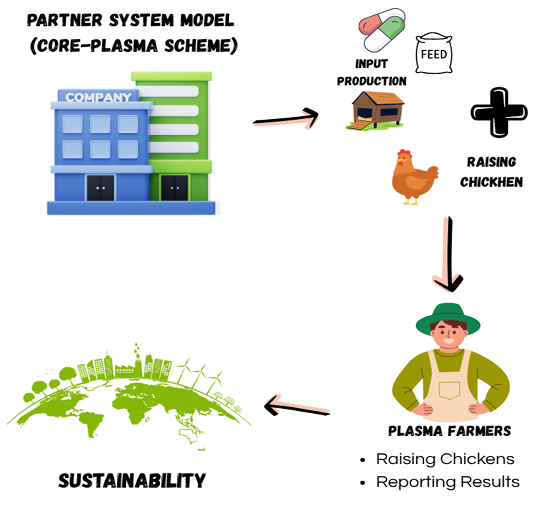
This research focuses on the relationship between core companies and plasma farmers. Simply put, the company provides day-old chicks, feed, and medicine. Farmers provide land, labor, and care until harvest. This division creates trust. The study found that flexible contracts, clear communication, and technical training are the main reasons why some partnerships thrive while others fail.
Why does this matter for global goals? Because this work directly supports SDG 1 (No Poverty) . Stable partnerships mean farmers have guaranteed buyers and fairer risk-sharing. When harvests fail, losses are not borne by farmers alone. This safety net helps keep families out of poverty. One farmer in Bontonompo shared that because of the partnership, he can now send his children to school and save for emergencies.
However, the research also uncovered challenges. In some areas, farmers feel that contracts are too rigid. In others, waste from chicken farms pollutes nearby homes and water sources. This is where SDG 15 (Life on Land) becomes critical. Poor waste management damages soil and spreads disease. The study recommends turning waste into compost. This simple step reduces pollution and creates extra income.
Technology also plays a role. Farmers using closed-house systems see higher productivity. But these systems cost money. Without access to affordable technology or training, smaller farmers get left behind. That is why SDG 4 (Quality Education) matters. Continuous technical assistance and hands-on training help farmers adopt better practices. Knowing how to read a feed label, calculate mortality rates, or report illnesses early makes a real difference.
The researchers interviewed farmers who had worked with companies for at least three years. They observed that loyalty grows when farmers feel heard. In West Bajeng, where contract terms are flexible and no time limits are set, farmers are more motivated. In contrast, rigid rules in other districts have led to protests and farmers switching partners.
In conclusion, sustainable poultry agribusiness is not just about chickens or profits. It is about designing fair systems that protect people and the planet. The study proves that SDG 17 (Partnerships for the Goals) is at the heart of success. Governments, private companies, and farmers must work together. With adaptive contracts, investment in training, and smarter waste management, broiler farming can lift communities without destroying the land. That is a win-win worth replicating across Indonesia and beyond.
Reference
DOI: https://dx.doi.org/10.17582/journal.jahp/2025/13.s1.903.912
Contact:
Prof. Syahdar Baba
+62 812-4244-359
syahdarbaba@unhas.ac.id