MAKASSAR, Indonesia August 16 2026 /SLF-RG/ For millions of rural Indonesian households, a small herd of beef cattle is not simply a livestock operation. It is a savings account, a safety net, and sometimes the only reliable source of income a family has. In Soppeng Regency, one of South Sulawesi’s recognized beef cattle development centers, smallholder farmers have long relied on cattle farming to sustain their livelihoods. But a critical question has remained largely unanswered: does the number of cattle a farmer keeps actually determine whether the business is profitable, and by how much?
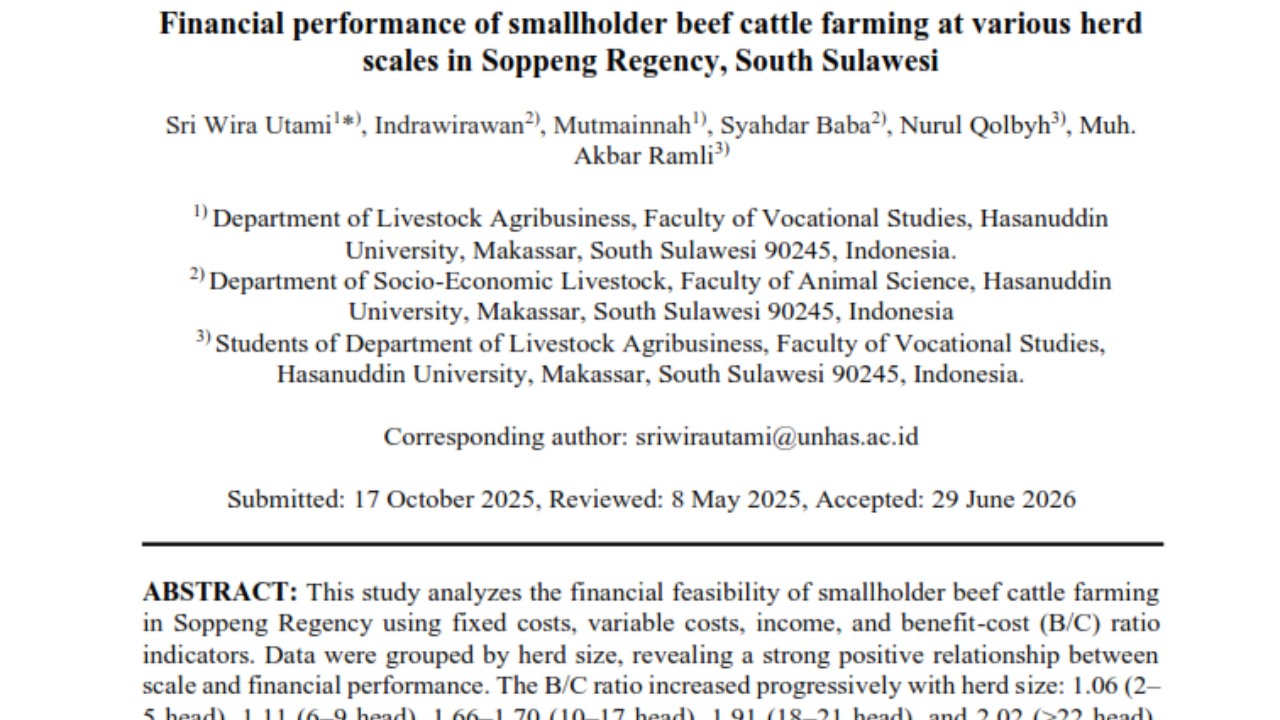
A study published in Jurnal Ilmu-Ilmu Peternakan (Indonesian Journal of Animal Science), titled “Financial Performance of Smallholder Beef Cattle Farming at Various Herd Scales in Soppeng Regency, South Sulawesi” by Sri Wira Utami, Indrawirawan, Mutmainnah, Syahdar Baba, Nurul Qolbyh, and Muh. Akbar Ramli, accepted on 29 June 2026 and published in Volume 36 Number 2 August 2026 by Universitas Brawijaya, provides a direct and data-driven answer. Surveying 60 beef cattle farmers in Salokaraja Village across six herd-size categories during one complete fattening cycle from March to June 2025, the study analyzed fixed costs, variable costs, total revenue, net income, and the Benefit-Cost (B/C) ratio for each group.
The findings tell a compelling story of scale and efficiency. Every single herd-size category, from the smallest group with just 2 to 5 cattle to the largest with more than 22, achieved a B/C ratio above 1.0, confirming that smallholder beef cattle farming in Soppeng is financially viable at all operational scales. However, the degree of profitability grows dramatically with herd size. The smallest farmers earned a B/C ratio of only 1.06 and a net income of IDR 156,835 per cycle, while farmers managing more than 22 cattle achieved a B/C ratio of 2.02 and net income of IDR 7,908,000. That is a 50-fold difference in absolute income from a roughly 4 to 5 times increase in herd size.
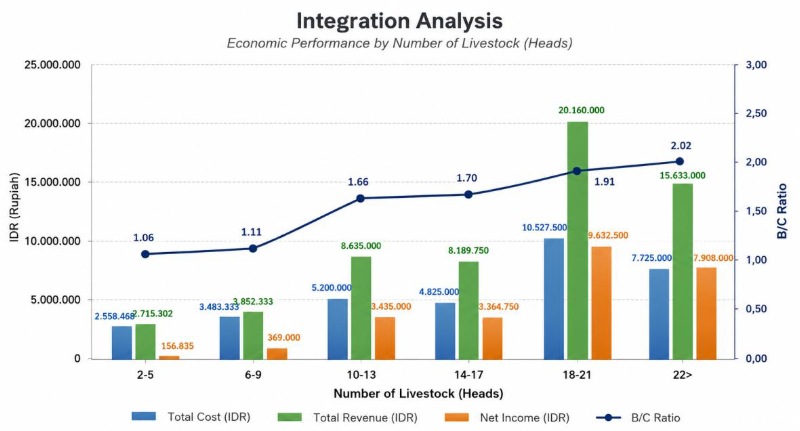
Two key drivers explain this gap. First, larger farms benefit from economies of scale: fixed infrastructure costs such as pen depreciation are spread across more cattle, reducing cost per head. Second, and most strikingly, farmers managing more than 22 cattle reported zero purchased feed costs because they produce all forage from their own land. Since feed typically accounts for 60 to 80% of variable costs, this single practice fundamentally transforms the farm’s financial structure.
These findings connect directly to Sustainable Development Goal 1 (SDG 1): No Poverty. Beef cattle farming in rural South Sulawesi is a primary poverty-reduction mechanism for smallholder households. The research shows that even very small herds generate positive cash flows, meaning that supporting entry-level farmers is economically justified. At the same time, the substantial income gap between small and large herds points to the importance of creating pathways for gradual scaling up, integrating local forage systems, and strengthening farmer group institutions to help smallholders move from subsistence viability toward genuine economic prosperity.
For policymakers, extension workers, and rural development agencies, the message is practical and actionable: profitability in smallholder beef cattle farming is real, but it is not equal. Targeted support for scaling up, feed self-sufficiency, and financial literacy can transform cattle farming from a survival strategy into a genuine engine of rural economic growth.
Reference
DOI: https://doi.org/10.21776/ub.jiip.2026.036.2.11
Contact:
Sri Wira Utami
+62 877-3677-6438
sriwirautami@unhas.ac.id