


MAKASSAR, Indonesia Apr 12 2026 /ODFRG/–Dairy farming is not just about producing milk—it is about managing the health and performance of cows across different stages of lactation. A recent study published in the Advances in Animal and Veterinary Sciences (ResearchersLinks, 03 September 2024), titled “Performance, Physiological Status, and Heat Tolerance of Holstein Friesian Dairy Cows at Different Lactation Phases”, sheds light on how cows respond physiologically and metabolically during early, mid, and late lactation.
The research involved 15 Holstein Friesian cows divided into three groups based on their lactation phase. The findings revealed that while milk yield and feed conversion efficiency did not differ significantly across phases, body condition scores and respiratory rates did. Early lactation cows were more vulnerable to negative energy balance (NEB), a condition where energy demands for milk production exceed dietary intake. This often leads to weight loss and metabolic stress. Mid-lactation cows showed the highest milk yield and feed efficiency, while late lactation cows had improved body condition but lower milk output as nutrients were redirected toward pregnancy and fetal growth.
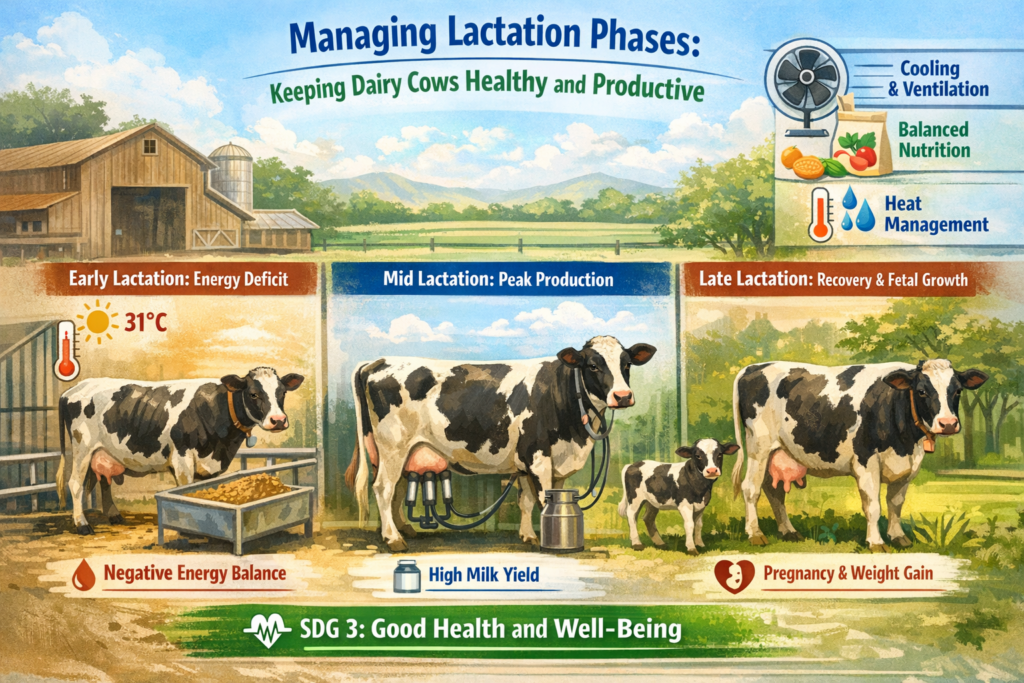
Heat tolerance was another critical factor studied. The cowshed environment showed midday temperatures reaching over 31°C with humidity levels dropping to 57%, creating moderate heat stress conditions. While cows adapted physiologically, their comfort and productivity were clearly influenced by these microclimate changes. This highlights the importance of proper housing, ventilation, and feeding strategies to reduce heat stress and maintain performance.
These findings directly support the United Nations’ Sustainable Development Goal (SDG) 3: Good Health and Well-Being. By understanding how cows’ physiological needs change across lactation phases, farmers can provide tailored nutrition and management practices that improve animal welfare and productivity. Healthier cows not only produce more consistent milk but also reduce economic losses associated with disease and poor performance. Moreover, managing heat stress aligns with SDG 15: Life on Land, as it encourages sustainable farming practices that protect livestock and ecosystems.
What makes this study particularly valuable is its practical application. Farmers can use these insights to adjust feed composition, monitor body condition scores, and improve housing conditions. By doing so, they can reduce the risks of NEB in early lactation, maximize efficiency in mid-lactation, and support reproductive health in late lactation. This holistic approach ensures that dairy farming remains profitable, sustainable, and animal-friendly.
In conclusion, the article published on September 3, 2024, in Advances in Animal and Veterinary Sciences demonstrates that managing lactation phases is more than a technical detail—it is a pathway to healthier cows, better milk production, and sustainable farming. By aligning dairy management with SDG 3: Good Health and Well-Being, farmers can build systems that benefit both animals and communities.
Reference:
DOI: https://dx.doi.org/10.17582/journal.aavs/2024/12.10.2024.2042
Contact:
Prof. Ambo Ako
+62 852-5550-5411
amboako@yahoo.com
amboako@unhas.ac.id


