

The Obesity and Child Nutrition Research Group at Universitas Hasanuddin implemented a school-based training program to support the Peer Group Educator initiative, “Sahabat Gizi,” in Parepare on 31 July–1 August 2025. Conducted at SDN 3 Parepare and SD Katolik Parepare, the two-day training involved 16 selected students from each school who were prepared as peer educators, accompanied by designated teacher mentors.
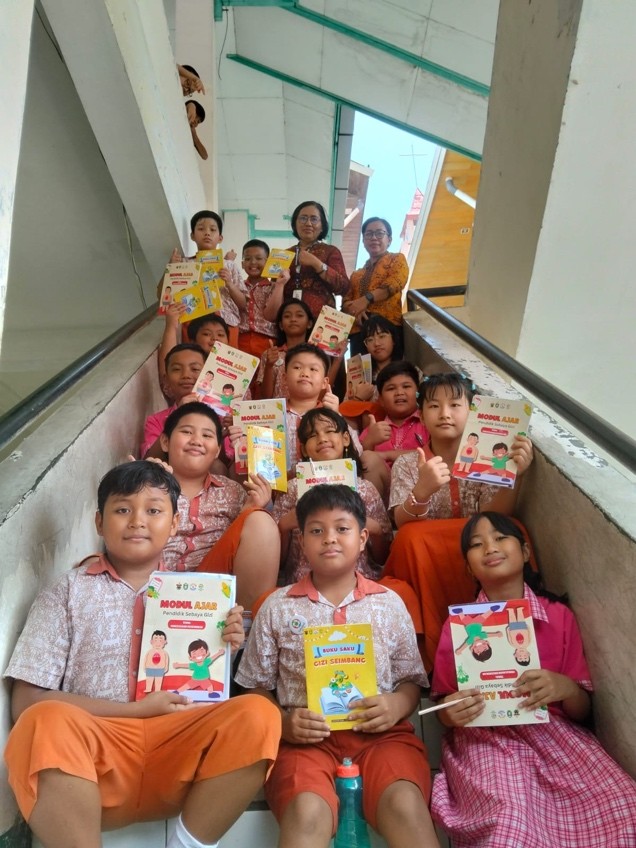
This initiative represents a research-to-practice model designed to operationalize evidence on childhood obesity prevention within primary school settings. By applying a peer-led framework, the program positions children as active health promoters, leveraging peer influence to strengthen the adoption of balanced nutrition and active lifestyle behaviors.
During the training, participants received structured modules on balanced nutrition principles, childhood obesity and its health risks, and effective communication skills for peer education. The curriculum combined scientific accuracy with age-appropriate delivery strategies. To enhance engagement and knowledge retention, interactive tools were integrated into the sessions, including the “Know Obesity” snakes-and-ladders board game and the “Dende” game, allowing students to learn key messages through play-based activities. Teaching materials were also provided to support structured dissemination within the school. While the core training lasted two days, the implementation and evaluation phase extends over a two-month period. During this phase, peer educators actively deliver nutrition messages to students from Grades 1 to 6 under teacher supervision. A monitoring and evaluation framework, including knowledge assessment and process monitoring, has been established to measure improvements in understanding, communication effectiveness, and feasibility of sustained peer-led health promotion.
The initiative directly contributes to SDG 3 (Good Health and Well-being) by addressing early prevention of non-communicable diseases, particularly childhood obesity. It also aligns with SDG 4 (Quality Education)through capacity strengthening and experiential learning within schools, and SDG 17 (Partnerships for the Goals) by fostering collaboration between academic institutions and local schools.
Through the “Sahabat Gizi” initiative, the Obesity and Child Nutrition Research Group demonstrates how evidence-based strategies can be embedded within school systems—empowering children as credible health ambassadors and building sustainable, community-level capacity for childhood obesity prevention.